Campus apps by department
Admissions, orientation, student life, and more — one campus app that works across departments.

Campus apps by department
Admissions, orientation, student life, and more — one campus app that works across departments.
Build unlimited event apps on one license
One partnership for unlimited campus events — orientation, tours, student life, and everything in between.
Build unlimited event apps on one license
One partnership for unlimited campus events — orientation, tours, student life, and everything in between.
Compare event app platforms
See how Guidebook stacks up against other event app and registration platforms.
Compare event app platforms
See how Guidebook stacks up against other event app and registration platforms.
Event apps for nonprofit and community programs
Give members, volunteers, and donors one branded app for conferences, fundraisers, and year-round community.
Event apps for nonprofit and community programs
Give members, volunteers, and donors one branded app for conferences, fundraisers, and year-round community.
Campus integrations and an open API
Connect Guidebook with the campus systems, APIs, and tools your team already uses.
Campus integrations and an open API
Connect Guidebook with the campus systems, APIs, and tools your team already uses.
Event apps for corporate and enterprise teams
Internal meetings, offsites, and large-scale corporate events — with the branding and control enterprise teams need.
Event apps for corporate and enterprise teams
Internal meetings, offsites, and large-scale corporate events — with the branding and control enterprise teams need.
Create a branded event app with no coding
Put schedules, maps, resources, and updates in every attendee's pocket — built for campus events and programs.
Create a branded event app with no coding
Put schedules, maps, resources, and updates in every attendee's pocket — built for campus events and programs.
Launch a branded, white-label event app
A white-label event app with your branding, your content, and your attendee experience — no coding required.
Launch a branded, white-label event app
A white-label event app with your branding, your content, and your attendee experience — no coding required.
Everything in the Guidebook platform
Explore the features event teams use to engage attendees before, during, and after the event.
Everything in the Guidebook platform
Explore the features event teams use to engage attendees before, during, and after the event.
One app for in-person and virtual attendees
The same schedule, networking, and updates whether people are in the room or joining remotely.
One app for in-person and virtual attendees
The same schedule, networking, and updates whether people are in the room or joining remotely.
Event apps built for associations
Annual meetings, chapter events, and member engagement — without rebuilding a new app every year.
Event apps built for associations
Annual meetings, chapter events, and member engagement — without rebuilding a new app every year.
A branded event website that matches the app
Promote the event, collect interest, and keep branding consistent from the first click to check-in.
A branded event website that matches the app
Promote the event, collect interest, and keep branding consistent from the first click to check-in.
Plan, run, and measure events on one platform
App, registration, badges, and websites in one workflow — so planning isn't a pile of disconnected tools.
Plan, run, and measure events on one platform
App, registration, badges, and websites in one workflow — so planning isn't a pile of disconnected tools.
Keep members engaged between events
One branded app for the conference and everything that happens the other 51 weeks of the year.
Keep members engaged between events
One branded app for the conference and everything that happens the other 51 weeks of the year.
The conference app attendees actually use
Schedules, maps, networking, and live updates for annual meetings, summits, and multi-day conferences.
The conference app attendees actually use
Schedules, maps, networking, and live updates for annual meetings, summits, and multi-day conferences.
Registration that feeds your app and badges
Collect registrations, payments, and attendee data in the same platform as your event app.
Registration that feeds your app and badges
Collect registrations, payments, and attendee data in the same platform as your event app.
Design and print event badges in one place
Custom badges, QR check-in, and on-site printing — without a separate badge vendor.
Design and print event badges in one place
Custom badges, QR check-in, and on-site printing — without a separate badge vendor.
A Smaller School?
Deliver a polished, branded event experience without a large team or a big budget.
A Smaller School?
Deliver a polished, branded event experience without a large team or a big budget.
Running Family Programs?
Give families everything they need, from schedules and maps to real-time updates, all in one place.

Running Family Programs?
Give families everything they need, from schedules and maps to real-time updates, all in one place.
Coordinating Move-In Day?
Share updates, manage events, and keep students informed from move-in through the academic year.

Coordinating Move-In Day?
Share updates, manage events, and keep students informed from move-in through the academic year.
Offering Campus Tours?
Deliver branded, self-guided tour experiences with interactive maps and rich media, available 24/7.

Offering Campus Tours?
Deliver branded, self-guided tour experiences with interactive maps and rich media, available 24/7.
Organising a Career Fair?
Simplify logistics for students, employers, and Career Services staff with one easy-to-use app.
Organising a Career Fair?
Simplify logistics for students, employers, and Career Services staff with one easy-to-use app.
Managing Alumni Events?
Plan reunions, regional events, and fundraising campaigns with an app built for alumni engagement.

Managing Alumni Events?
Plan reunions, regional events, and fundraising campaigns with an app built for alumni engagement.
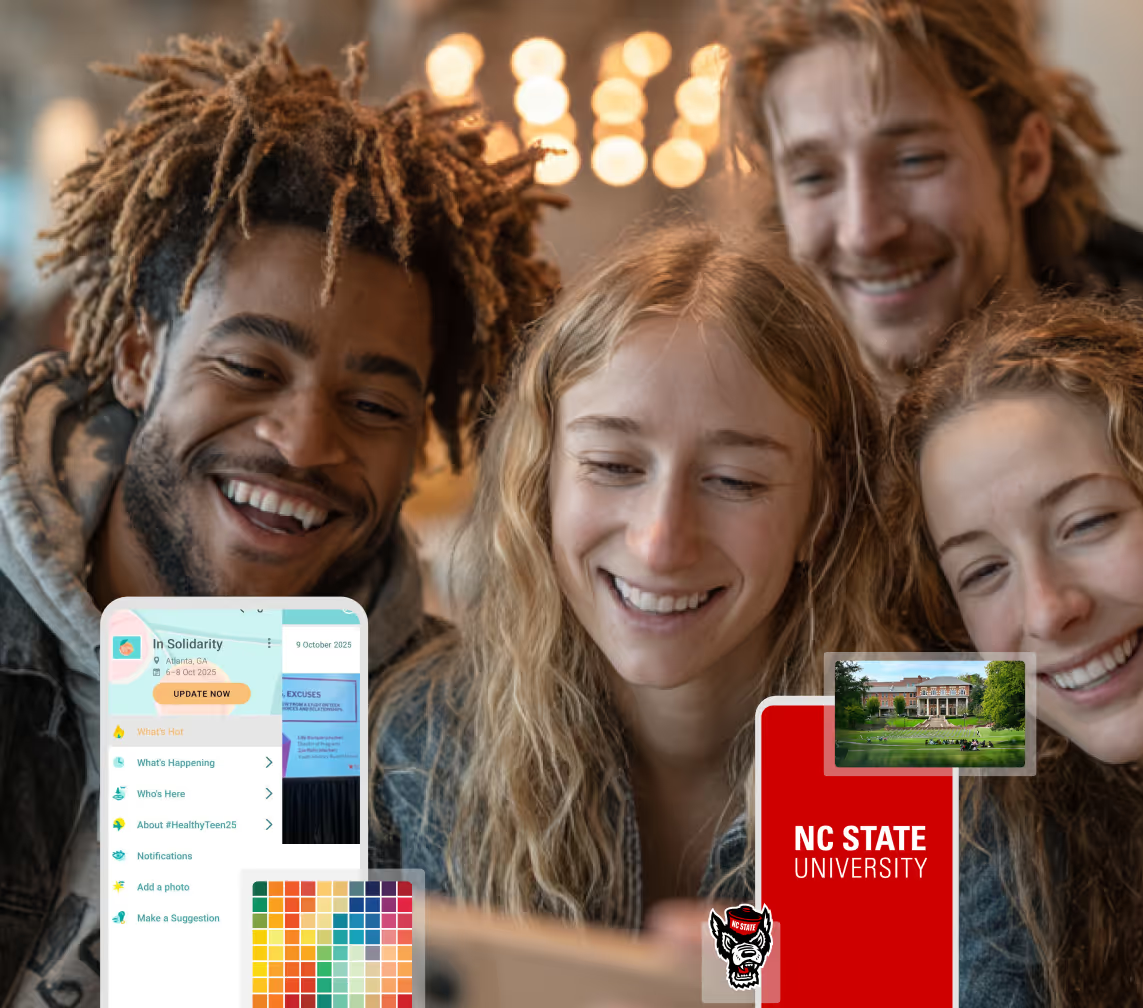
Boost Student Engagement
One hub for schedules, resources, and events that keeps students connected throughout the academic year.
Boost Student Engagement
One hub for schedules, resources, and events that keeps students connected throughout the academic year.
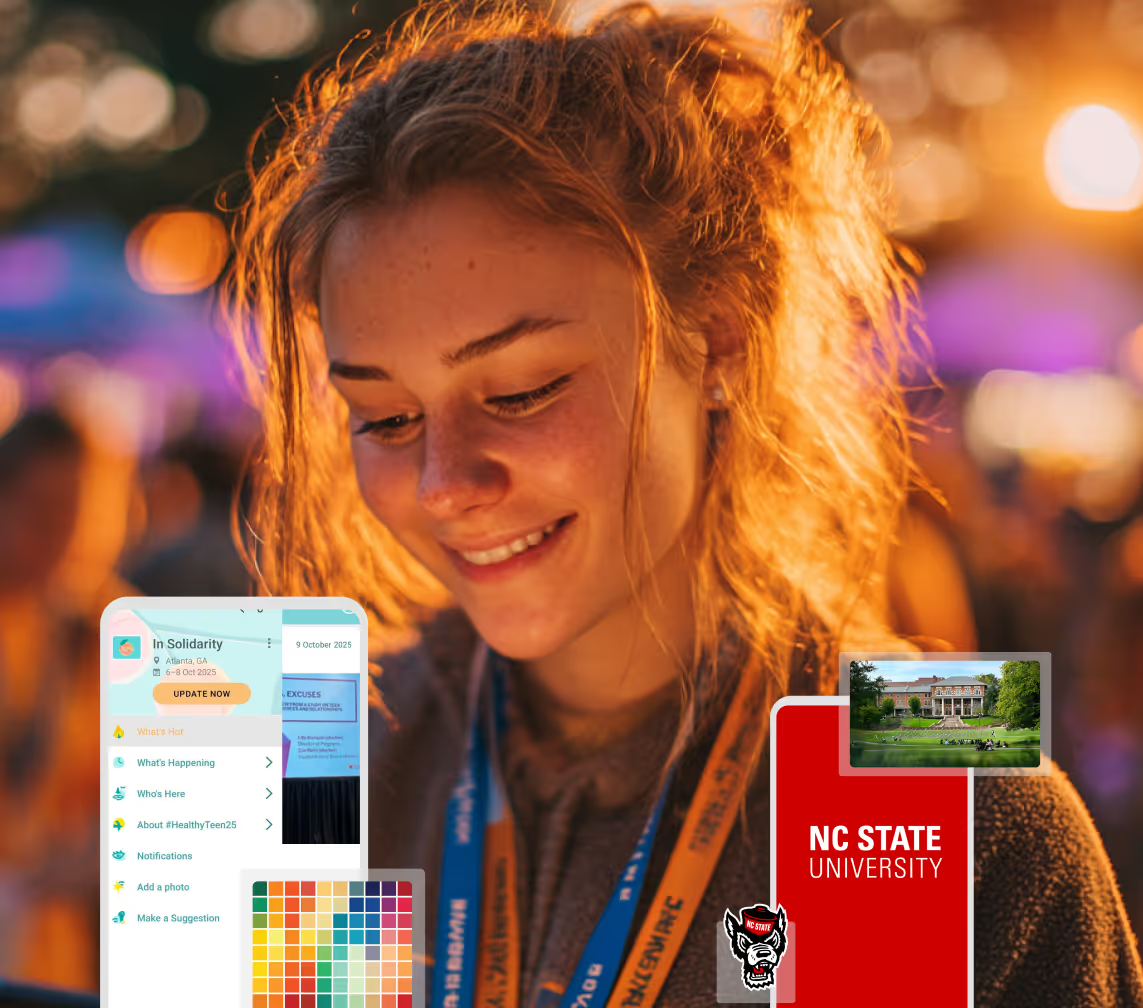
Planning Orientation?
Help new students feel prepared from day one with schedules, campus resources, and real-time updates in one app.
Planning Orientation?
Help new students feel prepared from day one with schedules, campus resources, and real-time updates in one app.
Running Admissions Events?
Manage open houses, tours, and yield events with a branded app that saves time and engages prospective students.

Running Admissions Events?
Manage open houses, tours, and yield events with a branded app that saves time and engages prospective students.
Get a custom Sponsorship Package Template
Stop starting from scratch. Grab free templates that helWe'll build a tailored sponsorship package with suggested pricing, tiers, and benefits..for your specific event.p you build professional sponsorship packages and close deals faster.
Get a custom Sponsorship Package Template
Stop starting from scratch. Grab free templates that helWe'll build a tailored sponsorship package with suggested pricing, tiers, and benefits..for your specific event.p you build professional sponsorship packages and close deals faster.
Plan Your Next Event Without Missing a Beat.
From venue selection to post-event wrap-up, this free checklist walks you through every step (so nothing falls through the cracks).
.avif)
Plan Your Next Event Without Missing a Beat.
From venue selection to post-event wrap-up, this free checklist walks you through every step (so nothing falls through the cracks).
Real Results From Real Events
100,000+ organizations trust Guidebook. See exactly how universities, associations, enterprises, and more put it to work.

Real Results From Real Events
100,000+ organizations trust Guidebook. See exactly how universities, associations, enterprises, and more put it to work.
Flexible pricing for every event size
Find the perfect plan for your needs, from intimate gatherings to large-scale conferences.

Flexible pricing for every event size
Find the perfect plan for your needs, from intimate gatherings to large-scale conferences.
Join our event experts
Watch on-demand webinars and join live sessions with industry leaders sharing best practices for event success.
.avif)
Join our event experts
Watch on-demand webinars and join live sessions with industry leaders sharing best practices for event success.
Guidebook in Action
Book a personalized walkthrough and discover how we help event teams create better attendee experiences.
Guidebook in Action
Book a personalized walkthrough and discover how we help event teams create better attendee experiences.
What Is Summer Melt? A 2026 Definition for Admissions Teams
%20(1).avif)




.avif)
What Is Summer Melt? A 2026 Definition for Admissions Teams
- Summer melt is the loss of deposited students between May 1 and the first day of fall term. National averages range from 10-40%, with first-generation and regional comprehensive populations at the highest end.
- The students most at risk share a common profile: limited post-deposit contact, no personal connection to campus, and no reason to picture themselves there yet.
- Melt isn't a mysterious force. It's a gap in the belonging timeline, and it opens in the same predictable window every year.
- Admissions teams are already doing the work that reduces melt. The question is whether that work is coordinated and mobile-first enough to reach students where they actually are.
- The institutions that close the melt gap fastest connect every post-deposit touchpoint, from the May 2 email to move-in day, in one continuous student experience.
It's the second week of May. Deposits are in. The team exhales.
Then someone runs the numbers in mid-July, and the math doesn't add up.
A handful of students who confirmed in April haven't completed their housing form. A few more never registered for orientation. Some stopped opening emails in late May and haven't responded since. By August, the yield number that looked solid on May 2 has quietly shrunk.
That's summer melt. And if your team has ever found itself scrambling to recover students in July, you already know exactly what it feels like. You've been fighting it for years. This piece is about understanding it well enough to fight it on your own terms.
Here's what you'll learn: what summer melt is and how it's defined, who's most at risk and why, the three root causes that drive it, and what the admissions teams reducing it most effectively are actually doing differently.
What is summer melt?
Summer melt is the loss of deposited students between May 1 and the start of fall term. A student submits their enrollment deposit, signals their intent to enroll, and then doesn't show up in August.
National averages put melt at 10–40% depending on institution type. Regional comprehensive universities and institutions with high proportions of first-generation students tend to see rates at the higher end of that range. The students at greatest risk are those who deposited without making a strong personal connection to campus, and who receive limited or inconsistent communication between May and move-in.
Summer melt is distinct from standard attrition. Attrition happens after a student enrolls. Melt happens before. The student is counted in your deposit number, sometimes in your yield projections, and then never arrives.
How common is summer melt, and who's most at risk?
The 10–40% range is wide because melt isn't uniform. Selective private colleges with strong yield events and robust alumni networks see rates at the low end. Open-access institutions, community colleges, and regional comprehensives, where students are often choosing between multiple offers and have fewer financial and social anchors to any one institution, see rates that can reach 40% in the worst years.
The student profile most likely to melt looks like this: first-generation, Pell-eligible, from a family without prior college experience, living far from campus, and without a peer group already committed to the same school. They deposited with genuine intent. Something got in the way.
The first-generation compounding factor
First-generation students melt at disproportionately higher rates, and the reasons aren't hard to understand.
They don't have a parent who went through this process and can normalize the anxiety of not hearing from campus for three weeks. They're more likely to face a competing financial offer that arrives in June. They're more likely to second-guess a deposit made without a firm sense of belonging at the institution.
Bureaucratic friction compounds it. A confusing housing portal. An orientation registration form that bounces on mobile. A financial aid question that sits unanswered for 10 days. Each one is a small signal that maybe this school wasn't quite ready for a student like them.
Research consistently finds that students who encounter bureaucratic friction during the enrollment process are less likely to persist than peers who feel a strong sense of belonging. For first-generation students especially, friction in May and June can undo the belonging built at Admitted Student Day.
Why does summer melt happen? Three root causes
Melt has proximate causes (a competing offer, a financial shock, a change in family circumstance) and structural ones. The structural causes are the ones admissions teams can actually address. There are three.
1. The belonging gap
A student attends Admitted Student Day in March. They're excited. The energy is high, the campus looks great, and they can picture themselves there. They submit their deposit on May 1.
Then nothing happens for six weeks.
The excitement fades. The mental image softens. Other schools are still showing up in their inbox with programming invitations, merit award reminders, and personalized messages from current students. Your school, which did everything right in March, has gone quiet at exactly the wrong moment.
Belonging isn't a feeling that gets installed during a single visit. It has to be reinforced. The window between deposit and move-in is where that reinforcement either happens or it doesn't.
2. The communication collapse
After May 1, most admissions operations hand the student off to orientation. That transition makes sense internally. The student rarely experiences it as a seamless handoff.
What they experience is: the admissions counselor who emailed them regularly in February and March stops reaching out. A new set of emails arrives from a different office with a different tone. The communication that felt personal starts to feel institutional.
Many admissions teams describe this handoff as one of the most persistent structural frustrations in the enrollment calendar. The relationship built through yield season gets severed at the exact moment students need continuity most. The student interprets the change in communication as indifference, even when neither team intended that signal.
Gen Z students don't rely on email the way earlier cohorts did. They read the first line of a notification and decide in two seconds whether to open it. They expect information to be available on their phone, on demand, without logging into a portal. Communication strategies built around email sequences and web portals were designed for a different student.
3. The competing offer
Other institutions don't stop recruiting after a student deposits with you.
A late scholarship arrives in June. A gap year program sends a compelling email in July. A community college offers a dual-enrollment pathway that feels lower-risk. A friend commits to a different school and the student starts reconsidering. These pulls are strongest on students who don't feel firmly connected to their chosen institution.
The competing offer isn't always financial. Sometimes it's just the presence of a school that kept showing up while yours went quiet.
What does the summer melt window actually look like?
The highest-risk window isn't "summer." It's a specific arc from late May through early August.
Here's how it typically unfolds for an at-risk student.
May 1 to May 15: High engagement. They submitted their deposit. They're checking your website. They might post about their decision on social media.
May 15 to June 15: Gradual disengagement. Communication volume drops. The student starts managing other end-of-year priorities. If they're a graduating senior, they're focused on finishing high school. If orientation registration isn't simple and mobile-friendly, they defer it.
June 15 to July 31: The critical window. This is where melt actually happens. Students who haven't completed orientation registration, selected housing, or received any personal communication from your institution in the past 30 days are at genuine risk. Competing offers arrive. Financial anxiety peaks. The decision starts to feel reversible.
August 1 to move-in: Recovery is possible but expensive. Reactive outreach at this stage requires staff time, urgency, and sometimes financial intervention. Some students come back. Some don't.
The institutions that reduce melt most effectively don't wait for the July signal. They structure the May-to-August arc as a deliberate communication sequence, not a quiet period between yield and orientation.
How admissions teams are already fighting melt (and what actually works)
Here's what's worth naming directly: your team is almost certainly already doing the work that reduces melt. You're sending post-deposit emails. You're running summer welcome programming. You're pushing orientation registration reminders. You're calling students who go quiet.
The question isn't whether you're trying. It's whether the infrastructure supports what you're trying to do.
Andrea Crilly, Assistant Director of Admissions for Campus Experience at Indiana Tech, has seen that question answered in the numbers. "Our yield grew tremendously once we began using Guidebook," she said. "When we started in 2015, we yielded 40%. After implementing Guidebook in 2020, that number grew to 60-72%, and in 2022 and 2023 it increased to 82%. We believe Guidebook had a strong impact on that growth."
The operational shift behind those numbers is concrete. Indiana Tech went from a team of five running 400 hours of work per event to a team of two running 25 hours. Printing costs of $4,350 per event dropped to near zero. Staff hours freed up went back into direct student relationships, not logistics. And admitted students who attended their event now represent 32% of total enrollment, up from 14%.
That's 375 hours per year returned to the team, and a 105% yield improvement. You can read the full details in the Indiana Tech case study.
The pattern holds across institutions that reduce melt successfully: the work isn't new, but it's coordinated and it reaches students on the device they actually use. Emails help. Push notifications to a phone reach students who'd never open the email.
What is a summer melt prevention strategy?
A summer melt prevention strategy is a coordinated sequence of post-deposit touchpoints designed to maintain a deposited student's connection to campus from May 1 through move-in day.
Effective strategies share three characteristics. First, they're continuous: there's no 30-day silence between Admitted Student Day and orientation outreach. Second, they're personal: communication references the student's name, intended major, and specific next steps, rather than generic institutional broadcasts. Third, they're mobile-first: the student can complete every required action (orientation registration, housing selection, peer community connection) from their phone without needing to log into a desktop portal.
The institutions that close the melt gap fastest treat the period between deposit and move-in as its own enrollment event. Not a waiting period. An event with milestones, communication beats, and engagement checkpoints designed to keep deposited students connected and moving forward.
Summer bridge programming is one specific intervention within this framework, particularly effective for first-generation and Pell-eligible students who benefit from an early campus connection before fall term begins.
Less melt. More moments.
Summer melt isn't a force of nature. It's a gap in the belonging timeline, and it opens in the same predictable window every year.
Your deposited students aren't disappearing because they chose wrong. They're disappearing because the six months between "you're in" and "welcome to campus" didn't give them enough reasons to stay connected. That's a solvable problem. You're already doing the outreach. The question is whether the infrastructure matches the intention.
The admissions teams reducing melt fastest have one thing in common: every touchpoint from Admitted Student Day to Welcome Week lives in a single connected experience the student carries on their phone. The relationship doesn't get handed off. It continues.
That's the bet behind one app for every moment that matters: admitted students deserve a single connected experience, not five separate logins, and the institutions that build it are the ones whose yield numbers hold through August.
Your yielded class is closer than you think. See how Guidebook connects every moment that matters for admissions and enrollment teams.
[faq] Q: What is summer melt in higher education? A: Summer melt is the loss of deposited students between May 1 and the start of fall term. A student submits an enrollment deposit, signals their intent to enroll, and then doesn't arrive in August. It's distinct from attrition, which happens after enrollment begins. National averages put melt at 10-40% depending on institution type, with regional comprehensives and first-generation-heavy populations seeing the highest rates. Q: What percentage of college students experience summer melt? A: Nationally, summer melt affects anywhere from 10-40% of deposited students, depending on institution type. Selective private colleges with strong yield programming tend to see rates at the lower end. Open-access institutions and regional comprehensives, where students often hold multiple offers and have fewer social anchors to any one school, see rates closer to the higher end. Q: Which students are most at risk of summer melt? A: First-generation students, Pell-eligible students, and students without a peer group already committed to the same institution are at the highest risk. Students who deposited without making a strong personal connection to campus during the yield season, and who receive limited communication between May and move-in, are most likely to disengage before the fall term begins. Q: What causes summer melt? A: Three structural causes drive most melt. First, the belonging gap: the connection built during Admitted Student Day fades without reinforcement across the summer. Second, the communication collapse: the handoff from admissions to orientation often creates a silence the student reads as indifference. Third, the competing offer: other institutions keep recruiting after a student deposits with you, and students without a firm sense of connection are most susceptible to late scholarship offers or alternative pathways. Q: When does summer melt happen? What's the highest-risk window? A: The highest-risk window runs from mid-June through the end of July. Students who haven't completed orientation registration, selected housing, or received personal outreach from your institution within the past 30 days during that window are at genuine risk. The period from May 1 to mid-May is typically high engagement. Disengagement begins in late May. By August, recovery is possible but requires reactive outreach that's costly in staff time. Q: What's the difference between summer melt and regular attrition? A: Summer melt happens before enrollment. A student who melts was counted in your deposit number but never arrived on campus. Attrition happens after a student enrolls and then leaves, whether at the end of first semester, first year, or later. The interventions for each are different. Melt is addressed through post-deposit communication and belonging-building. Attrition is addressed through retention programming, advising, and first-year experience design. Q: How do you prevent summer melt? A: Effective summer melt prevention strategies share three features: they're continuous (no 30-day silence between deposit and orientation outreach), personal (communication references the student's name, major, and specific next steps), and mobile-first (every required action is completable from a phone). Institutions that treat the May-to-move-in window as a deliberate enrollment event, rather than a quiet handoff period, consistently see lower melt rates. Indiana Tech, for example, grew yield from 40% to 82% after building a connected mobile experience across their admitted student events. Q: How do admissions teams measure summer melt? A: The simplest measure is the gap between your confirmed deposit count on May 1 and your actual enrolled headcount on the first day of fall term. More granular tracking looks at orientation registration completion rates, housing selection rates, and communication response rates across the May-to-August window. Teams that monitor engagement signals in June and July (not just final enrollment numbers in August) have the most time to intervene before a student's decision becomes final. [/faq]
Get the Mobile App Playbook
A short guide to running the whole student journey in one app. No fluff, just what works.
for higher ed
Campus
Playbook
A practical guide to building a connected campus experience.
Free playbook
The Mobile App Playbook for Universities
Students decide if they belong long before they set foot on campus. This playbook shows how to win them over from the first visit through graduation.
- Grow enrollment and boost recruitment
- Increase belonging and retention
- Run every event from one branded app
By submitting, you agree to our Privacy Policy.
You're in.
.png)