Send app engagement back to Slate
For students who opt in, downloads, schedule adds, views, and form responses land on their event registration every hour.
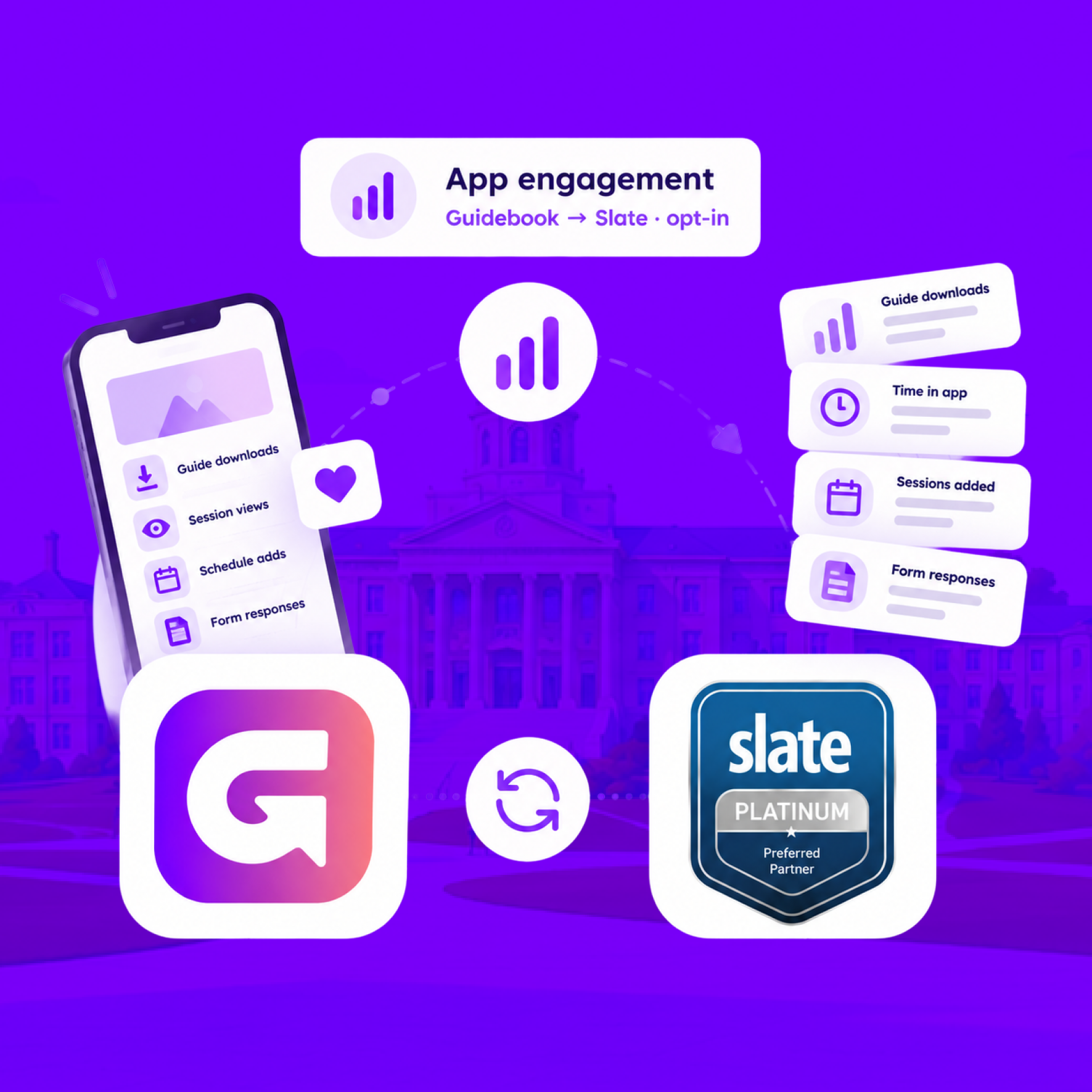
Send app engagement back to Slate
For students who opt in, downloads, schedule adds, views, and form responses land on their event registration every hour.
Build the campus event once in Slate
Link a Slate folder to a guide. Every event becomes a session, and registrants are added automatically.
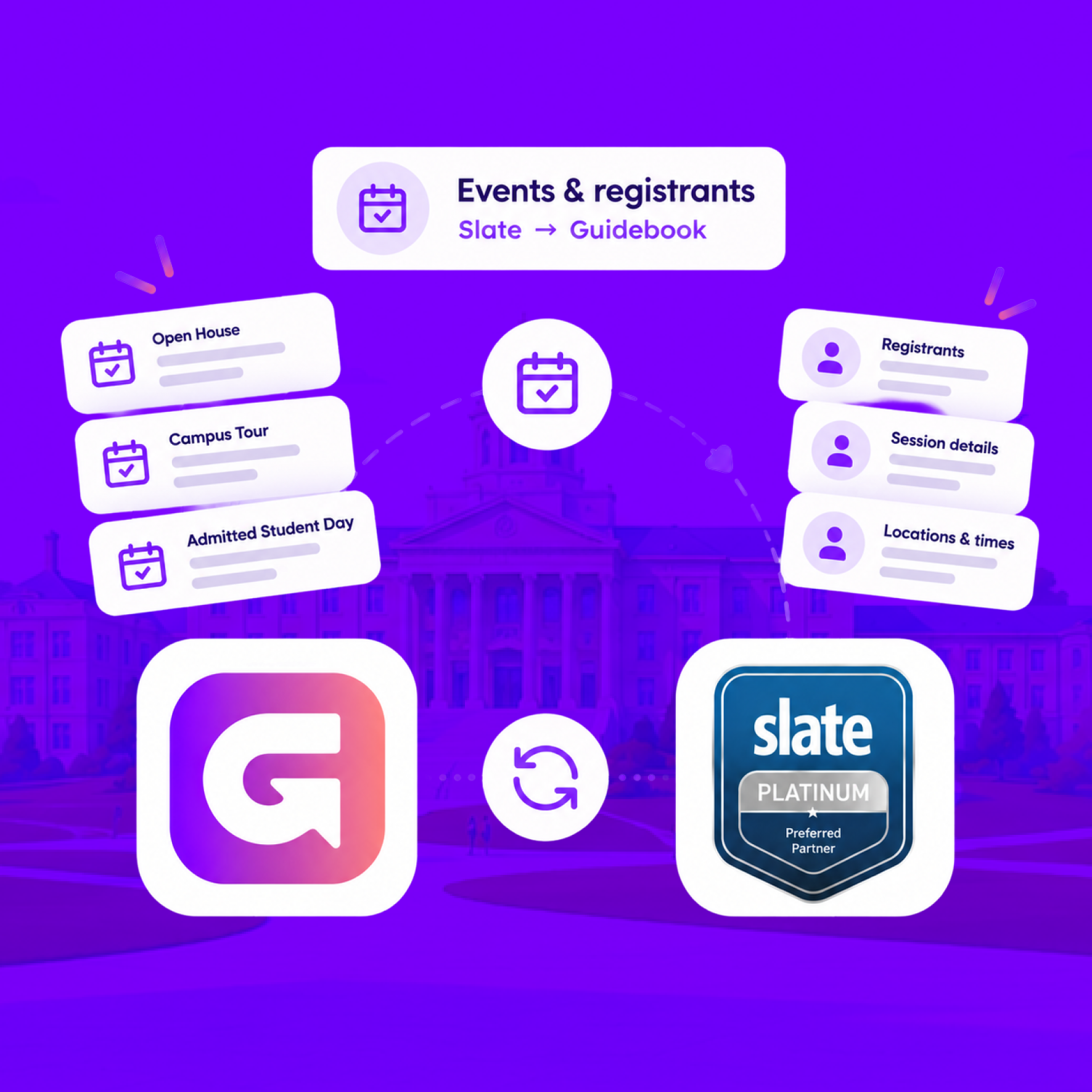
Build the campus event once in Slate
Link a Slate folder to a guide. Every event becomes a session, and registrants are added automatically.
Slate profiles, in the campus app
Match each student's Slate record to their Guidebook account, so college, major, and orientation details stay current on every sync.
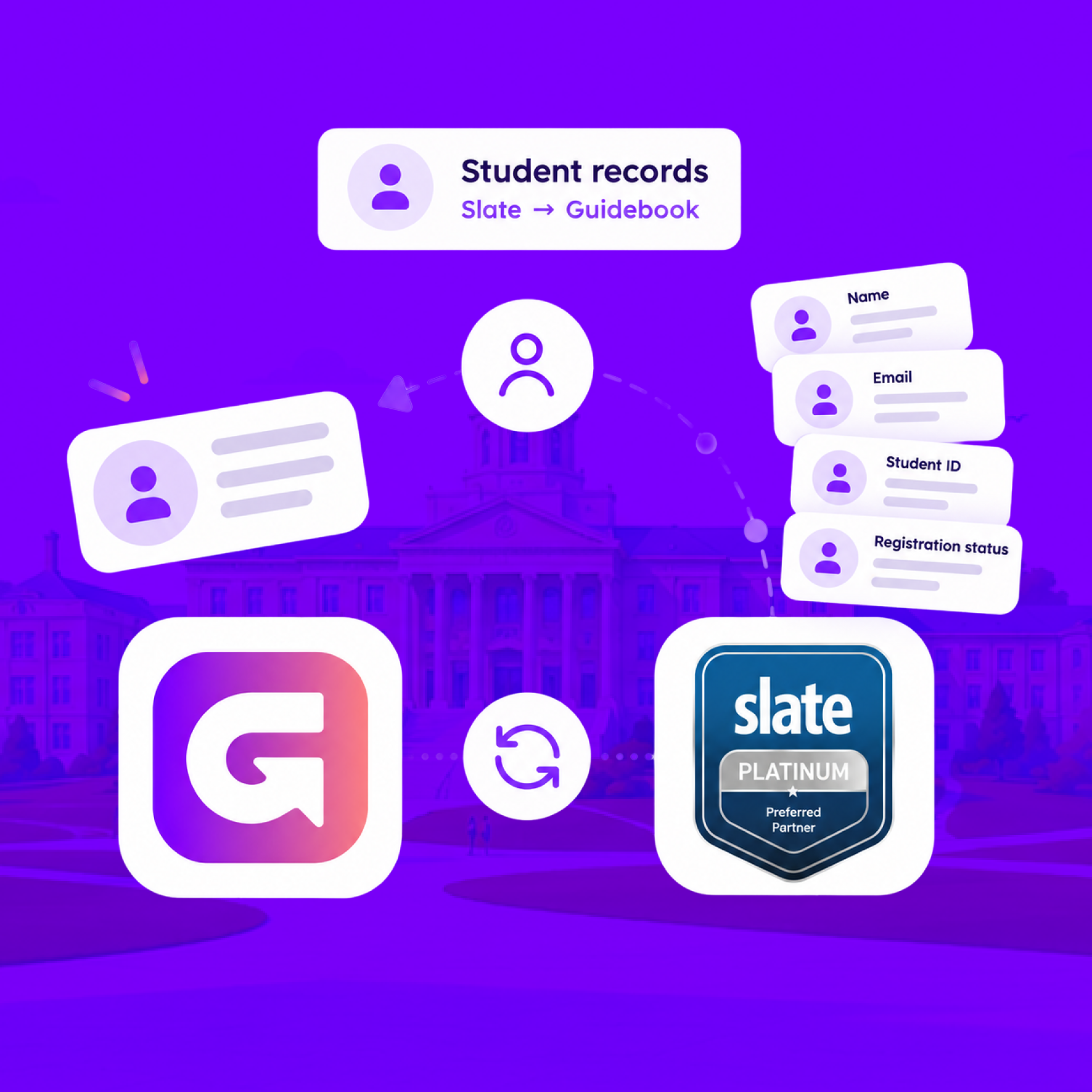
Slate profiles, in the campus app
Match each student's Slate record to their Guidebook account, so college, major, and orientation details stay current on every sync.
Campus apps by department
Admissions, orientation, student life, and more — one campus app that works across departments.

Campus apps by department
Admissions, orientation, student life, and more — one campus app that works across departments.
Build unlimited event apps on one license
One partnership for unlimited campus events — orientation, tours, student life, and everything in between.
Build unlimited event apps on one license
One partnership for unlimited campus events — orientation, tours, student life, and everything in between.
Compare event app platforms
See how Guidebook stacks up against other event app and registration platforms.
Compare event app platforms
See how Guidebook stacks up against other event app and registration platforms.
Event apps for nonprofit and community programs
Give members, volunteers, and donors one branded app for conferences, fundraisers, and year-round community.
Event apps for nonprofit and community programs
Give members, volunteers, and donors one branded app for conferences, fundraisers, and year-round community.
Campus integrations and an open API
Connect Guidebook with the campus systems, APIs, and tools your team already uses.
Campus integrations and an open API
Connect Guidebook with the campus systems, APIs, and tools your team already uses.
Event apps for corporate and enterprise teams
Internal meetings, offsites, and large-scale corporate events — with the branding and control enterprise teams need.
Event apps for corporate and enterprise teams
Internal meetings, offsites, and large-scale corporate events — with the branding and control enterprise teams need.
Create a branded event app with no coding
Put schedules, maps, resources, and updates in every attendee's pocket — built for campus events and programs.
Create a branded event app with no coding
Put schedules, maps, resources, and updates in every attendee's pocket — built for campus events and programs.
Launch a branded, white-label event app
A white-label event app with your branding, your content, and your attendee experience — no coding required.
Launch a branded, white-label event app
A white-label event app with your branding, your content, and your attendee experience — no coding required.
Everything in the Guidebook platform
Explore the features event teams use to engage attendees before, during, and after the event.
Everything in the Guidebook platform
Explore the features event teams use to engage attendees before, during, and after the event.
One app for in-person and virtual attendees
The same schedule, networking, and updates whether people are in the room or joining remotely.
One app for in-person and virtual attendees
The same schedule, networking, and updates whether people are in the room or joining remotely.
Event apps built for associations
Annual meetings, chapter events, and member engagement — without rebuilding a new app every year.
Event apps built for associations
Annual meetings, chapter events, and member engagement — without rebuilding a new app every year.
A branded event website that matches the app
Promote the event, collect interest, and keep branding consistent from the first click to check-in.
A branded event website that matches the app
Promote the event, collect interest, and keep branding consistent from the first click to check-in.
Plan, run, and measure events on one platform
App, registration, badges, and websites in one workflow — so planning isn't a pile of disconnected tools.
Plan, run, and measure events on one platform
App, registration, badges, and websites in one workflow — so planning isn't a pile of disconnected tools.
Keep members engaged between events
One branded app for the conference and everything that happens the other 51 weeks of the year.
Keep members engaged between events
One branded app for the conference and everything that happens the other 51 weeks of the year.
The conference app attendees actually use
Schedules, maps, networking, and live updates for annual meetings, summits, and multi-day conferences.
The conference app attendees actually use
Schedules, maps, networking, and live updates for annual meetings, summits, and multi-day conferences.
Registration that feeds your app and badges
Collect registrations, payments, and attendee data in the same platform as your event app.
Registration that feeds your app and badges
Collect registrations, payments, and attendee data in the same platform as your event app.
Design and print event badges in one place
Custom badges, QR check-in, and on-site printing — without a separate badge vendor.
Design and print event badges in one place
Custom badges, QR check-in, and on-site printing — without a separate badge vendor.
A Smaller School?
Deliver a polished, branded event experience without a large team or a big budget.
A Smaller School?
Deliver a polished, branded event experience without a large team or a big budget.
Running Family Programs?
Give families everything they need, from schedules and maps to real-time updates, all in one place.
Running Family Programs?
Give families everything they need, from schedules and maps to real-time updates, all in one place.
Coordinating Move-In Day?
Share updates, manage events, and keep students informed from move-in through the academic year.

Coordinating Move-In Day?
Share updates, manage events, and keep students informed from move-in through the academic year.
Offering Campus Tours?
Deliver branded, self-guided tour experiences with interactive maps and rich media, available 24/7.

Offering Campus Tours?
Deliver branded, self-guided tour experiences with interactive maps and rich media, available 24/7.
Organising a Career Fair?
Simplify logistics for students, employers, and Career Services staff with one easy-to-use app.
Organising a Career Fair?
Simplify logistics for students, employers, and Career Services staff with one easy-to-use app.
Managing Alumni Events?
Plan reunions, regional events, and fundraising campaigns with an app built for alumni engagement.
Managing Alumni Events?
Plan reunions, regional events, and fundraising campaigns with an app built for alumni engagement.
Boost Student Engagement
One hub for schedules, resources, and events that keeps students connected throughout the academic year.
Boost Student Engagement
One hub for schedules, resources, and events that keeps students connected throughout the academic year.
Planning Orientation?
Help new students feel prepared from day one with schedules, campus resources, and real-time updates in one app.
Planning Orientation?
Help new students feel prepared from day one with schedules, campus resources, and real-time updates in one app.
Running Admissions Events?
Manage open houses, tours, and yield events with a branded app that saves time and engages prospective students.

Running Admissions Events?
Manage open houses, tours, and yield events with a branded app that saves time and engages prospective students.
Get a custom Sponsorship Package Template
Stop starting from scratch. Grab free templates that helWe'll build a tailored sponsorship package with suggested pricing, tiers, and benefits..for your specific event.p you build professional sponsorship packages and close deals faster.
Get a custom Sponsorship Package Template
Stop starting from scratch. Grab free templates that helWe'll build a tailored sponsorship package with suggested pricing, tiers, and benefits..for your specific event.p you build professional sponsorship packages and close deals faster.
Plan Your Next Event Without Missing a Beat.
From venue selection to post-event wrap-up, this free checklist walks you through every step (so nothing falls through the cracks).

Plan Your Next Event Without Missing a Beat.
From venue selection to post-event wrap-up, this free checklist walks you through every step (so nothing falls through the cracks).
Real Results From Real Events
100,000+ organizations trust Guidebook. See exactly how universities, associations, enterprises, and more put it to work.

Real Results From Real Events
100,000+ organizations trust Guidebook. See exactly how universities, associations, enterprises, and more put it to work.
Flexible pricing for every event size
Find the perfect plan for your needs, from intimate gatherings to large-scale conferences.

Flexible pricing for every event size
Find the perfect plan for your needs, from intimate gatherings to large-scale conferences.
Join our event experts
Watch on-demand webinars and join live sessions with industry leaders sharing best practices for event success.

Join our event experts
Watch on-demand webinars and join live sessions with industry leaders sharing best practices for event success.
Guidebook in Action
Book a personalized walkthrough and discover how we help event teams create better attendee experiences.
Guidebook in Action
Book a personalized walkthrough and discover how we help event teams create better attendee experiences.
Campus-Wide Communication Tips: Getting Students' Attention



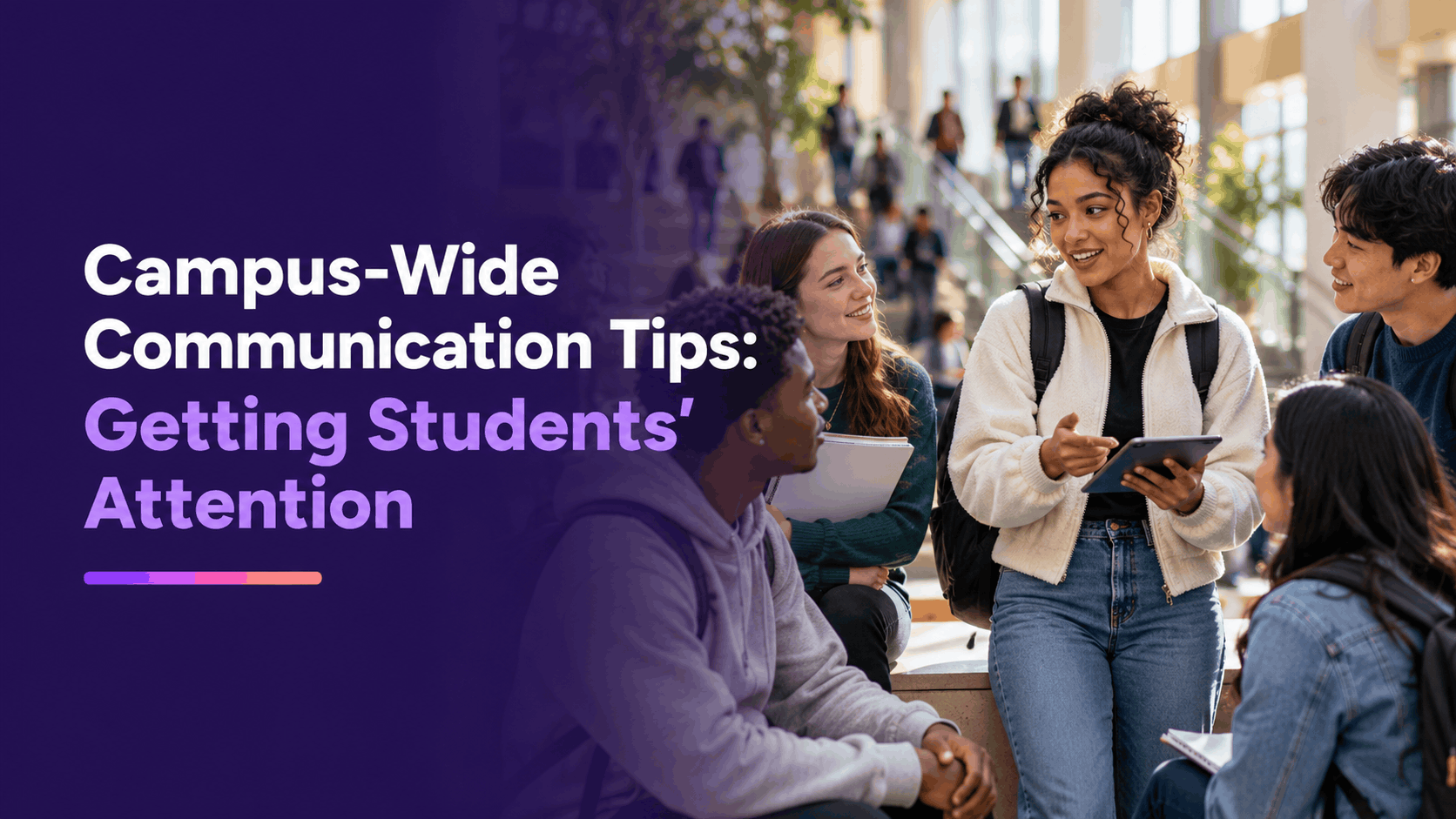
Campus-Wide Communication Tips: Getting Students' Attention
College students have their attention pulled in many different directions. With demanding classes and constant social engagements, it's hard to keep track of every notification. This presents a challenge for higher education administrators, who need to communicate with students about routine reminders and urgent alerts alike.
The key is to invest in the right communication tools and approaches to increase engagement in campus events, offer students the resources they need to succeed academically, and ensure student safety during critical incidents.
In this guide, we'll break down actionable strategies to streamline student communications and ensure they receive every message you send. By updating your institution's outreach strategies, you create a cohesive, supportive environment that provides students with the information they need to engage fully in your community.

Refine your student communication channels
If your university is trying to connect with students across disjointed or outdated channels, students will struggle to keep up with important updates. Evaluate your communication methods to make sure you're meeting students where they are.
To streamline your institutional outreach, focus on these foundational steps:
- Audit existing platforms: Review every tool currently used to send messages, identifying where information overlaps or gets lost. If your team is sending identical deadline reminders through email, the student portal, and an outdated app, this may confuse recipients.
- Identify gaps in delivery: Determine which student groups consistently miss updates and adjust the delivery method to match their habits. For example, commuter students often ignore campus-wide flyers, but they may find targeted text alerts more convenient.
- Adopt a mobile-first mindset: Ensure all schedules, directories, and announcements are easily accessible on the devices students use most. Since a majority of college students spend at least four hours a day on their mobile devices, look for an SMS platform designed for higher education institutions to increase the open rate of your communications.
When your university consolidates and modernizes its outreach tools, you'll remove administrative friction and ensure your student body remains informed.
Establish a unified communication governance board to prevent future platform sprawl and ensure all campus departments adhere to the same standards. This collaborative approach protects students from notification overload while maximizing the impact of every message sent.
Communication tips for higher education
Managing university messaging requires you to remain a reliable source of information from the first deposit to graduation. Consider these primary areas of focus for campus outreach:
Establish trust during orientation
The first few weeks on campus set the tone for a student's entire collegiate experience. Providing a reliable cadence of information early helps alleviate anxiety and builds long-term trust.
To help new students acclimate quickly, implement these communication tips during orientation:
- Space out communication: Starting college is stressful enough without inbox overload. Divide your communication into phases, starting with pre-arrival (30 days before move-in), then taking on a new tactic for move-in day communications and post-orientation follow-up.
- Segment your incoming class: Tailor your welcome messaging based on student type — such as transfer, international, and first-year students — so they only receive relevant details.
- Centralize essential resources: Group campus maps, orientation schedules, and welcome packets into a single accessible hub to help students navigate your campus with ease.
By guiding new arrivals with clear, targeted information, institutions empower students to confidently navigate their new environment.

Boost engagement for campus events
Campus events are a key way for students to form connections and develop a sense of belonging at your university. However, these events will only succeed if students know that they're happening. Maximize participation by clearly communicating when and where an event is taking place and why students should attend.
To encourage attendance, try these strategies:
- Integrate rich multimedia elements: Rich communication services (RCS) enable you to send highly interactive text messages directly to students' usual inboxes. These messages capture students' attention with elements like interactive carousels, embedded forms, and call-to-action (CTA) buttons. In your event marketing communications, include the need-to-know details and add a button that links to your registration page.
- Pace your promotional outreach: Space out event announcements to maintain interest without overwhelming your audience. Start by sending an invite a few weeks before the event, then follow up the week before, two days before, and the morning of to remind students to RSVP.
- Use a campus event app: Instead of posting flyers around campus and hoping students walk by and read them, invest in an event app that allows students to view upcoming events, create their own schedules, and check in via QR code. You can even send messages and enable networking through the app without requiring students to navigate elsewhere.
Centralizing event discovery removes the guesswork for students, making it easier for them to participate in the activities that enrich their college experience.

Guarantee delivery for critical alerts
Student safety is at the forefront of any higher education administrator's mind. If classes need to be canceled due to inclement weather or if there is a threat to student safety on campus, you need to be able to reach students as quickly as possible to help them respond effectively.
Ensure safety and awareness during high-stakes situations by leveraging emergency response software. Incident management platforms for higher education institutions help you identify potential threats, communicate with students and staff alike, and track your response efforts.
Conduct regular tests of your notification systems to make sure they're functioning in case of an emergency.
How better campus communication fuels engagement
Auditing your current outreach platforms and adopting a mobile-first framework will enhance how students interact with your institution. By centralizing resources and segmenting your messaging, you'll build a cohesive digital campus that supports student success year-round.

Get the Mobile App Playbook
A short guide to running the whole student journey in one app. No fluff, just what works.
for higher ed
Campus
Playbook
A practical guide to building a connected campus experience.
Free playbook
The Mobile App Playbook for Universities
Students decide if they belong long before they set foot on campus. This playbook shows how to win them over from the first visit through graduation.
- Grow enrollment and boost recruitment
- Increase belonging and retention
- Run every event from one branded app
By submitting, you agree to our Privacy Policy.
You're in.