Send app engagement back to Slate
For students who opt in, downloads, schedule adds, views, and form responses land on their event registration every hour.
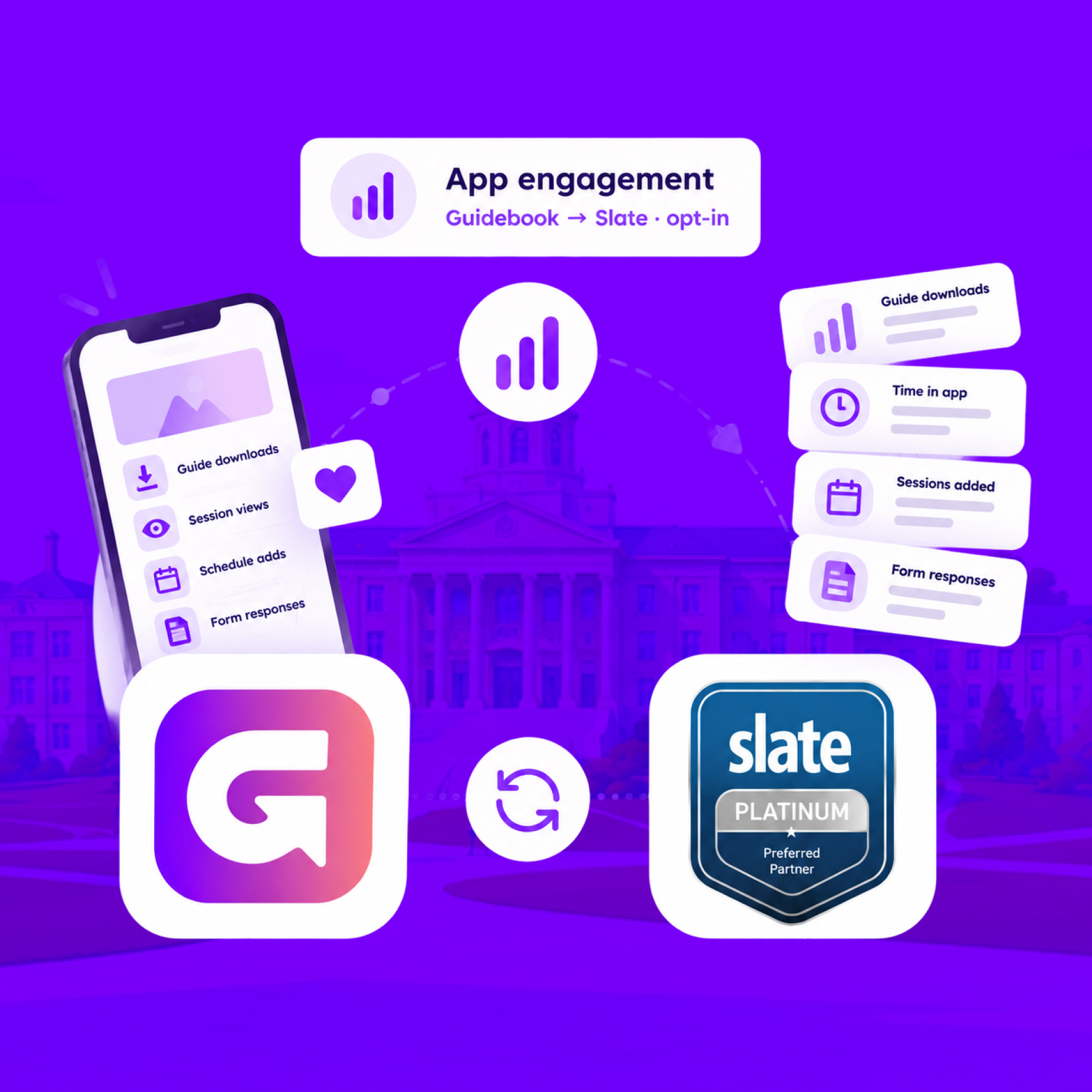
Send app engagement back to Slate
For students who opt in, downloads, schedule adds, views, and form responses land on their event registration every hour.
Build the campus event once in Slate
Link a Slate folder to a guide. Every event becomes a session, and registrants are added automatically.
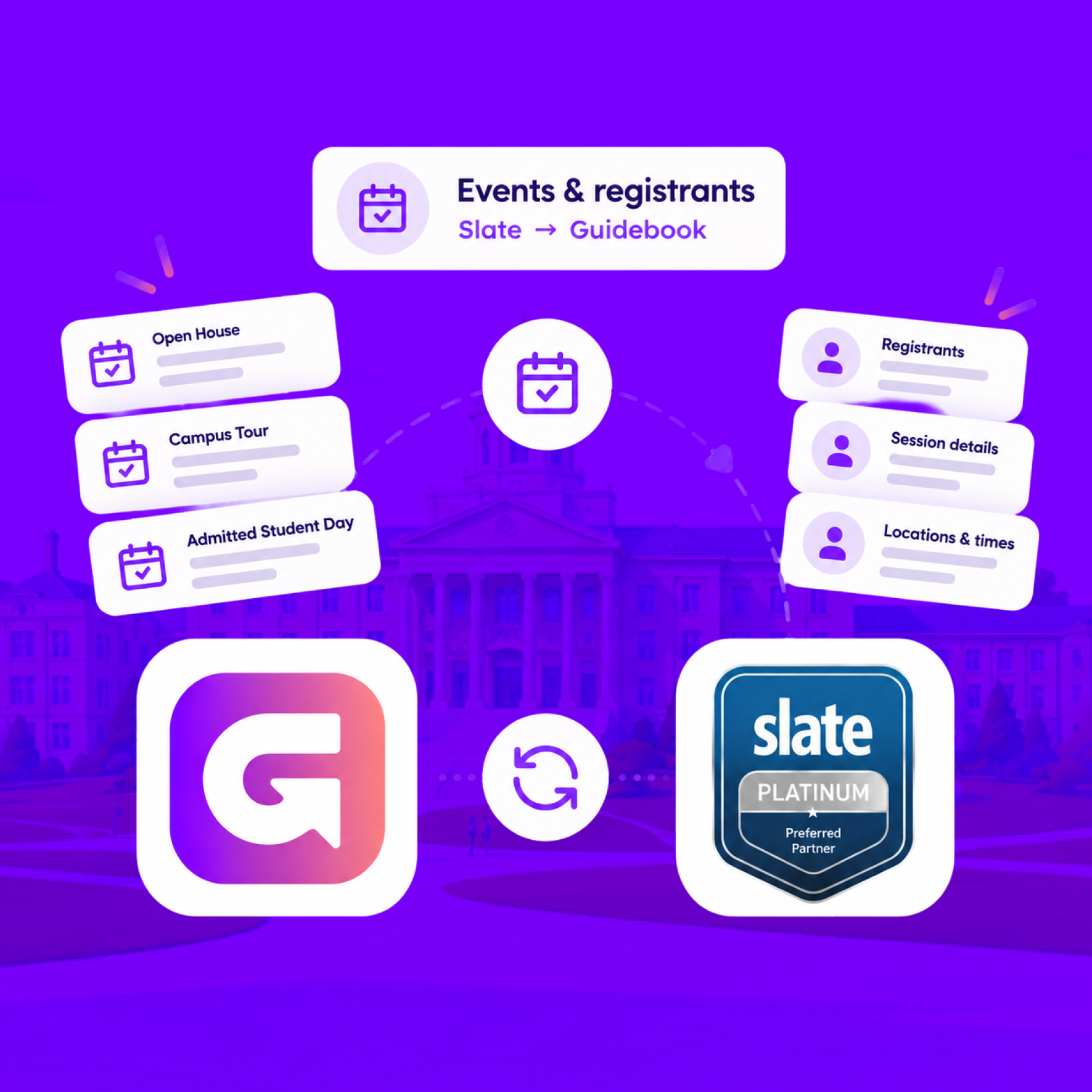
Build the campus event once in Slate
Link a Slate folder to a guide. Every event becomes a session, and registrants are added automatically.
Slate profiles, in the campus app
Match each student's Slate record to their Guidebook account, so college, major, and orientation details stay current on every sync.
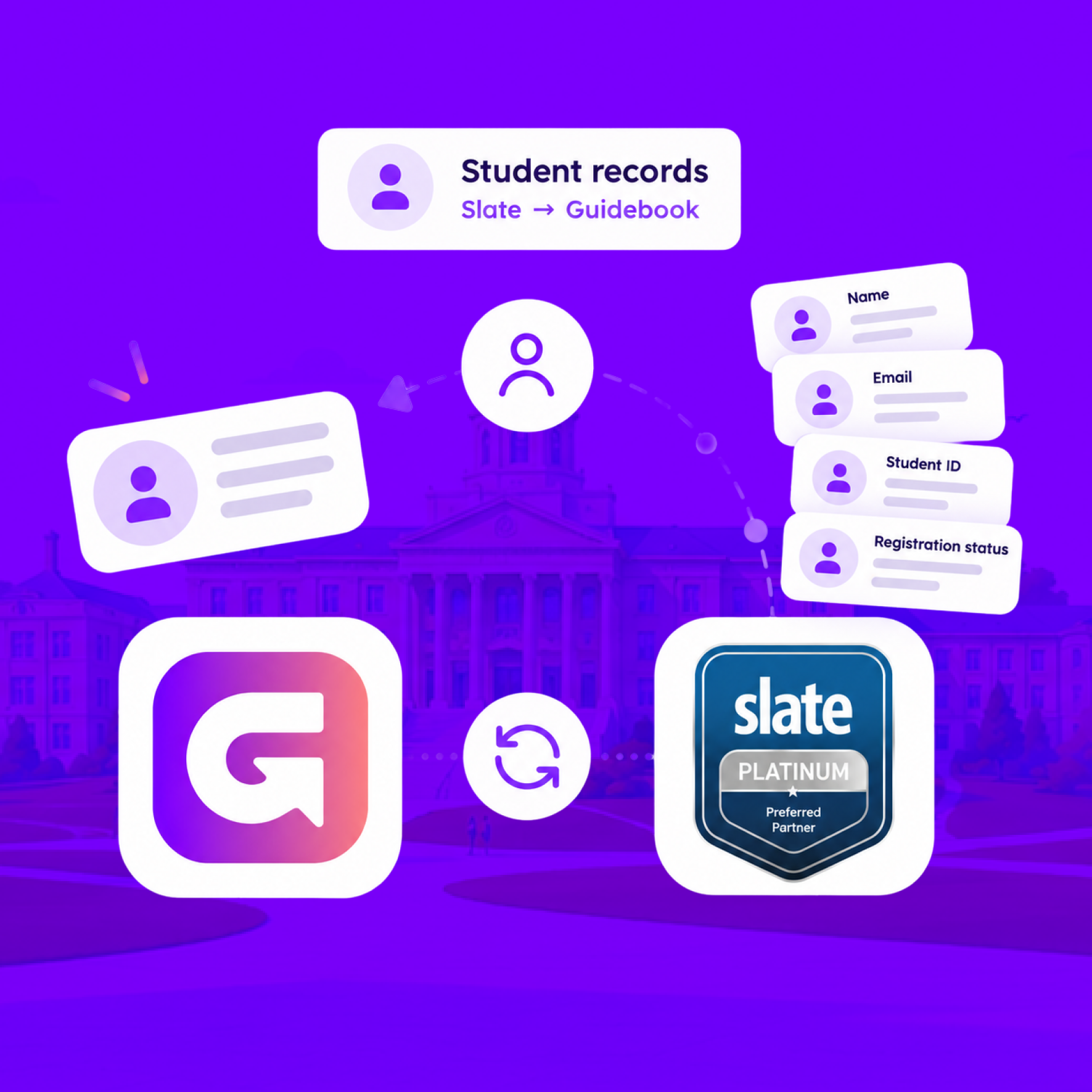
Slate profiles, in the campus app
Match each student's Slate record to their Guidebook account, so college, major, and orientation details stay current on every sync.
Campus apps by department
Admissions, orientation, student life, and more — one campus app that works across departments.

Campus apps by department
Admissions, orientation, student life, and more — one campus app that works across departments.
Build unlimited event apps on one license
One partnership for unlimited campus events — orientation, tours, student life, and everything in between.
Build unlimited event apps on one license
One partnership for unlimited campus events — orientation, tours, student life, and everything in between.
Compare event app platforms
See how Guidebook stacks up against other event app and registration platforms.
Compare event app platforms
See how Guidebook stacks up against other event app and registration platforms.
Event apps for nonprofit and community programs
Give members, volunteers, and donors one branded app for conferences, fundraisers, and year-round community.
Event apps for nonprofit and community programs
Give members, volunteers, and donors one branded app for conferences, fundraisers, and year-round community.
Campus integrations and an open API
Connect Guidebook with the campus systems, APIs, and tools your team already uses.
Campus integrations and an open API
Connect Guidebook with the campus systems, APIs, and tools your team already uses.
Event apps for corporate and enterprise teams
Internal meetings, offsites, and large-scale corporate events — with the branding and control enterprise teams need.
Event apps for corporate and enterprise teams
Internal meetings, offsites, and large-scale corporate events — with the branding and control enterprise teams need.
Create a branded event app with no coding
Put schedules, maps, resources, and updates in every attendee's pocket — built for campus events and programs.
Create a branded event app with no coding
Put schedules, maps, resources, and updates in every attendee's pocket — built for campus events and programs.
Launch a branded, white-label event app
A white-label event app with your branding, your content, and your attendee experience — no coding required.
Launch a branded, white-label event app
A white-label event app with your branding, your content, and your attendee experience — no coding required.
Everything in the Guidebook platform
Explore the features event teams use to engage attendees before, during, and after the event.
Everything in the Guidebook platform
Explore the features event teams use to engage attendees before, during, and after the event.
One app for in-person and virtual attendees
The same schedule, networking, and updates whether people are in the room or joining remotely.
One app for in-person and virtual attendees
The same schedule, networking, and updates whether people are in the room or joining remotely.
Event apps built for associations
Annual meetings, chapter events, and member engagement — without rebuilding a new app every year.
Event apps built for associations
Annual meetings, chapter events, and member engagement — without rebuilding a new app every year.
A branded event website that matches the app
Promote the event, collect interest, and keep branding consistent from the first click to check-in.
A branded event website that matches the app
Promote the event, collect interest, and keep branding consistent from the first click to check-in.
Plan, run, and measure events on one platform
App, registration, badges, and websites in one workflow — so planning isn't a pile of disconnected tools.
Plan, run, and measure events on one platform
App, registration, badges, and websites in one workflow — so planning isn't a pile of disconnected tools.
Keep members engaged between events
One branded app for the conference and everything that happens the other 51 weeks of the year.
Keep members engaged between events
One branded app for the conference and everything that happens the other 51 weeks of the year.
The conference app attendees actually use
Schedules, maps, networking, and live updates for annual meetings, summits, and multi-day conferences.
The conference app attendees actually use
Schedules, maps, networking, and live updates for annual meetings, summits, and multi-day conferences.
Registration that feeds your app and badges
Collect registrations, payments, and attendee data in the same platform as your event app.
Registration that feeds your app and badges
Collect registrations, payments, and attendee data in the same platform as your event app.
Design and print event badges in one place
Custom badges, QR check-in, and on-site printing — without a separate badge vendor.
Design and print event badges in one place
Custom badges, QR check-in, and on-site printing — without a separate badge vendor.
A Smaller School?
Deliver a polished, branded event experience without a large team or a big budget.
A Smaller School?
Deliver a polished, branded event experience without a large team or a big budget.
Running Family Programs?
Give families everything they need, from schedules and maps to real-time updates, all in one place.
Running Family Programs?
Give families everything they need, from schedules and maps to real-time updates, all in one place.
Coordinating Move-In Day?
Share updates, manage events, and keep students informed from move-in through the academic year.

Coordinating Move-In Day?
Share updates, manage events, and keep students informed from move-in through the academic year.
Offering Campus Tours?
Deliver branded, self-guided tour experiences with interactive maps and rich media, available 24/7.

Offering Campus Tours?
Deliver branded, self-guided tour experiences with interactive maps and rich media, available 24/7.
Organising a Career Fair?
Simplify logistics for students, employers, and Career Services staff with one easy-to-use app.
Organising a Career Fair?
Simplify logistics for students, employers, and Career Services staff with one easy-to-use app.
Managing Alumni Events?
Plan reunions, regional events, and fundraising campaigns with an app built for alumni engagement.
Managing Alumni Events?
Plan reunions, regional events, and fundraising campaigns with an app built for alumni engagement.
Boost Student Engagement
One hub for schedules, resources, and events that keeps students connected throughout the academic year.
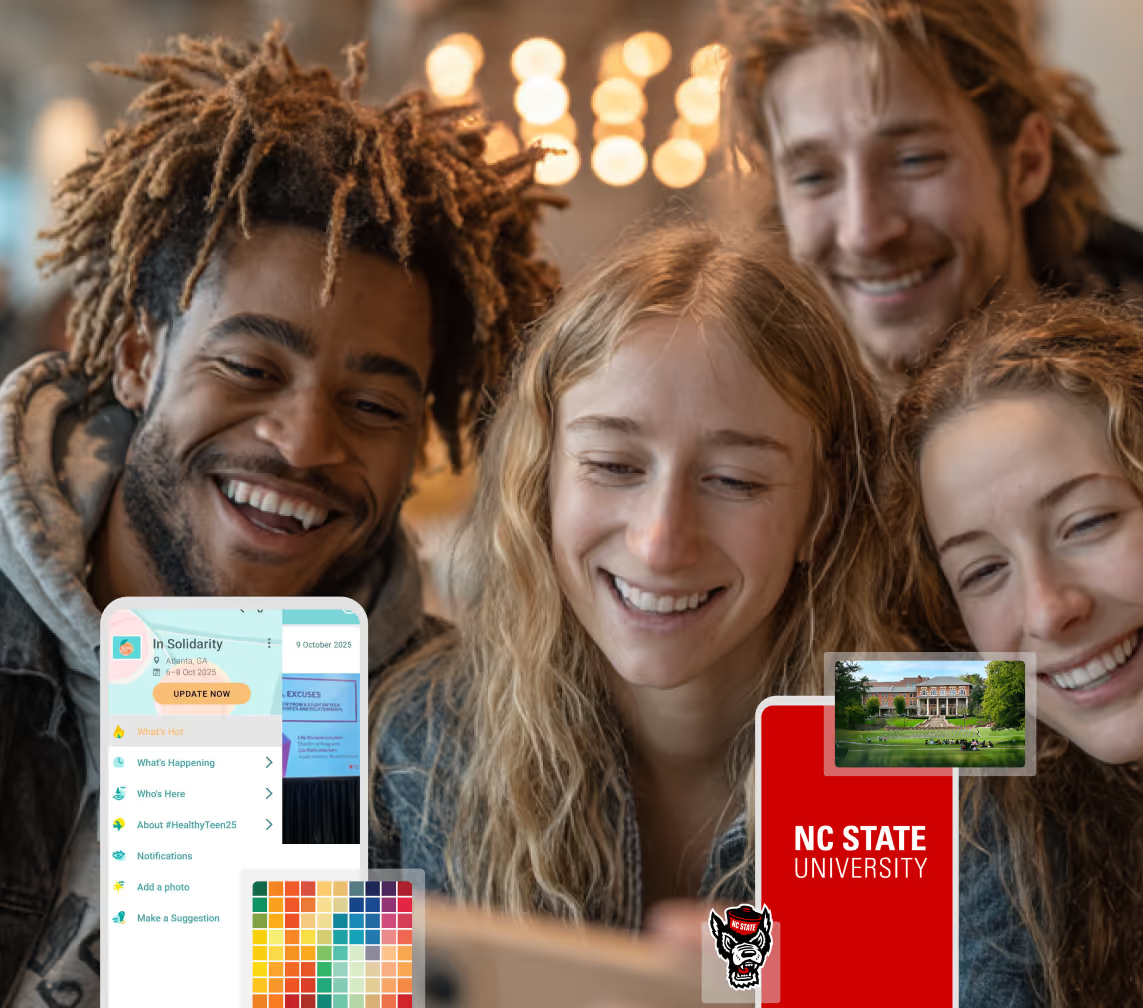
Boost Student Engagement
One hub for schedules, resources, and events that keeps students connected throughout the academic year.
Planning Orientation?
Help new students feel prepared from day one with schedules, campus resources, and real-time updates in one app.
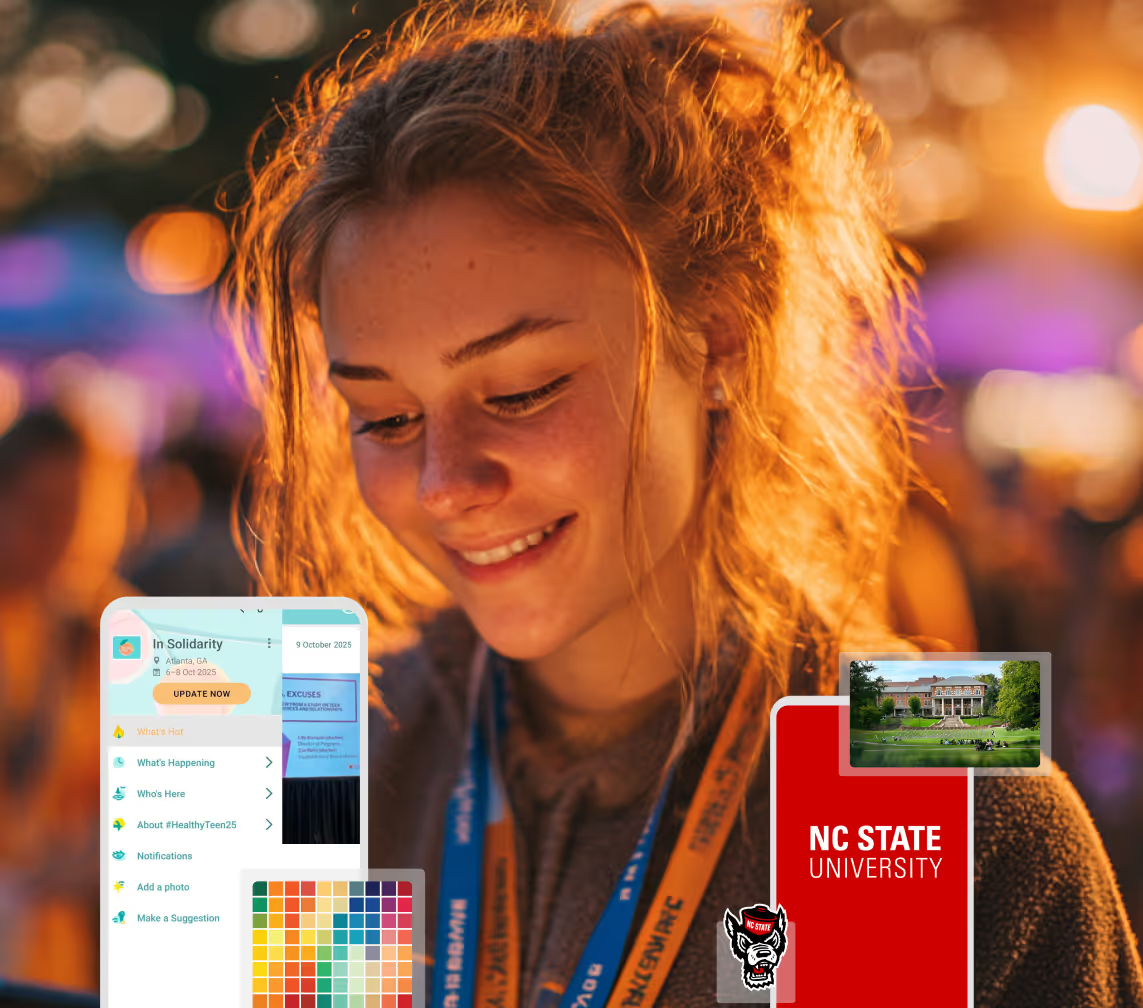
Planning Orientation?
Help new students feel prepared from day one with schedules, campus resources, and real-time updates in one app.
Running Admissions Events?
Manage open houses, tours, and yield events with a branded app that saves time and engages prospective students.

Running Admissions Events?
Manage open houses, tours, and yield events with a branded app that saves time and engages prospective students.
Get a custom Sponsorship Package Template
Stop starting from scratch. Grab free templates that helWe'll build a tailored sponsorship package with suggested pricing, tiers, and benefits..for your specific event.p you build professional sponsorship packages and close deals faster.
Get a custom Sponsorship Package Template
Stop starting from scratch. Grab free templates that helWe'll build a tailored sponsorship package with suggested pricing, tiers, and benefits..for your specific event.p you build professional sponsorship packages and close deals faster.
Plan Your Next Event Without Missing a Beat.
From venue selection to post-event wrap-up, this free checklist walks you through every step (so nothing falls through the cracks).
.avif)
Plan Your Next Event Without Missing a Beat.
From venue selection to post-event wrap-up, this free checklist walks you through every step (so nothing falls through the cracks).
Real Results From Real Events
100,000+ organizations trust Guidebook. See exactly how universities, associations, enterprises, and more put it to work.

Real Results From Real Events
100,000+ organizations trust Guidebook. See exactly how universities, associations, enterprises, and more put it to work.
Flexible pricing for every event size
Find the perfect plan for your needs, from intimate gatherings to large-scale conferences.

Flexible pricing for every event size
Find the perfect plan for your needs, from intimate gatherings to large-scale conferences.
Join our event experts
Watch on-demand webinars and join live sessions with industry leaders sharing best practices for event success.
.avif)
Join our event experts
Watch on-demand webinars and join live sessions with industry leaders sharing best practices for event success.
Guidebook in Action
Book a personalized walkthrough and discover how we help event teams create better attendee experiences.
Guidebook in Action
Book a personalized walkthrough and discover how we help event teams create better attendee experiences.
The 6 Communication Moments Between Deposit and Move-In (And What to Send When)




The 6 Communication Moments Between Deposit and Move-In (And What to Send When)
- The 90 days between deposit and move-in are when summer melt happens. Most communication calendars treat it as a holding pattern rather than an active yield strategy.
- There are 6 distinct moments in the post-deposit window, each with a different emotional job.
- The teams that keep the most students aren't sending more emails. They're sending the right message at the right moment on the right channel.
- Students who feel connected before move-in day are significantly more likely to persist through their first year.
- A 6-moment communication plan can be owned entirely by an admissions communications coordinator without additional headcount or IT involvement.
Picture a deposited student on a Thursday in mid-June. Three weeks since the deposit deadline. She's committed, on paper. But she's also quietly comparing. The competing institution sent a text on Tuesday. A current student reached out on Wednesday. Saturday she has a campus visit booked there, just to "be sure."
Your last message landed in her inbox twelve days ago. It was the welcome email. Auto-sent. Could have come from anyone.
That's the gap. Not a communication problem, a timing problem. A moments problem.
Less melt. More moments.
The 90 days between deposit day and move-in are the highest-stakes stretch in enrollment. Here's the 6-moment playbook your team can run this summer to keep your deposited class right where they belong.
Why the post-deposit window is where yields are won or lost
Most Slate sequences do one thing well: confirm the deposit. After that, they go quiet until orientation registration opens. That silence isn't neutral. It reads as indifference to a 17-year-old who just made one of the largest decisions of their life.
Andrea Crilly, Assistant Director of Admissions for Campus Experience at Indiana Tech, watched this play out firsthand. "When we started in 2015, we yielded 40%," she said. "After implementing Guidebook in 2020, that number grew to 60-72%, and in 2022 and 2023 it increased to 82%. We believe Guidebook had a strong impact on that growth."
That's a 105% yield increase over eight years. Indiana Tech's direct lever was rebuilding the on-the-day Admitted Students Day experience, not a summer communication sequence. But the underlying principle scales: yield moves when admitted students feel seen across every stage of the summer, not just the events.
Many admissions teams describe building their summer communication sequence on a deadline in April, then watching it go out unchanged for the next three cycles. The problem isn't effort. It's that the sequence was designed to send information, not to build a relationship.
The 6 moments below fix that. Each one has a distinct emotional job. Each one hits differently when it lands on the right channel.
The 6 moments
Moment 1: The confirmation (Days 1 to 3 after deposit)
Emotional job: Validation. Your student just bet on your institution. Tell them they made the right call.
What to send: A warm, specific, human message. Not "Welcome to the [Mascot] Family!", every school sends that. Instead: reference something specific about them. Their intended major. The campus visit they took in February. The scholarship they earned. Make it feel like it was written for one person, because in spirit, it was.
Channel: Email plus text. Both. The email is the record; the text is the relationship.
Mistake to avoid: The generic mass welcome that could have come from any institution they applied to. If your message could pass for a competitor's message, rewrite it.
Moment 2: The connection point (Weeks 2 to 3)
Emotional job: Belonging, before they've set foot on campus.
What to send: An introduction to a peer. A current student in their intended major. A student ambassador who went to a high school like theirs. A link to a student community they can join right now. This is the moment where "I chose this school" starts becoming "I belong here."
Channel: Text or app notification, whichever gets them to tap, not scroll past. A common frustration among admissions teams: the first "connection" touchpoint links to a portal the student hasn't been activated on yet. Send them somewhere that actually opens on the first try.
Mistake to avoid: Sending this without confirming the destination works. Test every link on a phone before the message goes out.
Moment 3: The reassurance check-in (Weeks 4 to 6)
Emotional job: Feeling seen.
By week four, the initial excitement has leveled off. Students aren't panicking, but they're not engaged either. Most institutions don't send anything here. That's a mistake.
What to send: A low-ask touchpoint. A short survey ("What are you most excited about? Most nervous about?"). A preview of something coming in August. A brief note from a named admissions counselor, not a noreply address.
Channel: Text. Email open rates drop sharply in June. The students who are drifting toward melt are the ones least likely to open an email from an institution they're second-guessing.
Mistake to avoid: Using this moment for logistics. This isn't the place for "please complete your housing application." This is relationship work. Save the action items for Moment 4.
Moment 4: The orientation anchor (6 to 8 weeks before move-in)
Emotional job: Something concrete to plan around.
This is the moment orientation registration opens, and it's often the first time admissions and orientation hand off the communication relationship. That handoff is bumpy at most institutions. Students hear from two different offices in the same week, with different tones, different channels, and sometimes conflicting information.
What to send: Orientation registration, yes, but frame it as a preview, not a form. Tell them what orientation actually feels like. What they'll do on day one. Who they'll meet. What to bring. See how Purdue's orientation team thinks about this: Craig Johnson, Director of Orientation Programs, describes the design challenge plainly. "If you just let students fly as soon as the beginning of the program, there are quite a few students that are gonna find themselves in the wrong place on campus and then just lock up." That lock-up, he adds, can lead to a student thinking "I'd rather just sit in the comfort of my room, the one place that I am familiar with on campus."
Structure prevents that. Orientation registration is the first piece of structure. Make it feel like an invitation, not a deadline.
Channel: Email is appropriate here. Students are in planning mode, and a longer-format message is welcome. Families often read orientation communication alongside students; consider a parallel touchpoint for parents and family programs.
Mistake to avoid: Sending logistics before the student feels connected. If you haven't done Moments 1 through 3, Moment 4 lands cold.
Moment 5: The pre-arrival ramp (2 weeks before move-in)
Emotional job: Readiness, not overwhelm.
Two weeks out, your students want to feel prepared. They don't want a 40-item checklist PDF. They want to know the three things they need to do this week, the three things to do next week, and where to find everything else when they need it.
This is the moment the communication channel shifts. Email has been losing ground since June. Admissions teams often describe this stretch as the moment the inbox finally stops working, and there's no backup channel ready. The students who haven't opened an email in three weeks will pull out their phone to check a move-in schedule on Tuesday morning.
What to send: Practical information in small doses. Move-in time slot. What to download before arrival. Who to text if something goes wrong. A preview of move-in day.
Channel: App-first. A mobile app, not a website squeezed onto a phone: that distinction matters at 7am on move-in day when 400 families are trying to find the right parking lot. If your students have been using your app since Moment 2, this is where it pays off. See how Northeastern University handled 5,700 admitted students across their events: Leilani Potgieter, Events Assistant, put it simply. "It was completely seamless for the past fall."
Mistake to avoid: Sending everything at once. Stagger the information. Your students can only act on so much at a time.
Moment 6: The arrival welcome (Move-in day)
Emotional job: Feeling expected, not processed.
Move-in day is the payoff for everything your team built over the summer. It's also the moment where the logistics are most likely to swallow the experience. Long lines, wrong buildings, WiFi failing at the worst possible time.
What to send: A personalized welcome push notification. Their move-in time slot and location. A map that works offline. One clear contact for questions (a named person, not a help desk email).
Channel: Push notification. This is not an email moment. The student who got a push notification with their name, their building, and their move-in window at 8am will remember that arrival differently than the student who stood in a parking lot trying to load a PDF.
Mistake to avoid: Making this feel like a logistics handoff. Move-in day is a belonging moment. The welcome comes first. The directions come second.
The mistakes that kill momentum between moments
Three failure modes show up again and again.
The first is treating all six moments as email jobs. Email worked in 2015. It works less each year with students who grew up on push notifications and texts. The channel is part of the message. A text that says "we're thinking of you" lands differently than an email with the same words.
The second is spacing messages by calendar date rather than enrollment psychology. A week-by-week drip doesn't account for the fact that a student's anxiety peaks at different moments. Weeks 4 through 6 are high-risk. Two weeks before move-in is high-risk. Build the sequence around those moments, not the calendar.
The third is building for the average student. First-generation students need different reassurances than continuing-generation students. Transfer students have different anxieties than first-years. The more your communication can reflect who a student actually is, the stronger the connection it builds.
What this looks like when it works
What is a post-deposit communication plan?
A post-deposit communication plan is a structured sequence of touchpoints sent to deposited students between the deposit deadline and move-in day. Its purpose is to maintain connection, reduce summer melt, and build the sense of belonging that research consistently links to first-year retention. Effective plans include at minimum 5 to 6 distinct moments, each matched to a different emotional need in the student's summer experience, and delivered across more than one channel.
When all six moments land well, August looks different. Your team isn't chasing students who went quiet in June. You're not scrambling to fill gaps created by late withdrawals. Instead, you arrive at move-in day with a class that's been in conversation with your institution for three months. They've downloaded the app. They know someone on campus. They've registered for orientation. They know where to park.
Andrea Crilly's team at Indiana Tech didn't get to 82% yield by sending more emails. They got there by building one app for every moment that matters, a connected experience that holds every touchpoint of the admitted student journey in one place. See how Indiana Tech did it, and how their admitted student day became the anchor for a summer that converts.
That's your yielded class. The 6 moments are how you keep them.
What comes next
Your summer communication calendar is already drafted. The question is whether it's doing six jobs or two.
Look at what you have scheduled between deposit day and move-in. Count the distinct emotional moments, not the number of sends. If you have a welcome email, an orientation registration reminder, and a move-in checklist, you have three sends doing information work. You don't have a belonging strategy.
The teams that hold their class through August aren't working harder. They're working at the right moments.
See how Guidebook structures the post-deposit communication window for admissions teams at mid-size privates. One conversation. No IT ticket required.
[faq]
Q: What should you send admitted students between deposit and move-in?
A: Effective post-deposit communication covers six distinct emotional jobs: confirming the student made the right choice, introducing a peer connection, checking in during the quiet weeks of early summer, anchoring them to orientation registration, ramping up practical pre-arrival information, and welcoming them personally on move-in day. The teams that reduce melt aren't sending more messages. They're sending the right message at the right moment on the right channel.
Q: How many touchpoints should you send a deposited student before orientation?
A: Most admissions teams send three to five messages between deposit day and orientation registration. Research and practitioner experience suggest six distinct touchpoints tied to specific emotional moments outperforms a higher volume of generic sends. Quality and timing matter more than frequency.
Q: When does summer melt actually happen in the deposit-to-move-in window?
A: Melt risk is highest in two windows: weeks four through six after deposit day, when the initial excitement fades and institutions often go quiet, and the two weeks immediately before move-in, when logistical stress peaks and students without a strong sense of connection are most likely to withdraw. Communication gaps in those two stretches are where most attrition happens.
Q: What channel works best for post-deposit student communication?
A: It depends on the moment. Email works well for longer-format messages like orientation previews and move-in planning guides, where students are in planning mode. Text outperforms email for short emotional touchpoints in June and July, when inbox engagement drops. Push notifications through a mobile app are most effective on move-in day itself, when students need real-time, location-specific information they can access without logging into anything.
Q: What's the difference between a post-deposit communication plan and an orientation registration sequence?
A: An orientation registration sequence is logistics: here's when registration opens, here's what to complete, here's the deadline. A post-deposit communication plan is relationship-building across the entire 90-day window from deposit to move-in, of which orientation registration is just one moment. Teams that conflate the two tend to go quiet for weeks at a time, then flood students with action items right before orientation.
Q: How do you communicate differently with first-generation students in the post-deposit window?
A: First-generation students often carry more unspoken anxiety about belonging and logistics than their continuing-generation peers, and are less likely to ask for help when they're uncertain. Communication that names what they might be feeling, introduces a peer who shares their background, and reduces logistical uncertainty in small doses tends to land better than the same message sent to the full deposited class.
Q: What should a move-in day push notification say?
A: Keep it short, personal, and practical. Include the student's name, their specific move-in time and location, one link to a map or schedule that works offline, and a single contact for questions. Avoid sending a list of reminders. The goal of a move-in day notification is to make the student feel expected and prepared, not to deliver a final checklist.
[/faq]

Get the Mobile App Playbook
A short guide to running the whole student journey in one app. No fluff, just what works.
for higher ed
Campus
Playbook
A practical guide to building a connected campus experience.
Free playbook
The Mobile App Playbook for Universities
Students decide if they belong long before they set foot on campus. This playbook shows how to win them over from the first visit through graduation.
- Grow enrollment and boost recruitment
- Increase belonging and retention
- Run every event from one branded app
By submitting, you agree to our Privacy Policy.
You're in.
.png)

%20(1).avif)