Campus apps by department
Admissions, orientation, student life, and more — one campus app that works across departments.

Campus apps by department
Admissions, orientation, student life, and more — one campus app that works across departments.
Build unlimited event apps on one license
One partnership for unlimited campus events — orientation, tours, student life, and everything in between.
Build unlimited event apps on one license
One partnership for unlimited campus events — orientation, tours, student life, and everything in between.
Compare event app platforms
See how Guidebook stacks up against other event app and registration platforms.
Compare event app platforms
See how Guidebook stacks up against other event app and registration platforms.
Event apps for nonprofit and community programs
Give members, volunteers, and donors one branded app for conferences, fundraisers, and year-round community.
Event apps for nonprofit and community programs
Give members, volunteers, and donors one branded app for conferences, fundraisers, and year-round community.
Campus integrations and an open API
Connect Guidebook with the campus systems, APIs, and tools your team already uses.
Campus integrations and an open API
Connect Guidebook with the campus systems, APIs, and tools your team already uses.
Event apps for corporate and enterprise teams
Internal meetings, offsites, and large-scale corporate events — with the branding and control enterprise teams need.
Event apps for corporate and enterprise teams
Internal meetings, offsites, and large-scale corporate events — with the branding and control enterprise teams need.
Create a branded event app with no coding
Put schedules, maps, resources, and updates in every attendee's pocket — built for campus events and programs.
Create a branded event app with no coding
Put schedules, maps, resources, and updates in every attendee's pocket — built for campus events and programs.
Launch a branded, white-label event app
A white-label event app with your branding, your content, and your attendee experience — no coding required.
Launch a branded, white-label event app
A white-label event app with your branding, your content, and your attendee experience — no coding required.
Everything in the Guidebook platform
Explore the features event teams use to engage attendees before, during, and after the event.
Everything in the Guidebook platform
Explore the features event teams use to engage attendees before, during, and after the event.
One app for in-person and virtual attendees
The same schedule, networking, and updates whether people are in the room or joining remotely.
One app for in-person and virtual attendees
The same schedule, networking, and updates whether people are in the room or joining remotely.
Event apps built for associations
Annual meetings, chapter events, and member engagement — without rebuilding a new app every year.
Event apps built for associations
Annual meetings, chapter events, and member engagement — without rebuilding a new app every year.
A branded event website that matches the app
Promote the event, collect interest, and keep branding consistent from the first click to check-in.
A branded event website that matches the app
Promote the event, collect interest, and keep branding consistent from the first click to check-in.
Plan, run, and measure events on one platform
App, registration, badges, and websites in one workflow — so planning isn't a pile of disconnected tools.
Plan, run, and measure events on one platform
App, registration, badges, and websites in one workflow — so planning isn't a pile of disconnected tools.
Keep members engaged between events
One branded app for the conference and everything that happens the other 51 weeks of the year.
Keep members engaged between events
One branded app for the conference and everything that happens the other 51 weeks of the year.
The conference app attendees actually use
Schedules, maps, networking, and live updates for annual meetings, summits, and multi-day conferences.
The conference app attendees actually use
Schedules, maps, networking, and live updates for annual meetings, summits, and multi-day conferences.
Registration that feeds your app and badges
Collect registrations, payments, and attendee data in the same platform as your event app.
Registration that feeds your app and badges
Collect registrations, payments, and attendee data in the same platform as your event app.
Design and print event badges in one place
Custom badges, QR check-in, and on-site printing — without a separate badge vendor.
Design and print event badges in one place
Custom badges, QR check-in, and on-site printing — without a separate badge vendor.
A Smaller School?
Deliver a polished, branded event experience without a large team or a big budget.
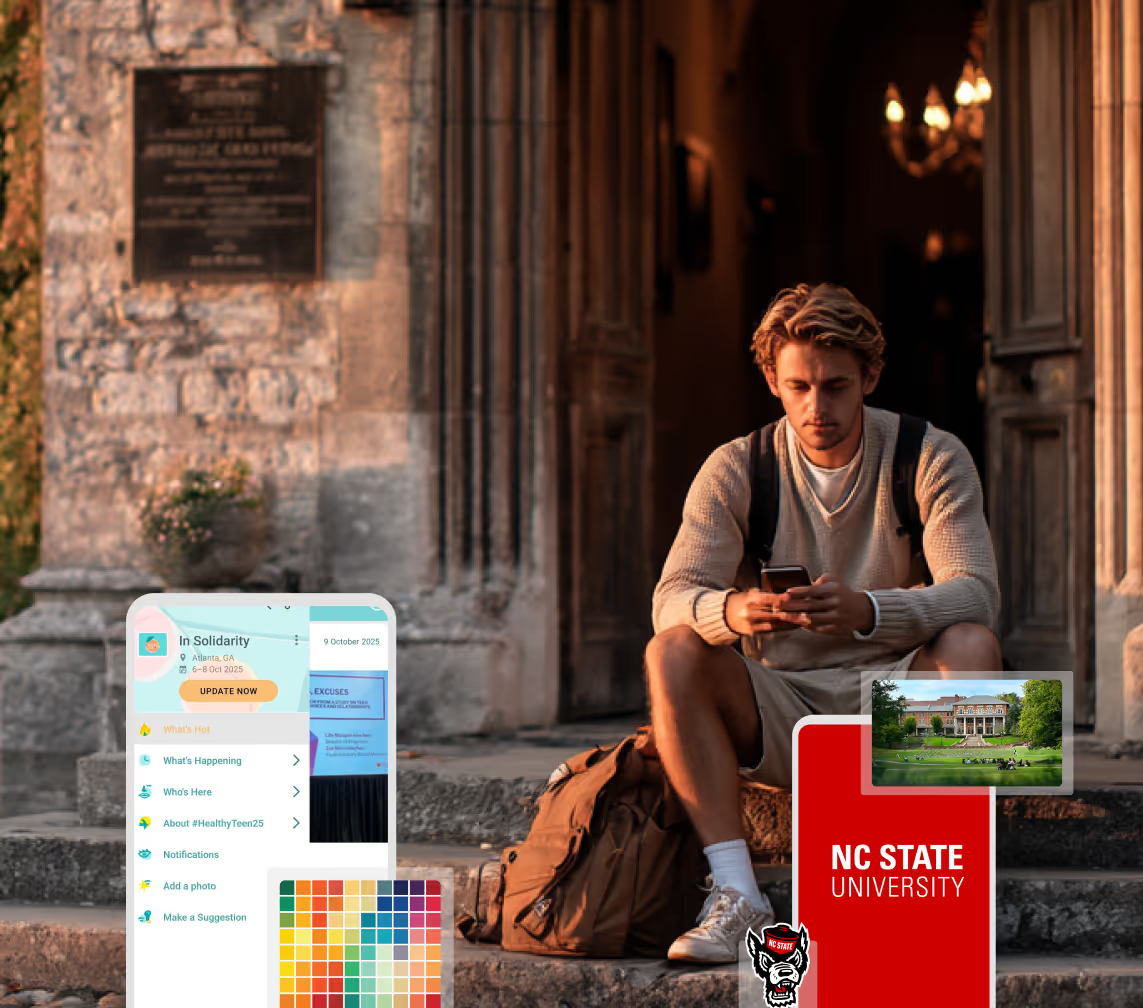
A Smaller School?
Deliver a polished, branded event experience without a large team or a big budget.
Running Family Programs?
Give families everything they need, from schedules and maps to real-time updates, all in one place.
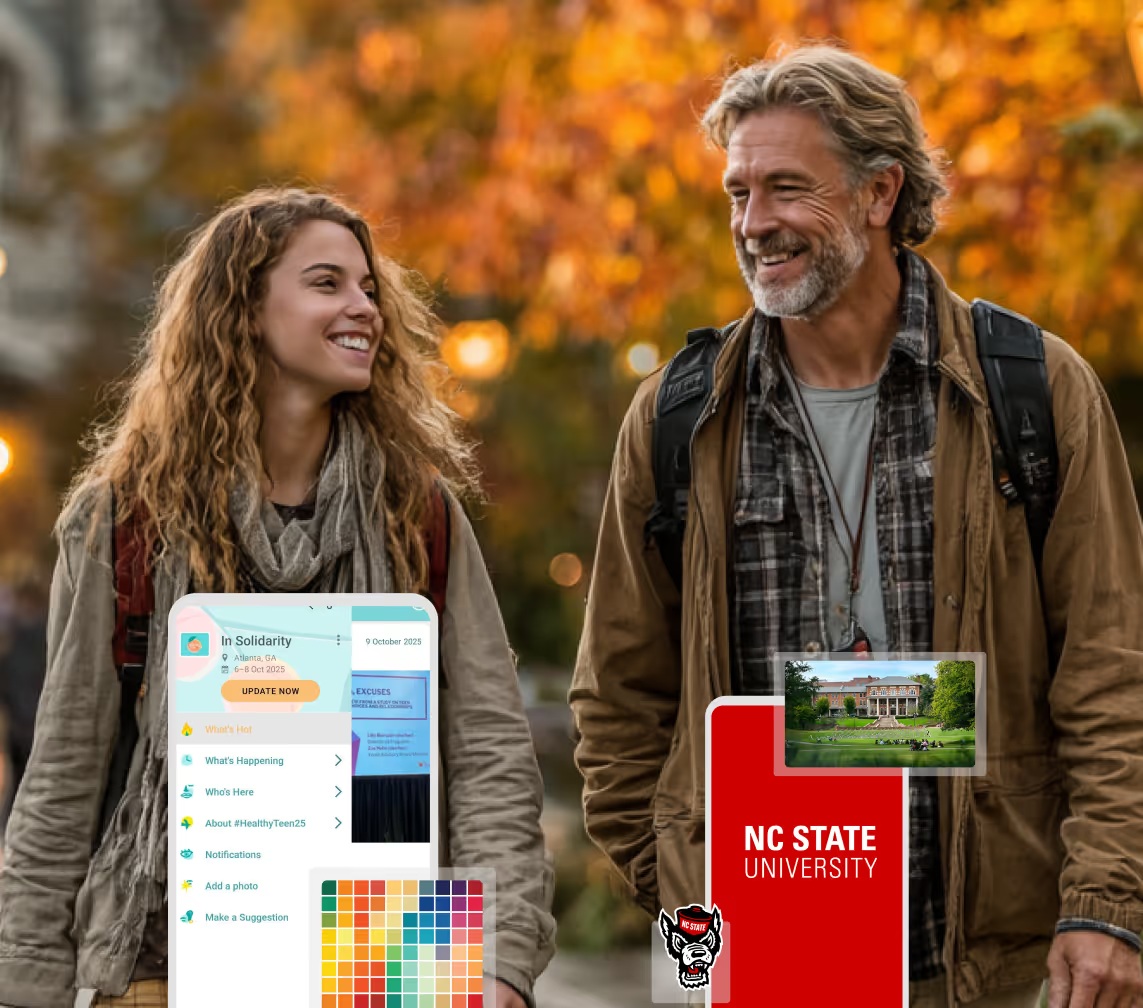
Running Family Programs?
Give families everything they need, from schedules and maps to real-time updates, all in one place.
Coordinating Move-In Day?
Share updates, manage events, and keep students informed from move-in through the academic year.

Coordinating Move-In Day?
Share updates, manage events, and keep students informed from move-in through the academic year.
Offering Campus Tours?
Deliver branded, self-guided tour experiences with interactive maps and rich media, available 24/7.

Offering Campus Tours?
Deliver branded, self-guided tour experiences with interactive maps and rich media, available 24/7.
Organising a Career Fair?
Simplify logistics for students, employers, and Career Services staff with one easy-to-use app.
Organising a Career Fair?
Simplify logistics for students, employers, and Career Services staff with one easy-to-use app.
Managing Alumni Events?
Plan reunions, regional events, and fundraising campaigns with an app built for alumni engagement.
Managing Alumni Events?
Plan reunions, regional events, and fundraising campaigns with an app built for alumni engagement.
Boost Student Engagement
One hub for schedules, resources, and events that keeps students connected throughout the academic year.
Boost Student Engagement
One hub for schedules, resources, and events that keeps students connected throughout the academic year.
Planning Orientation?
Help new students feel prepared from day one with schedules, campus resources, and real-time updates in one app.
Planning Orientation?
Help new students feel prepared from day one with schedules, campus resources, and real-time updates in one app.
Running Admissions Events?
Manage open houses, tours, and yield events with a branded app that saves time and engages prospective students.

Running Admissions Events?
Manage open houses, tours, and yield events with a branded app that saves time and engages prospective students.
Get a custom Sponsorship Package Template
Stop starting from scratch. Grab free templates that helWe'll build a tailored sponsorship package with suggested pricing, tiers, and benefits..for your specific event.p you build professional sponsorship packages and close deals faster.
Get a custom Sponsorship Package Template
Stop starting from scratch. Grab free templates that helWe'll build a tailored sponsorship package with suggested pricing, tiers, and benefits..for your specific event.p you build professional sponsorship packages and close deals faster.
Plan Your Next Event Without Missing a Beat.
From venue selection to post-event wrap-up, this free checklist walks you through every step (so nothing falls through the cracks).
.avif)
Plan Your Next Event Without Missing a Beat.
From venue selection to post-event wrap-up, this free checklist walks you through every step (so nothing falls through the cracks).
Real Results From Real Events
100,000+ organizations trust Guidebook. See exactly how universities, associations, enterprises, and more put it to work.

Real Results From Real Events
100,000+ organizations trust Guidebook. See exactly how universities, associations, enterprises, and more put it to work.
Flexible pricing for every event size
Find the perfect plan for your needs, from intimate gatherings to large-scale conferences.

Flexible pricing for every event size
Find the perfect plan for your needs, from intimate gatherings to large-scale conferences.
Join our event experts
Watch on-demand webinars and join live sessions with industry leaders sharing best practices for event success.
.avif)
Join our event experts
Watch on-demand webinars and join live sessions with industry leaders sharing best practices for event success.
Guidebook in Action
Book a personalized walkthrough and discover how we help event teams create better attendee experiences.
Guidebook in Action
Book a personalized walkthrough and discover how we help event teams create better attendee experiences.
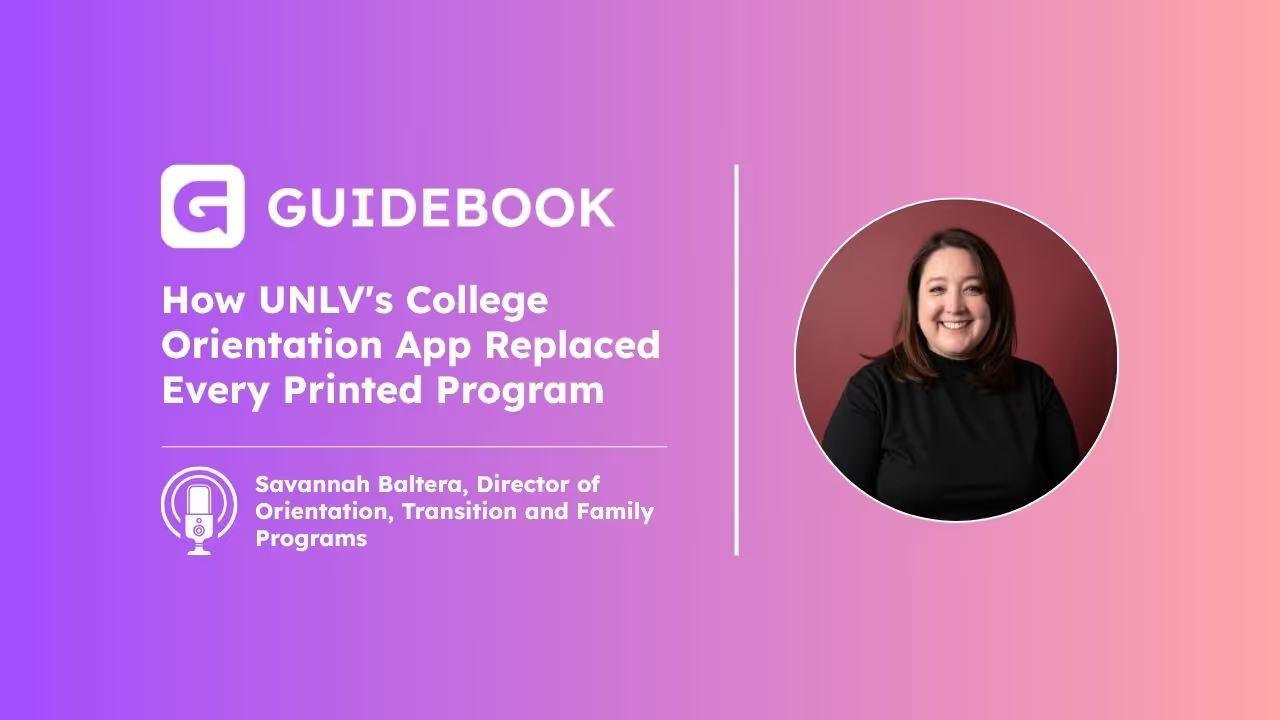
How UNLV's College Orientation App Replaced Every Printed Program
.avif)




How UNLV's College Orientation App Replaced Every Printed Program
Launching a brand-new orientation program for 5,000 incoming students means coordinating hundreds of sessions, dozens of presenters, and a campus full of people who've never been there before…all while trying to make sure every student actually feels welcome and ready to succeed.
Adding a printed program into that mix sounds manageable, until you realize that any change means you’re stuck with stacks of outdated paper (and no easy way to update everyone).
That was the situation Savannah Baltera (Director of Orientation, Transition and Family Programs at the University of Nevada, Las Vegas), was navigating when she launched Rebel Ready Week in 2023.
Her solution was to go fully paperless from day one. What started as a practical decision to avoid printing headaches has since grown into one of the most thoughtful digital orientation strategies we've seen at any institution.
In this post, you'll learn:
- Why UNLV chose a college orientation app over printed programs (and why flexibility, not cost, was the real driver).
- How Guidebook evolved from a digital schedule into a full communication and engagement platform.
- How UNLV uses in-session survey data to make structural program decisions.
- How they take an intention approach to push notifications.
- How session-level attendance data is being connected to first-year student retention outcomes.
- How deploying the app earlier in the student journey reduces friction at every subsequent event.
What Rebel Ready Week Actually Looks Like
Before diving into the strategy, it helps to understand the scale of what UNLV is managing.
Rebel Ready Week is a required, week-long pre-fall orientation program for all incoming first-year students.
It launched in 2023 and has grown into a flagship experience that runs across the entire UNLV campus.
One important aspect of this week-long program is that students navigate largely on their own. That's what makes the logistics so complex, and what makes a well-designed mobile guide so essential.
While Savannah oversees the program through a 12-person core planning committee, the day-of execution involves a much larger network of contributors.
The sheer coordination required across sessions, spaces, presenters, and student leaders means that any communication breakdown has immediate, visible consequences.
Why Going Paperless Was a No-Brainer (But Not for the Reason You'd Expect)
Most institutions that ditch printed programs cite cost savings as the primary motivator. But for UNLV, the real driver was something more pressing: the need for flexibility.
When you're running 500 sessions across a week with 160 presenters, something is always going to change.
A room gets reassigned.
A speaker cancels.
A session gets added at the last minute.
With a printed program, every one of those changes becomes a communication problem you have no good way to solve.
As Savannah put it: "We knew once we printed the program, if anything changed — a room changed, a presenter canceled, or we needed to add something because something changed — we just knew if it was printed, it just became a headache. So it was kind of a no-brainer to insert Guidebook."
The cost savings were welcome. But the ability to update information in real time, and push those updates directly to students' phones, was what made the decision feel inevitable.
From Digital Schedule to Full Engagement Platform
When Savannah first got exposed to Guidebook, she thought of it primarily as an electronic schedule. That framing changed quickly once she and her team got inside the platform.
Though she hadn’t initially planned for features like interactive campus maps, push notifications, session-level QR code check-in scanning, in-session surveys, discussion boards, and photo uploads, they’ve become central to how Rebel Ready Week operates.
"At first I thought it was just for the schedule and that flexibility," she said. "But then, once we got into Guidebook, I really saw that there was so much more than just an electronic schedule. And we were able to enhance the student experience [...] We thought we were just saving money on printing, but then it became so much more."
That shift in perspective is worth sitting with, because it reflects a pattern we see across many institutions: the initial case for a college orientation app is often narrow (replace the printed program), but the long-term value is much broader.
Here's how Savannah now thinks about the role Guidebook’s event technology plays: "I used to think of it as an electronic schedule, but I don't think of it like that anymore. Now I think of it as an app that's like a partner in the student's journey [...] A student can feel comfortable using Guidebook for their whole journey because it's something that's familiar to them that feels like UNLV."
A Phased Rollout That Actually Works
One of the most insightful things Savannah shared during our live webinar is how UNLV approached feature adoption over time, and why they deliberately didn't try to use everything in year one.
In year one, the team focused on three core capabilities:
- Interactive campus map: essential for a large campus with 60 simultaneous sessions and buildings with codes instead of names.
- Push notifications: the primary real-time communication channel.
- Session-level check-in scanning: capturing attendance data at the individual session level
In years two and three, they integrated discussion boards and photo uploads into the app because at that point, the team had a handle on the core program and the Guidebook platform.
This kind of phased adoption is a great strategy that allows universities to launch a brand-new program and learn a new platform, without feeling overwhelmed.
Starting with the features that solve your most immediate operational problems, and layering in engagement features as you gain confidence, keeps the experience manageable for both your team and your students.
The Push Notification Strategy That Saves Hours
Push notifications are one of the most powerful tools in any university orientation app. That said, many teams use them reactively, sending messages when something comes up.
UNLV takes the opposite approach.
Before Rebel Ready Week begins, Savannah’s team builds a full communication plan for every day of the program. That plan includes:
- Morning keynote reminders to start the day with clear direction.
- Meal reminders so students know where and when to eat.
- Afternoon session reminders to keep students on schedule mid-day.
- End-of-day recaps that reinforce what happened and what's coming next.
- Event-specific nudges tied to particular sessions or logistics.
All of these are pre-scheduled before the week begins so the team isn't scrambling to draft messages while managing 5,000 students on campus.
"We're not doing any of that just off the cuff," Savannah explained. "When we build those intentional communication plans in, it's saving us time because it's already done. You can pre-schedule them. It's wonderful. But if you need to adjust, you also have that flexibility right on your phone. That can’t be overstated enough."
That last point matters: pre-scheduling doesn't mean losing agility. When an unexpected situation arises, the ability to send a real-time push notification from a phone is exactly the kind of on-the-ground flexibility that makes the difference.
That flexibility proved its value in a vivid way when an unexpected hurricane warning hit Las Vegas during a program period.
Savannah's team used push notifications to communicate rapidly changing decisions directly to students, reaching them far faster and more reliably than university email ever could.
"This generation of student, they're way more likely to look at that on their cell phone than let me log into my Rebel mail," she noted.
How 4-Question Surveys Changed the Program Structure
One of the most powerful uses of Guidebook at UNLV is the in-session survey.
Rather than relying solely on an end-of-week assessment, Savannah's team attaches a four-question survey to individual sessions throughout Rebel Ready Week. Students complete them in real time, right after the session ends, while the experience is still fresh.
As with every choice that UNLV makes, the decision to do four questions isn't arbitrary; it's intentional.
The reality is that short surveys are more likely to get completed. And when you're collecting feedback across hundreds of sessions, response rate matters enormously.
The payoff from this approach showed up quickly. After year one, session-level survey data revealed that the required small group sessions were consistently scoring lower than other session types.
That granular, session-specific feedback gave Savannah’s team the evidence they needed to make a structural change.
For example, in year one, they put students in small groups and required them to attend sessions as a group.
However, Savannah noted that:
"In that year one, the surveys for those required small groups were not as good as our other sessions," she said. "We used that data, and in years two and three, we actually just got rid of those required small groups."
An end-of-week assessment alone wouldn't have surfaced that insight with the same clarity. The specificity of session-level data is what made the decision defensible, and made the program measurably better in subsequent years.
Using Attendance Data to Study Student Retention
This is where UNLV's use of Guidebook moves from event management into institutional research. And it's the part of this story that should get the attention of anyone in enrollment management.
Because Guidebook captures attendance at the individual session level via QR code scanning, Savannah’s team can see exactly which sessions each student attended across the full week. That event app data becomes the foundation for a longitudinal student retention analysis.
The team is:
- Correlating session attendance patterns with first-year to second-year retention rates.
- Looking at students who attended 3 sessions versus 15 versus 25
- Tracking whether those patterns predict whether students return for their sophomore year.
They're also segmenting by residential versus commuter students, given that UNLV is an 80% commuter campus.
"By using the data that Guidebook provides, we're able to drill down to really any level we want," Savannah explained. "We can sort students who live on campus versus our commuter students...]We can look at the patterns of those residential students versus commuter students at Rebel Ready Week to then look at whether that's affecting their retention."
The good news is first-year student retention rates have increased year-over-year since Rebel Ready Week launched.
Savannah is careful not to claim direct causation (orientation is one of many factors) but the directional trend is meaningful, and the data infrastructure to study it is already in place.
The long-term goal is even more ambitious: tracking the first Rebel Ready Week cohort from 2023 all the way through to graduation.
"I'm really excited to see where we can get to once that first cohort graduates. How does their pattern and behavior through their whole UNLV journey link back to their attendance at Rebel Ready Week or not?"
That's a question most orientation programs can't yet answer. UNLV is building toward being able to.
Why the App Spans the Entire Pre-Enrollment Journey
Rebel Ready Week is the flagship use case, but it's not the only one.
UNLV now uses Guidebook for prospective student open houses (Rebel Preview) and is launching it for summer orientation this year.
The reasoning behind this expansion is strategic:
- When a prospective student downloads the app for a Rebel Preview event as a junior in high school, they arrive at summer orientation already knowing how to use it.
- When they show up for Rebel Ready Week as an incoming first-year student, the app feels familiar and it’s not another new tool they have to figure out.
That continuity reduces onboarding friction at every event, which matters when you're trying to make a strong first impression on 5,000 new students simultaneously.
"If we have a student who's maybe a junior in high school who downloads our Guidebook at Rebel Preview... a year or so later they come to orientation... then they're coming to Rebel Ready Week," Savannah said. "That was for me the biggest reason to use Guidebook through that whole student journey. It was for the student experience."
The app becomes a consistent, branded communication channel that students associate with UNLV.
It’s distinct from email, distinct from social media, and more reliable than either for time-sensitive logistics.
By the Numbers
Here's a quick look at UNLV’s campus and events:
- 5,000+ students attend Rebel Ready Week annually, and attendance is required.
- ~500 passport sessions are offered across the five-day week.
- Up to 60 sessions run simultaneously in a single one-hour block during peak programming.
- 100 orientation leaders are hired to support the student experience.
- 160 unique presenters deliver passport sessions and keynotes throughout the week.
- 150 volunteers support wayfinding and session check-in scanning.
- 12-person core committee oversees the full planning process.
- Average of 15 passport sessions per student (the baseline Savannah uses for retention correlation analysis).
- 80% commuter campus (UNLV's population is predominantly commuter, which shapes how engagement data is segmented)
- First-year retention rates increasing year-over-year since Rebel Ready Week launched in 2023
Guidebook Features UNLV Uses
Takeaways for Orientation Professionals
If you're running a large-scale orientation program, or planning to launch one, here's what UNLV's three-year journey offers as a practical playbook:
- Start with the features that solve your most immediate pain point. UNLV launched with maps, push notifications, and check-in scanning. Everything else came later. A phased approach prevents overwhelm and keeps the team focused on what matters most in year one.
- Build your push notification plan before the event starts. Map out every message for the week (morning reminders, meal prompts, afternoon sessions, etc.) and pre-schedule them. Reserve real-time sends for unexpected situations. This saves hours and ensures students always know what's happening.
- Use short, session-level surveys instead of relying solely on end-of-event feedback. Four questions per session, collected in real time, gives you the granular data to make structural decisions. UNLV eliminated an entire program component based on this data, something a single end-of-week survey couldn't have surfaced as clearly.
- Deploy the app earlier in the student journey to reduce friction at your flagship event. If students encounter the app at an open house or preview day, they arrive at orientation already knowing how to use it. That familiarity translates directly into a smoother day-one experience.
- Use session-level attendance data for retention analysis, not just reporting. Segment students by attendance patterns and track their outcomes over time. This transforms event data into institutional research with real strategic value.
- Treat the app as a distinct communication channel, not a replacement for email. Students are more likely to engage with a push notification than a university email, especially for time-sensitive logistics. Position the app as the place where timely, logistical, and actionable information lives.
Advice for Universities Switching From Paper to Digital Orientation
For institutions still on the fence about making the shift to an orientation app, Savannah’s advice is refreshingly direct:
"I think my biggest piece of advice, or if I could tell past me, would be just to jump in and start. I definitely had reservations about whether the students would adapt to using an app instead of a traditional paper program. [...] I think just let go of those apprehensions and just get in there. [...] Once you're in there, the guides, the app — it's all really easy to use.”
Three years in, UNLV's experience backs that up.
If you're looking to move beyond printed programs and build a digital orientation experience that actually drives student engagement and retention, we'd love to help. You can start building your app or book a demo with one of our product experts.
FAQ: Using a Mobile App for College Orientation
[faq]
Q: How do universities use mobile apps for student orientation?
A: Universities use orientation apps to replace printed programs, manage real-time schedule changes, send push notifications, track session attendance via QR code scanning, collect in-session survey feedback, and build engagement through features like discussion boards and photo sharing. At UNLV, Guidebook powers all of these functions across a five-day, 5,000-student program.
Q: How can I eliminate printed programs for college orientation?
A: The most compelling case for going paperless isn't just cost savings, it's flexibility. Printed programs become outdated the moment anything changes. A mobile orientation app lets you update room assignments, add sessions, and push real-time notifications to students without reprinting anything. UNLV made this shift from day one of Rebel Ready Week and hasn't looked back.
Q: How do you use push notifications effectively during a college orientation event?
A: The most effective approach is to build a pre-scheduled communication plan before your event begins, covering morning reminders, meal prompts, afternoon session alerts, end-of-day recaps, and logistics nudges. Pre-scheduling saves time and ensures consistent communication throughout the day. Reserve real-time sends for unexpected changes or urgent situations.
Q: How can orientation programs use attendance data to improve student retention?
A: By capturing session-level attendance through QR code scanning, you can build a picture of how individual students engaged with the program (how many sessions they attended, which types, and when). Correlating those patterns with first-year to second-year retention rates lets you identify which engagement behaviors predict student success, and target support accordingly.
Q: What's the best way to collect feedback during a college orientation session?
A: Keep surveys short (four questions or fewer) and tie them to individual sessions rather than relying solely on an end-of-event assessment. Real-time, session-level feedback gives you the specificity to make structural decisions. UNLV used this approach to identify and eliminate an underperforming program component that a single end-of-week survey would not have surfaced as clearly.
Q: How do you get students to actually use an orientation app?
A: Deploy the app earlier in the student journey. UNLV uses Guidebook for prospective student open houses, so students encounter the app before they ever arrive at orientation. By the time they attend Rebel Ready Week, the app already feels familiar. That familiarity reduces day-one friction and increases engagement throughout the program.
Q: How do large universities manage orientation programs with hundreds of simultaneous sessions?
A: Operational scale requires tools that give you real-time visibility and control. UNLV runs up to 60 sessions simultaneously during peak programming blocks, with 150 volunteers handling wayfinding and check-in scanning. Guidebook's session-level QR scanning, interactive campus map, and push notification system make it possible to coordinate that complexity without everything running through a central bottleneck.
Q: Can a college orientation app work for commuter-heavy campuses?
A: Yes, and in some ways, it's even more valuable. Commuter students are less likely to be on campus outside of scheduled programming, which means a reliable mobile communication channel matters more, not less. UNLV's 80% commuter population is one of the reasons Savannah’s team segments retention data by residential versus commuter status, and it's shaped how they think about the app as a connection tool for students who aren't living on campus.
[/faq]

Get the Mobile App Playbook
A short guide to running the whole student journey in one app. No fluff, just what works.
for higher ed
Campus
Playbook
A practical guide to building a connected campus experience.
Free playbook
The Mobile App Playbook for Universities
Students decide if they belong long before they set foot on campus. This playbook shows how to win them over from the first visit through graduation.
- Grow enrollment and boost recruitment
- Increase belonging and retention
- Run every event from one branded app
By submitting, you agree to our Privacy Policy.
You're in.
.png)

%20(1).avif)