Campus apps by department
Admissions, orientation, student life, and more — one campus app that works across departments.

Campus apps by department
Admissions, orientation, student life, and more — one campus app that works across departments.
Build unlimited event apps on one license
One partnership for unlimited campus events — orientation, tours, student life, and everything in between.
Build unlimited event apps on one license
One partnership for unlimited campus events — orientation, tours, student life, and everything in between.
Compare event app platforms
See how Guidebook stacks up against other event app and registration platforms.
Compare event app platforms
See how Guidebook stacks up against other event app and registration platforms.
Event apps for nonprofit and community programs
Give members, volunteers, and donors one branded app for conferences, fundraisers, and year-round community.
Event apps for nonprofit and community programs
Give members, volunteers, and donors one branded app for conferences, fundraisers, and year-round community.
Campus integrations and an open API
Connect Guidebook with the campus systems, APIs, and tools your team already uses.
Campus integrations and an open API
Connect Guidebook with the campus systems, APIs, and tools your team already uses.
Event apps for corporate and enterprise teams
Internal meetings, offsites, and large-scale corporate events — with the branding and control enterprise teams need.
Event apps for corporate and enterprise teams
Internal meetings, offsites, and large-scale corporate events — with the branding and control enterprise teams need.
Create a branded event app with no coding
Put schedules, maps, resources, and updates in every attendee's pocket — built for campus events and programs.
Create a branded event app with no coding
Put schedules, maps, resources, and updates in every attendee's pocket — built for campus events and programs.
Launch a branded, white-label event app
A white-label event app with your branding, your content, and your attendee experience — no coding required.
Launch a branded, white-label event app
A white-label event app with your branding, your content, and your attendee experience — no coding required.
Everything in the Guidebook platform
Explore the features event teams use to engage attendees before, during, and after the event.
Everything in the Guidebook platform
Explore the features event teams use to engage attendees before, during, and after the event.
One app for in-person and virtual attendees
The same schedule, networking, and updates whether people are in the room or joining remotely.
One app for in-person and virtual attendees
The same schedule, networking, and updates whether people are in the room or joining remotely.
Event apps built for associations
Annual meetings, chapter events, and member engagement — without rebuilding a new app every year.
Event apps built for associations
Annual meetings, chapter events, and member engagement — without rebuilding a new app every year.
A branded event website that matches the app
Promote the event, collect interest, and keep branding consistent from the first click to check-in.
A branded event website that matches the app
Promote the event, collect interest, and keep branding consistent from the first click to check-in.
Plan, run, and measure events on one platform
App, registration, badges, and websites in one workflow — so planning isn't a pile of disconnected tools.
Plan, run, and measure events on one platform
App, registration, badges, and websites in one workflow — so planning isn't a pile of disconnected tools.
Keep members engaged between events
One branded app for the conference and everything that happens the other 51 weeks of the year.
Keep members engaged between events
One branded app for the conference and everything that happens the other 51 weeks of the year.
The conference app attendees actually use
Schedules, maps, networking, and live updates for annual meetings, summits, and multi-day conferences.
The conference app attendees actually use
Schedules, maps, networking, and live updates for annual meetings, summits, and multi-day conferences.
Registration that feeds your app and badges
Collect registrations, payments, and attendee data in the same platform as your event app.
Registration that feeds your app and badges
Collect registrations, payments, and attendee data in the same platform as your event app.
Design and print event badges in one place
Custom badges, QR check-in, and on-site printing — without a separate badge vendor.
Design and print event badges in one place
Custom badges, QR check-in, and on-site printing — without a separate badge vendor.
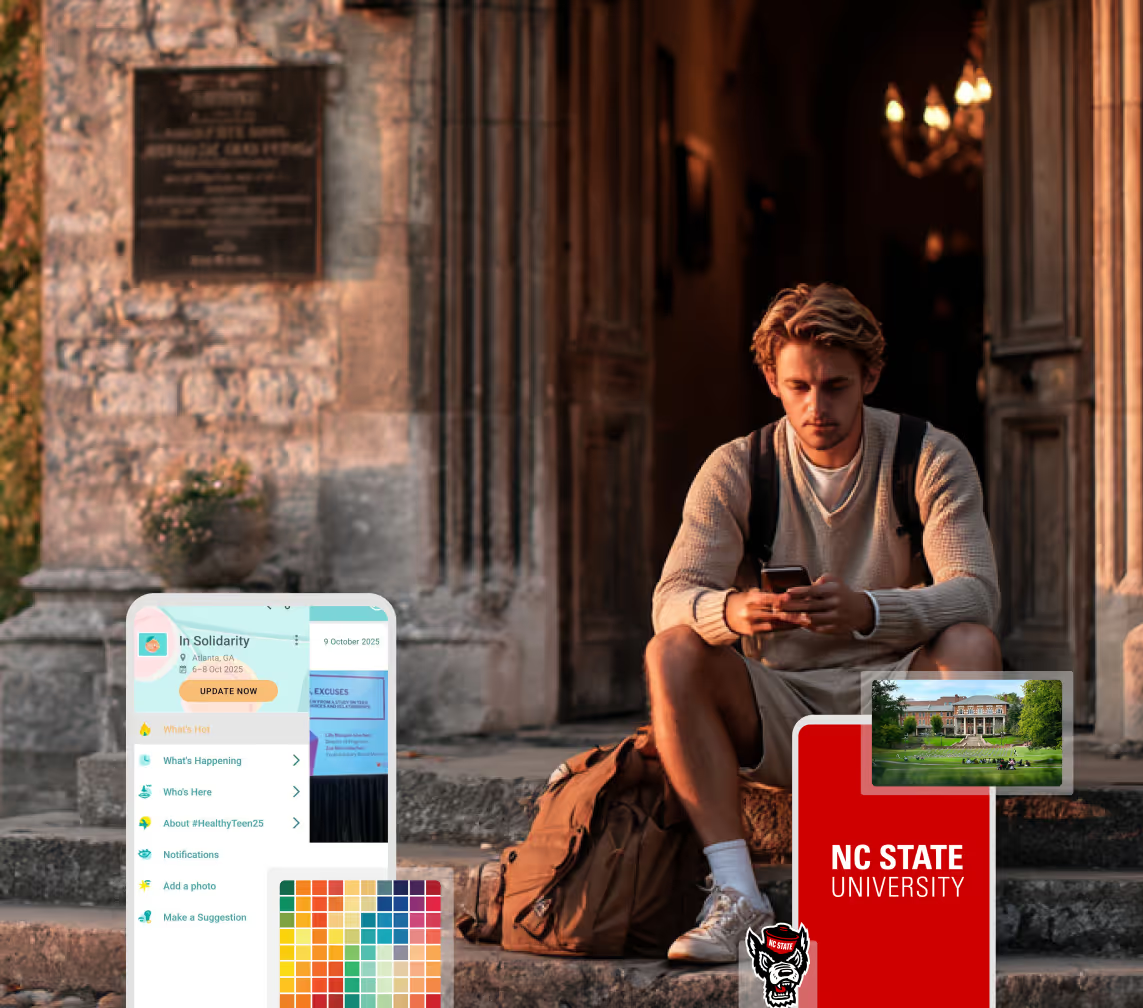
A Smaller School?
Deliver a polished, branded event experience without a large team or a big budget.
A Smaller School?
Deliver a polished, branded event experience without a large team or a big budget.
Running Family Programs?
Give families everything they need, from schedules and maps to real-time updates, all in one place.
Running Family Programs?
Give families everything they need, from schedules and maps to real-time updates, all in one place.
Coordinating Move-In Day?
Share updates, manage events, and keep students informed from move-in through the academic year.

Coordinating Move-In Day?
Share updates, manage events, and keep students informed from move-in through the academic year.
Offering Campus Tours?
Deliver branded, self-guided tour experiences with interactive maps and rich media, available 24/7.

Offering Campus Tours?
Deliver branded, self-guided tour experiences with interactive maps and rich media, available 24/7.
Organising a Career Fair?
Simplify logistics for students, employers, and Career Services staff with one easy-to-use app.
Organising a Career Fair?
Simplify logistics for students, employers, and Career Services staff with one easy-to-use app.
Managing Alumni Events?
Plan reunions, regional events, and fundraising campaigns with an app built for alumni engagement.
Managing Alumni Events?
Plan reunions, regional events, and fundraising campaigns with an app built for alumni engagement.
Boost Student Engagement
One hub for schedules, resources, and events that keeps students connected throughout the academic year.
Boost Student Engagement
One hub for schedules, resources, and events that keeps students connected throughout the academic year.
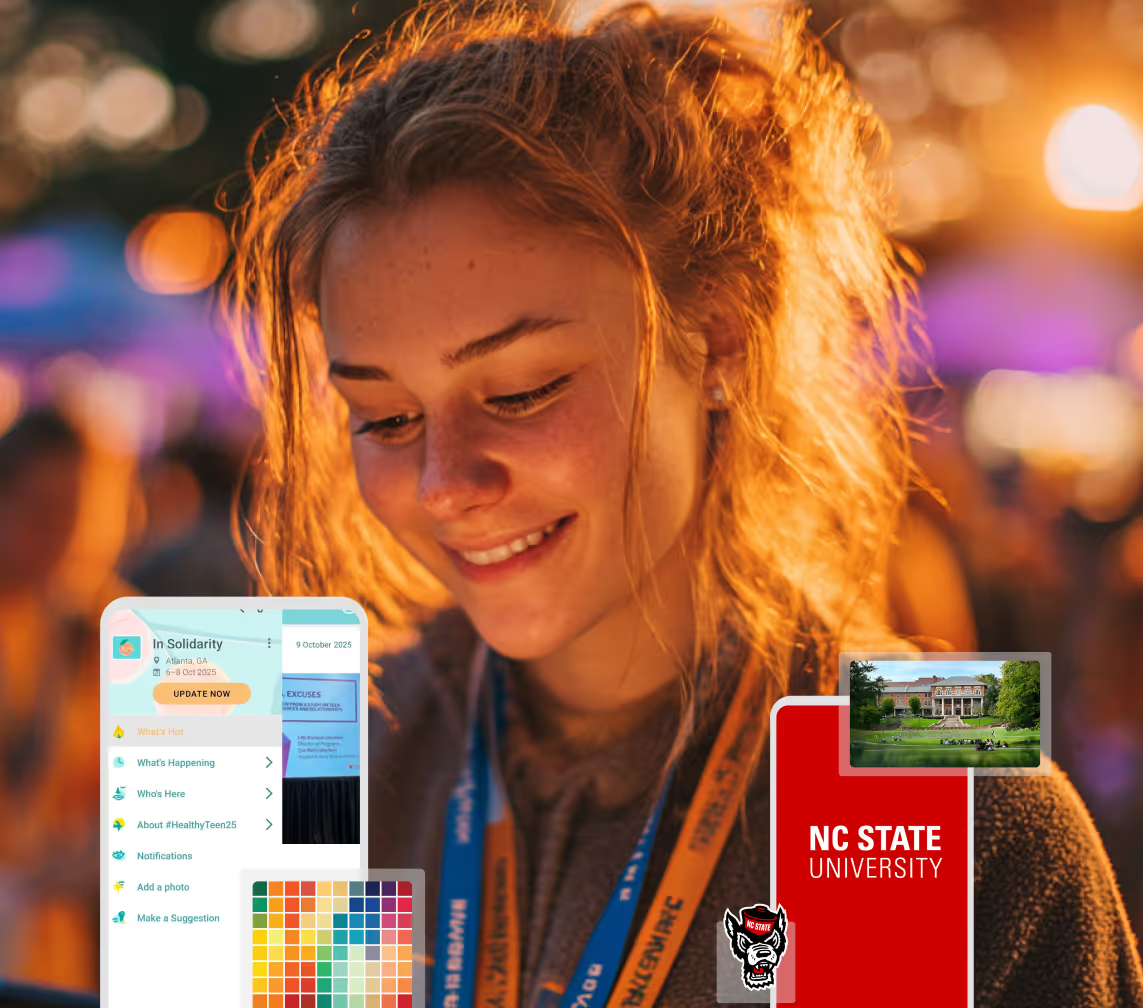
Planning Orientation?
Help new students feel prepared from day one with schedules, campus resources, and real-time updates in one app.
Planning Orientation?
Help new students feel prepared from day one with schedules, campus resources, and real-time updates in one app.
Running Admissions Events?
Manage open houses, tours, and yield events with a branded app that saves time and engages prospective students.

Running Admissions Events?
Manage open houses, tours, and yield events with a branded app that saves time and engages prospective students.
Get a custom Sponsorship Package Template
Stop starting from scratch. Grab free templates that helWe'll build a tailored sponsorship package with suggested pricing, tiers, and benefits..for your specific event.p you build professional sponsorship packages and close deals faster.
Get a custom Sponsorship Package Template
Stop starting from scratch. Grab free templates that helWe'll build a tailored sponsorship package with suggested pricing, tiers, and benefits..for your specific event.p you build professional sponsorship packages and close deals faster.
Plan Your Next Event Without Missing a Beat.
From venue selection to post-event wrap-up, this free checklist walks you through every step (so nothing falls through the cracks).
.avif)
Plan Your Next Event Without Missing a Beat.
From venue selection to post-event wrap-up, this free checklist walks you through every step (so nothing falls through the cracks).
Real Results From Real Events
100,000+ organizations trust Guidebook. See exactly how universities, associations, enterprises, and more put it to work.

Real Results From Real Events
100,000+ organizations trust Guidebook. See exactly how universities, associations, enterprises, and more put it to work.
Flexible pricing for every event size
Find the perfect plan for your needs, from intimate gatherings to large-scale conferences.

Flexible pricing for every event size
Find the perfect plan for your needs, from intimate gatherings to large-scale conferences.
Join our event experts
Watch on-demand webinars and join live sessions with industry leaders sharing best practices for event success.
.avif)
Join our event experts
Watch on-demand webinars and join live sessions with industry leaders sharing best practices for event success.
Guidebook in Action
Book a personalized walkthrough and discover how we help event teams create better attendee experiences.
Guidebook in Action
Book a personalized walkthrough and discover how we help event teams create better attendee experiences.
Best Event Management Software for Higher Education in 2026
%20(1).avif)




.avif)
Best Event Management Software for Higher Education in 2026
You're not planning a trade show. You're not managing exhibitor booths or selling sponsor packages. You're running the events that decide whether a student enrolls, whether they show up in August, and whether they feel like they belong when they do.
Open Houses. Admitted Student Days. Orientation. Welcome Week. Campus Visits. These aren't corporate events with a campus backdrop. They're the enrollment funnel in action. And the software you choose to run them matters more than most teams realize.
This guide covers the top event management software options for higher education teams in 2026: what each does well, where each falls short for the higher ed use case, and how to make a decision your admissions and orientation directors will actually thank you for.
What "event management software" actually means for higher ed
What is event management software for higher education?
Event management software for higher education is a platform that helps admissions, orientation, and student affairs teams plan, communicate, and run the student-facing events that drive enrollment and belonging. In higher ed, this typically means Open Houses, Admitted Student Days, Orientation programs, Welcome Week, Campus Visit days, and yield events. Unlike general event platforms built for conferences or corporate meetings, higher ed event software needs to serve Gen Z students on mobile, connect across the enrollment year rather than a single event, and be owned and operated by a functional team without IT involvement.
That last part matters more than it sounds.
Many teams discover this the hard way. They license a platform that looks right in the demo, then spend three months waiting on IT to configure it, only to launch a week before Admitted Student Day with a half-built experience that frustrates students and stresses staff.
The right tool for higher ed isn't just a feature checklist. It's about who can own it, when it's ready, and whether students actually use it on the day that counts.
What to look for before you choose
Before comparing platforms, get clear on five things specific to the higher ed use case.
Mobile-native design. There's a difference between a platform that has a mobile view and one that was built for mobile from the start. Gen Z students are on their phones. They won't navigate a portal or open a PDF schedule. If the app experience feels like a desktop website that's been squeezed onto a screen, adoption will disappoint.
Team ownership without IT dependency. Admissions and orientation teams operate on tight timelines. If launching or updating your event app requires an IT ticket, a consultant, or a six-month implementation, that's a problem. Look for platforms your team can configure, publish, and update independently.
Connected across the enrollment year. The best higher ed platforms connect the full journey: the prospective student at an Open House in October, the admitted student at their Admitted Student Day in March, the incoming student at Orientation in June, the new student at Welcome Week in August. Platforms built for one-off events make you rebuild from scratch every time.
Real-time update capability. Campus events change. A room flips, a speaker cancels, a session moves. You need to push a notification and update the schedule in real time, without reprinting anything or sending a panicked email that half the students won't open.
Analytics tied to outcomes. App downloads are a vanity metric. What you need to know is whether students who engaged with the app showed up, deposited, and enrolled. Look for platforms that give you session engagement data and attendance tracking, not just download counts.
The top event management software options for higher ed in 2026
Guidebook
Guidebook is purpose-built for higher education admissions and orientation. It's the only platform in this list designed specifically around the student enrollment journey rather than the conference or corporate event market.
Admissions and orientation teams own it end-to-end. No IT tickets for setup. No implementation consultants. A team can build, launch, and update a guide on their own timeline, which matters when Admitted Student Day is six weeks away and your IT department has a three-month queue.
The results that matter most to enrollment leadership: Indiana Tech used Guidebook for their Admitted Student Day and saw yield climb from 40% to 82% over three years. Their preparation time dropped from 400 staff hours across a team of five down to 25 hours with a team of two. Printing costs that had reached $4,350 per event were cut by roughly 29%, a four-figure saving per event.
Andrea Crilly, Assistant Director of Admissions for Campus Experience at Indiana Tech, oversaw that shift. The change wasn't just operational. The student experience got better, engagement went up, and yield numbers reflected it.
Northeastern University's admissions events team saw similar gains after switching to Guidebook for their Boston Welcome Days, which bring in around 550 students and 1,600 total guests per day across six sessions. Leilani Potgieter, Events Assistant in Northeastern's Admissions Events team, described what changed for her as the person building and maintaining the guide: "It's so much easier now doing this than making the physical agendas. I was able to take our preview day guide from last year, put it in for preview day this year, just change some information. It took me a quarter of the time than it did to even make the initial Excel sheet to upload."
Northeastern's post-event survey feedback on their first Guidebook Welcome Days was unambiguous: every comment about the app was positive. No complaints about the agenda. No confusion about the schedule. Students and guests were navigating a complex multi-college, multi-track event with confidence.
Guidebook connects Open Houses, Admitted Student Days, Orientation, Welcome Week, and Campus Visits in a single branded, mobile-native app your students already trust by the time they arrive in August.
What Guidebook doesn't do: catering management, venue sourcing, vendor contracts, or full registration and ticketing suites. If your primary need is a complex conference registration system, you'll want to look elsewhere. But for the events that drive enrollment, it's the most purpose-fit option in this list.
See the Indiana Tech case study for the full breakdown. And if you want to see what it looks like for higher ed teams specifically, explore Guidebook for higher ed.
Best for: Admissions and orientation teams at mid-size to large universities running yield events, Admitted Student Days, Orientation, and Welcome Week.
Webex Events (formerly Socio)
Webex Events, rebranded from Socio after Cisco's acquisition, is a full-featured event app platform with strong name recognition in the higher ed market. Teams evaluating event apps for orientation or admitted student days will encounter it during their search, and it does a lot well: session scheduling, attendee networking, live Q&A, and analytics.
The challenge for admissions and orientation teams is the same one that comes up with other enterprise platforms: it's built for the conference and corporate event market, and that origin shapes the product. The feature set is broad. The setup process reflects that breadth. Teams running yield events or Orientation on tight timelines typically find themselves configuring capabilities they don't need while the student-facing design priorities they do need (branded mobile experience, enrollment-year continuity, team ownership without IT) require more effort to achieve.
Cisco's ownership also means Webex Events sits inside a larger enterprise sales and procurement process. For institutions that already run Webex broadly and want a single-vendor relationship, that's a reasonable consideration. For admissions and orientation teams evaluating on fit and timeline, it tends to add friction rather than remove it.
See how Guidebook compares to Webex Events for the higher ed use case.
Best for: Institutions with existing Webex infrastructure looking for a consistent single-vendor event platform, or teams running large academic conferences where networking and live Q&A are central to the event experience.
Whova
Whova is a strong option for professional conferences and academic gatherings. Its networking features, in-app messaging, and agenda tools are well-designed for the faculty member or researcher attending a multi-day conference.
For admissions and orientation teams, the fit is narrower. Whova's design and default feature set are oriented toward professional conference-goers, not incoming students navigating a campus for the first time. Teams who've used it for enrollment events often find themselves working around the tool's conference-native assumptions rather than working with it.
If your institution hosts academic conferences or faculty-facing events and wants one tool for all of them, Whova is worth a look. For yield events and Orientation, the enrollment-focused design of a purpose-built higher ed platform will serve you better.
See how Guidebook compares to Whova for higher ed teams.
Best for: Academic conferences, research symposia, and faculty or professional development events.
Sched
Sched is a lightweight schedule and agenda management tool that's found a niche at academic conferences, unconferences, and faculty-led events. It's genuinely simple to use, which is its main selling point: teams can get a schedule published quickly, attendees can build personal agendas, and session feedback is built in.
For admissions and orientation teams, Sched's simplicity is also its limitation. It's a schedule tool, not a student experience platform. There's no meaningful mobile app beyond agenda browsing, no push notifications for real-time schedule changes, no campus maps or wayfinding, and no way to connect the experience across multiple events in the enrollment year. A student who uses Sched for an Open House has no continuity into their Admitted Student Day or Orientation.
Teams that need a quick, no-frills way to publish a conference agenda will find Sched fit for purpose. Teams that need their event software to move the needle on yield or belonging will find it falls well short of the job.
See how Guidebook compares to Sched for higher ed teams.
Best for: Academic conferences, faculty symposia, and internal institutional events where a simple published schedule is the primary deliverable.
Cvent
Cvent is one of the most established enterprise event platforms on the market. It handles large-scale conference logistics well: event registration, exhibitor management, hotel room blocks, multi-track agendas, and post-event reporting at scale.
For certain large institutional events, particularly academic conferences or research symposia where registration, abstract submissions, and attendee management are the core job, Cvent has real depth.
The challenge for admissions and orientation teams is fit. Cvent is built for the conference market. Its pricing model, feature set, and implementation pathway reflect that. Teams using it for yield events or Orientation typically find themselves paying for a lot of capabilities they don't use and missing the mobile-first, student-facing design they do need. Implementation tends to require significant IT involvement, which creates timeline risk for enrollment events that can't slip.
See how Guidebook compares to Cvent for the higher ed use case.
Best for: Large institutions with dedicated events staff running academic conferences, large-scale institutional gatherings, or multi-track registration-heavy events.
EventMobi
EventMobi is a flexible event app builder with solid customization options. Teams that want deep control over the look and layout of their event app, and have the technical capacity to configure it, can build a strong experience with EventMobi.
The trade-off is setup time and internal resource investment. EventMobi's strength is flexibility, which means it requires more configuration work to get right for a specific use case. Higher ed teams evaluating it typically weigh whether the customization upside is worth the build time, especially against tighter pre-event timelines.
EventMobi isn't purpose-built for the enrollment journey, so the higher ed framing (yield, melt, belonging, the student lifecycle) has to be built in rather than assumed. Teams that have evaluated both often find that the gap in setup time is the deciding factor.
See how Guidebook compares to EventMobi for the higher ed context.
Best for: Institutions with dedicated technical resources that want high customization flexibility for a range of event types.
25Live (Series25 by CollegeNET)
25Live deserves a mention in any higher ed event software conversation, not because it competes directly with student-facing event apps, but because it's so widely installed on campuses that it often comes up in the same conversation.
25Live is a room and resource scheduling system. It's what facilities managers and registrars use to book classrooms, manage space conflicts, and coordinate academic scheduling across campus. It's been on campuses for decades and is deeply embedded in institutional infrastructure at many universities.
What 25Live doesn't do is create a student-facing event experience. There's no mobile app for admitted students to navigate an Open House. No push notifications when a session room changes. No branded experience that helps a prospective student feel connected to an institution before they enroll. Admissions and orientation teams who encounter 25Live in their evaluation are typically looking at it because their institution already owns it, not because it serves their actual need.
If your campus uses 25Live for room scheduling, it still makes sense to evaluate a dedicated student-facing platform separately. They solve different problems and serve different audiences. Many campuses run both without any conflict.
Best for: Facilities management, registrar operations, and academic space scheduling at the institutional level. Not a student-facing event experience platform.
Eventbrite
Eventbrite is one of the most recognisable names in event management, and higher ed teams have reached for it more than once. It works particularly well for ticketed events, public lectures, alumni gatherings, and smaller departmental programming. Its registration tools are genuinely good, the interface is familiar to most users, and the public discoverability of events listed on Eventbrite's platform has real value for community-facing programming.
For admissions and orientation teams running yield events, Admitted Student Days, or Orientation, Eventbrite has meaningful gaps. It's a ticketing and registration platform, not a student experience platform. There's no branded mobile app that travels with a student through their enrollment journey. No real-time push notifications for schedule changes. No session-level personalisation that helps a nursing major at a multi-college Welcome Day find their specific track. No continuity between an Open House in October and an Orientation in June.
Teams that have tried using Eventbrite for orientation often describe the same pattern: it handles check-in and registration well enough, but once students are on campus the tool runs out of usefulness. Everything that happens inside the event (navigation, schedule changes, engagement, belonging) requires something else.
Eventbrite works well in higher ed as part of a broader toolkit for ticketed or public-facing events. It doesn't replace a purpose-built student experience platform for the events that drive enrollment.
Best for: Ticketed public events, alumni gatherings, community lectures, and departmental programming where registration and discoverability are the primary need.
Anthology Engage (formerly Campus Labs)
Anthology Engage occupies a different part of the campus event landscape than the others on this list. It's primarily a student engagement and campus life platform: clubs, organizations, co-curricular involvement, and recurring student programming.
It shows up in this comparison because many campuses run it for student life while separately managing admissions and orientation events in another tool. That fragmentation is a recognized pain point. Teams at institutions using Engage for student affairs often describe admissions events as operating in a separate silo, with different tools, separate communication channels, and no shared view of the student journey.
Engage doesn't position itself as an admissions or orientation events platform, and it doesn't try to be. If your campus already uses it for student affairs, it's worth understanding the boundary: Engage handles the co-curricular side, while your admissions and orientation events need a platform designed for that specific moment in the student lifecycle.
Best for: Student affairs teams managing clubs, organizations, and ongoing campus programming.
Localist (now part of Concept3D)
Localist is a campus event calendar platform widely used by universities to centralise and promote events across departments, student organisations, and the wider campus community. Acquired by Concept3D in 2022, it's an active platform with strong higher ed roots. Institutions including the University of Miami and Bentley University use it as their central public-facing event hub.
Localist's job is event discovery and promotion: aggregating events from across campus into one branded, searchable calendar that students, faculty, staff, and the local community can browse. It handles event submission workflows, approval queues, social sharing, and basic registration. For campuses struggling with fragmented event information spread across departmental websites, it solves a real problem.
Where it differs from a student-facing event app is in what happens on the day. Localist is a calendar and discovery layer, not an in-event experience platform. It doesn't provide a branded mobile app with personalised schedules, real-time push notifications, or campus wayfinding. An admitted student can use Localist to find out that Welcome Day is happening. Once they arrive, they need something else to navigate it.
Some institutions use both: Localist for campus-wide event discovery and a platform like Guidebook for the in-event mobile experience. They solve different problems. Teams evaluating both are often better served by being clear about which problem each tool addresses before the RFP goes out.
Best for: Institutions looking to centralise campus-wide event promotion, reduce fragmentation across departmental calendars, and give students, staff, and the wider community a single place to discover what's happening on campus.
The question higher ed teams actually ask: "Will students use it?"
Every platform comparison eventually comes back to this. You can build the most thoughtfully configured event app in the world. If students don't download it or don't open it, none of it matters.
The institutions seeing the strongest adoption have a few things in common. They launch the app before the event, not the day of. They give students a reason to download it early by making the schedule, campus maps, or session details available only in the app. And they over-communicate in the weeks before: emails, texts, QR codes at check-in, a QR code on the screen at the welcome session.
At one university running a multi-day orientation program, the team reported that a large share of students and families arrived having already downloaded the app the night before. Their question from students at the check-in table wasn't "where's the printed schedule?" It was "where do I go first?" They navigated it themselves.
Gen Z students adopt apps quickly when the app is clearly useful and clearly theirs. The key word is clearly theirs: branded to the institution, not looking like a generic third-party tool. Students who see their university's logo, colors, and name in the app experience connect it to the institution, not to a vendor. That matters for belonging, and it matters for adoption.
What the right tool actually changes
The operational wins are real. Less printing. Fewer panicked emails when a room changes. Less staff time in the weeks before an event. Indiana Tech went from 400 hours of event preparation to 25.
But the number that tends to get leadership's attention is yield.
When admitted students have a better experience at their Admitted Student Day, the correlation with deposit decisions is measurable. A student who arrives confused, can't find their session, and misses the financial aid table because the printed schedule was already out of date is more likely to quietly choose somewhere else. A student who walks in with a clear app, knows exactly where to be, and feels like the institution is organized and invested in them has a different experience entirely.
Built for enrollment. Not just events.
That's the distinction that matters for higher ed teams. Generic event software will handle the logistics. Purpose-built higher ed software changes the enrollment outcome: one app for every moment that matters, from the first Open House to Welcome Week.
See Guidebook in action for higher ed.
[faq]
Q: What is the best event management software for colleges and universities?
A: The best event management software for higher ed depends on your use case. For admissions and orientation teams running yield events, Admitted Student Days, and Orientation programs, Guidebook is purpose-built for the enrollment journey and designed to be owned by functional teams without IT involvement. Platforms like Cvent and Whova serve the conference market well but aren't designed around the student enrollment lifecycle. The most important criteria for higher ed teams are mobile-native design, team ownership, real-time update capability, and connection across the full enrollment year.
Q: How is higher ed event management software different from general event management software?
A: General event management software is typically designed for corporate conferences, tradeshows, or professional gatherings: exhibitor management, paid ticketing, abstract submissions, and multi-track registration. Higher ed event management software needs to serve a different job entirely: converting admitted students, reducing summer melt, building belonging at Orientation, and connecting the student experience across the full enrollment year. The audience is different (Gen Z students on mobile, not conference professionals), the outcomes are different (yield and retention, not attendee satisfaction scores), and the team running it is different (admissions and orientation professionals, not dedicated events staff).
Q: What features should higher ed teams look for in event management software?
A: Five features matter most for higher ed: mobile-native design that students will actually use on their phones, team ownership so admissions and orientation staff can build and update without IT, real-time push notifications for schedule changes, branded app experiences that reflect the institution, and analytics tied to event attendance and engagement. Registration and exhibitor management features, common in conference platforms, are rarely priorities for admissions and orientation teams.
Q: Can the same event app work for Open House, Orientation, and Welcome Week?
A: Yes, and ideally it should. The best higher ed platforms connect the full enrollment journey in a single branded experience so students aren't downloading a new app for every event. A student who uses the same app at their Open House in October, their Admitted Student Day in March, and their Orientation in June arrives on campus with a familiar tool. That continuity builds trust and reduces the friction that shows up on day one.
Q: How much does event management software for higher ed cost?
A: Pricing varies significantly by platform and institution size. Enterprise platforms like Cvent are typically priced for large-scale conference deployments and tend to carry enterprise-level costs. Purpose-built higher ed platforms tend to be more accessible for admissions and orientation teams operating without conference-scale budgets. Indiana Tech found that their Guidebook subscription cost less than what they'd previously been spending on printing materials for a single event. The honest answer is to request a quote from any platform you're seriously evaluating, and make sure the pricing model fits how you'll actually use it.
Q: Do students actually use event apps, or do they ignore them?
A: Adoption depends heavily on the quality of the app and when it's introduced. Students who receive app access before an event and find something immediately useful (their personal schedule, campus maps, session notifications) adopt at high rates. Institutions that see low adoption typically launched too late or built an experience that didn't feel native on mobile. At institutions using purpose-built higher ed apps, teams consistently report that students adopt the app faster and more naturally than they expected, particularly when the app is branded to the institution rather than looking like a generic third-party tool.
[/faq]

Get the Mobile App Playbook
A short guide to running the whole student journey in one app. No fluff, just what works.
for higher ed
Campus
Playbook
A practical guide to building a connected campus experience.
Free playbook
The Mobile App Playbook for Universities
Students decide if they belong long before they set foot on campus. This playbook shows how to win them over from the first visit through graduation.
- Grow enrollment and boost recruitment
- Increase belonging and retention
- Run every event from one branded app
By submitting, you agree to our Privacy Policy.
You're in.
.png)