Campus apps by department
Admissions, orientation, student life, and more — one campus app that works across departments.

Campus apps by department
Admissions, orientation, student life, and more — one campus app that works across departments.
Build unlimited event apps on one license
One partnership for unlimited campus events — orientation, tours, student life, and everything in between.
Build unlimited event apps on one license
One partnership for unlimited campus events — orientation, tours, student life, and everything in between.
Compare event app platforms
See how Guidebook stacks up against other event app and registration platforms.
Compare event app platforms
See how Guidebook stacks up against other event app and registration platforms.
Event apps for nonprofit and community programs
Give members, volunteers, and donors one branded app for conferences, fundraisers, and year-round community.
Event apps for nonprofit and community programs
Give members, volunteers, and donors one branded app for conferences, fundraisers, and year-round community.
Campus integrations and an open API
Connect Guidebook with the campus systems, APIs, and tools your team already uses.
Campus integrations and an open API
Connect Guidebook with the campus systems, APIs, and tools your team already uses.
Event apps for corporate and enterprise teams
Internal meetings, offsites, and large-scale corporate events — with the branding and control enterprise teams need.
Event apps for corporate and enterprise teams
Internal meetings, offsites, and large-scale corporate events — with the branding and control enterprise teams need.
Create a branded event app with no coding
Put schedules, maps, resources, and updates in every attendee's pocket — built for campus events and programs.
Create a branded event app with no coding
Put schedules, maps, resources, and updates in every attendee's pocket — built for campus events and programs.
Launch a branded, white-label event app
A white-label event app with your branding, your content, and your attendee experience — no coding required.
Launch a branded, white-label event app
A white-label event app with your branding, your content, and your attendee experience — no coding required.
Everything in the Guidebook platform
Explore the features event teams use to engage attendees before, during, and after the event.
Everything in the Guidebook platform
Explore the features event teams use to engage attendees before, during, and after the event.
One app for in-person and virtual attendees
The same schedule, networking, and updates whether people are in the room or joining remotely.
One app for in-person and virtual attendees
The same schedule, networking, and updates whether people are in the room or joining remotely.
Event apps built for associations
Annual meetings, chapter events, and member engagement — without rebuilding a new app every year.
Event apps built for associations
Annual meetings, chapter events, and member engagement — without rebuilding a new app every year.
A branded event website that matches the app
Promote the event, collect interest, and keep branding consistent from the first click to check-in.
A branded event website that matches the app
Promote the event, collect interest, and keep branding consistent from the first click to check-in.
Plan, run, and measure events on one platform
App, registration, badges, and websites in one workflow — so planning isn't a pile of disconnected tools.
Plan, run, and measure events on one platform
App, registration, badges, and websites in one workflow — so planning isn't a pile of disconnected tools.
Keep members engaged between events
One branded app for the conference and everything that happens the other 51 weeks of the year.
Keep members engaged between events
One branded app for the conference and everything that happens the other 51 weeks of the year.
The conference app attendees actually use
Schedules, maps, networking, and live updates for annual meetings, summits, and multi-day conferences.
The conference app attendees actually use
Schedules, maps, networking, and live updates for annual meetings, summits, and multi-day conferences.
Registration that feeds your app and badges
Collect registrations, payments, and attendee data in the same platform as your event app.
Registration that feeds your app and badges
Collect registrations, payments, and attendee data in the same platform as your event app.
Design and print event badges in one place
Custom badges, QR check-in, and on-site printing — without a separate badge vendor.
Design and print event badges in one place
Custom badges, QR check-in, and on-site printing — without a separate badge vendor.
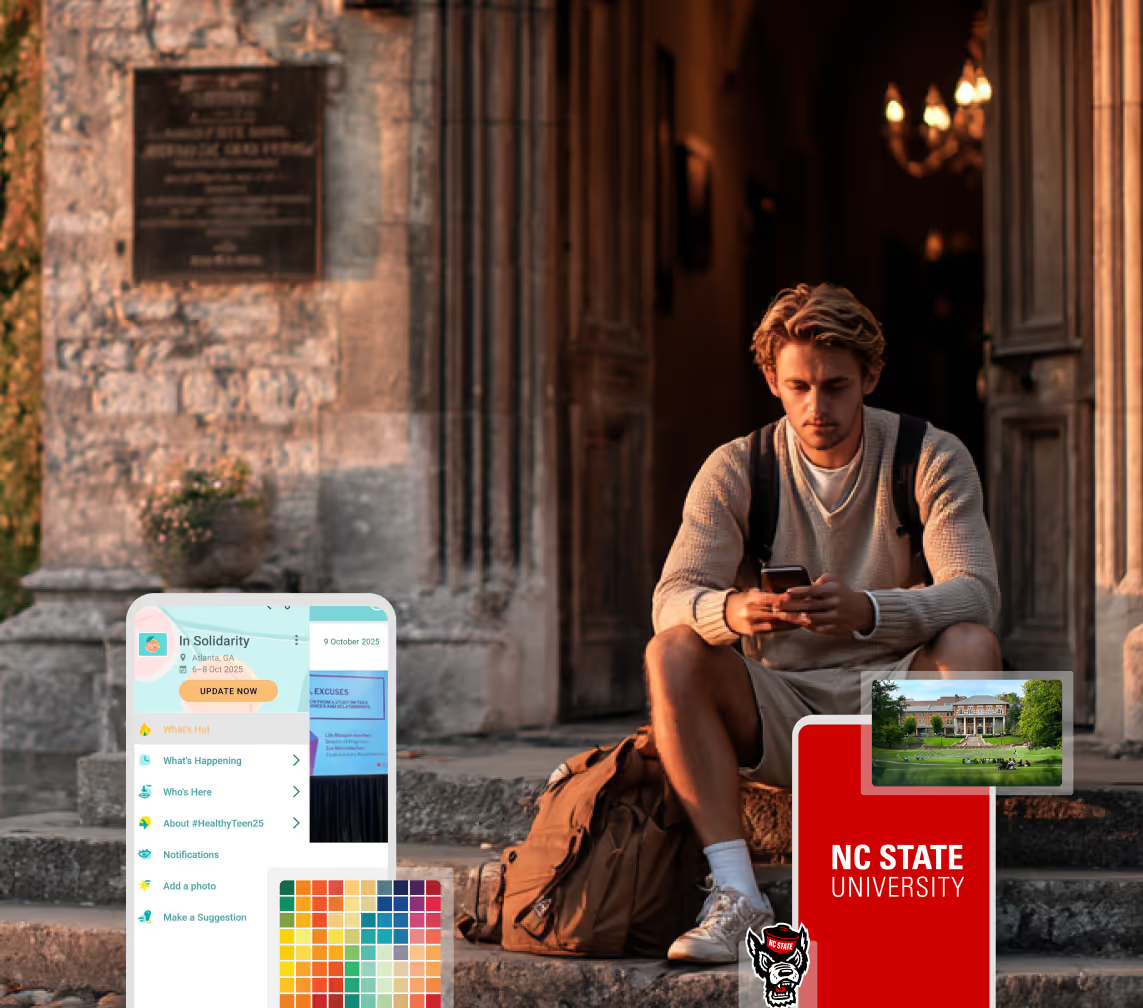
A Smaller School?
Deliver a polished, branded event experience without a large team or a big budget.
A Smaller School?
Deliver a polished, branded event experience without a large team or a big budget.
Running Family Programs?
Give families everything they need, from schedules and maps to real-time updates, all in one place.

Running Family Programs?
Give families everything they need, from schedules and maps to real-time updates, all in one place.
Coordinating Move-In Day?
Share updates, manage events, and keep students informed from move-in through the academic year.

Coordinating Move-In Day?
Share updates, manage events, and keep students informed from move-in through the academic year.
Offering Campus Tours?
Deliver branded, self-guided tour experiences with interactive maps and rich media, available 24/7.

Offering Campus Tours?
Deliver branded, self-guided tour experiences with interactive maps and rich media, available 24/7.
Organising a Career Fair?
Simplify logistics for students, employers, and Career Services staff with one easy-to-use app.
Organising a Career Fair?
Simplify logistics for students, employers, and Career Services staff with one easy-to-use app.
Managing Alumni Events?
Plan reunions, regional events, and fundraising campaigns with an app built for alumni engagement.

Managing Alumni Events?
Plan reunions, regional events, and fundraising campaigns with an app built for alumni engagement.
Boost Student Engagement
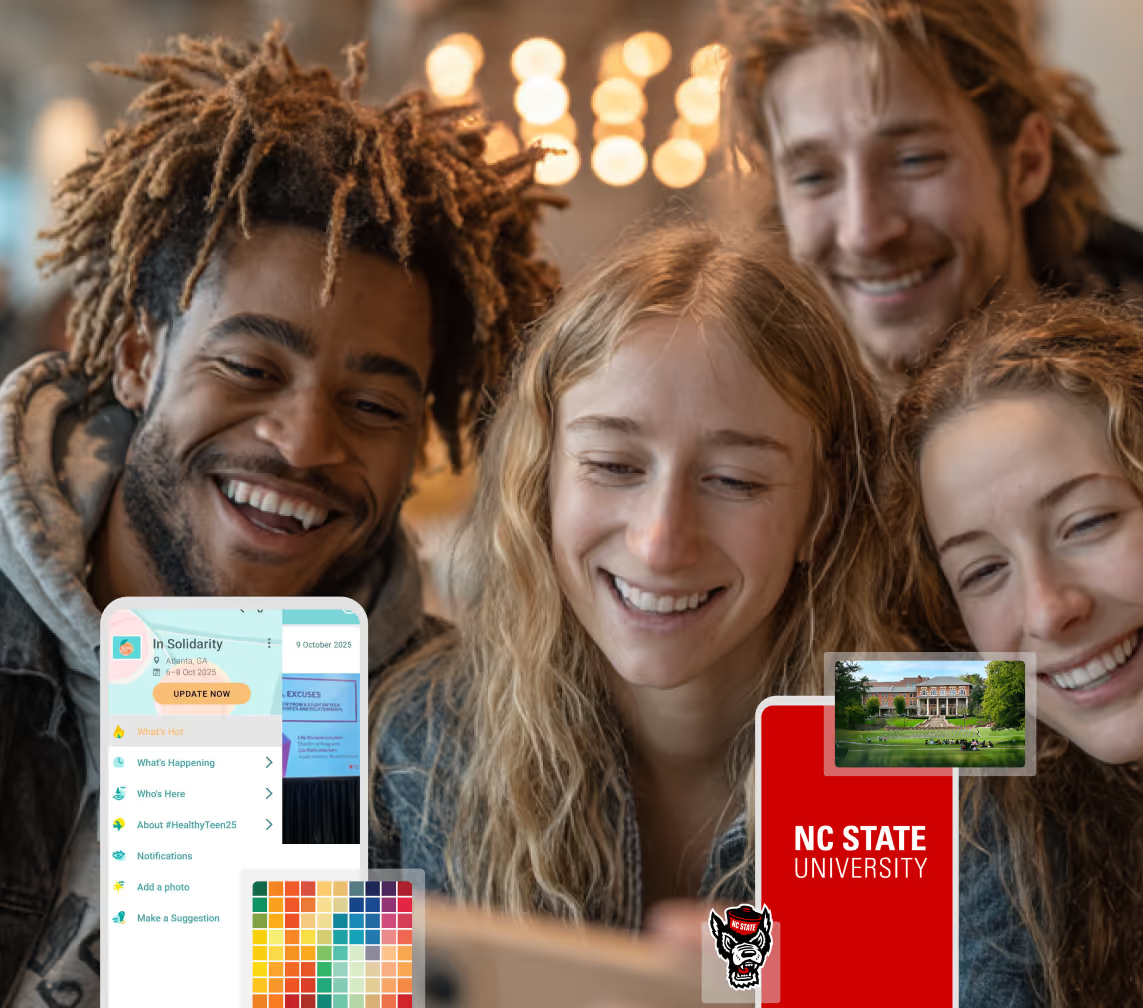
One hub for schedules, resources, and events that keeps students connected throughout the academic year.
Boost Student Engagement
One hub for schedules, resources, and events that keeps students connected throughout the academic year.
Planning Orientation?
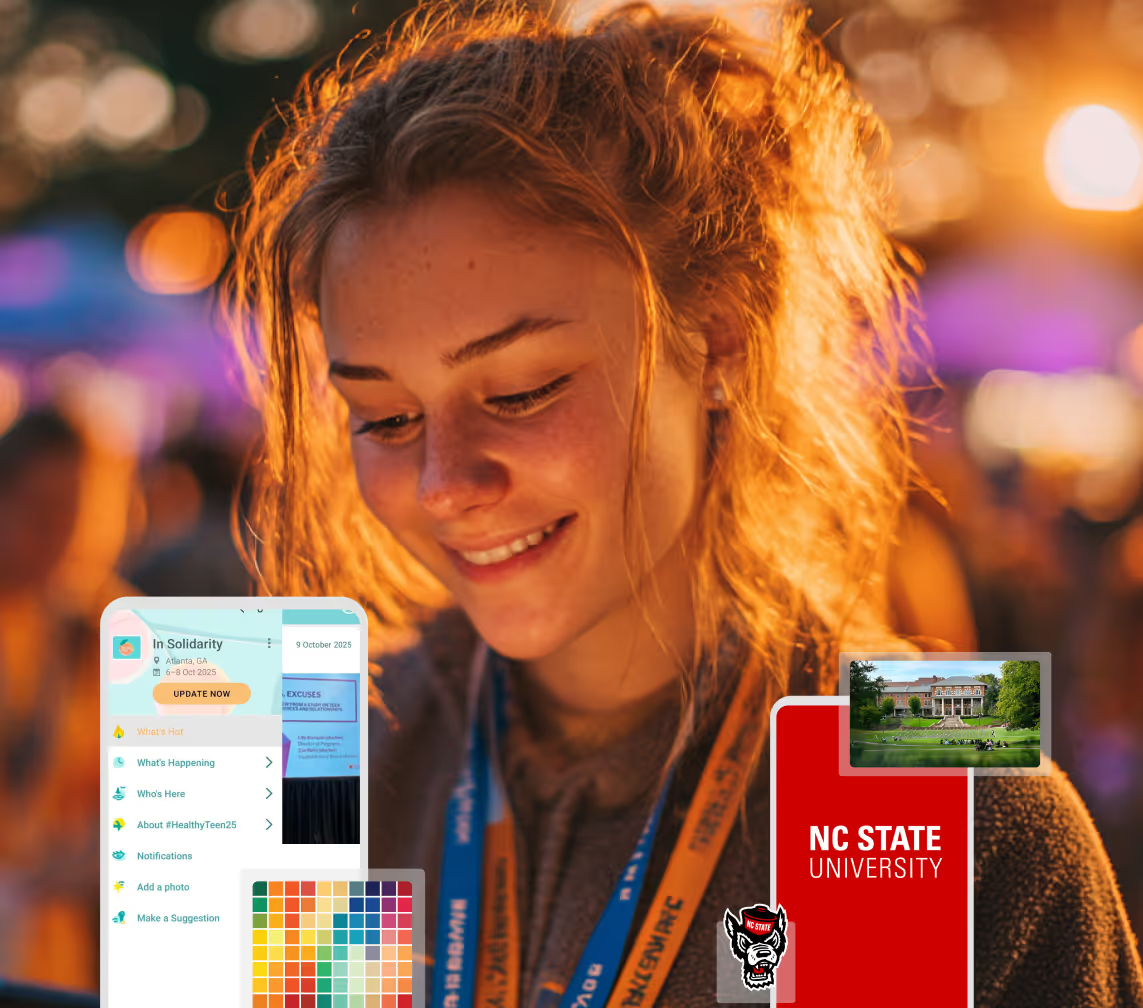
Help new students feel prepared from day one with schedules, campus resources, and real-time updates in one app.
Planning Orientation?
Help new students feel prepared from day one with schedules, campus resources, and real-time updates in one app.
Running Admissions Events?
Manage open houses, tours, and yield events with a branded app that saves time and engages prospective students.

Running Admissions Events?
Manage open houses, tours, and yield events with a branded app that saves time and engages prospective students.
Get a custom Sponsorship Package Template
Stop starting from scratch. Grab free templates that helWe'll build a tailored sponsorship package with suggested pricing, tiers, and benefits..for your specific event.p you build professional sponsorship packages and close deals faster.
Get a custom Sponsorship Package Template
Stop starting from scratch. Grab free templates that helWe'll build a tailored sponsorship package with suggested pricing, tiers, and benefits..for your specific event.p you build professional sponsorship packages and close deals faster.
Plan Your Next Event Without Missing a Beat.
From venue selection to post-event wrap-up, this free checklist walks you through every step (so nothing falls through the cracks).
.avif)
Plan Your Next Event Without Missing a Beat.
From venue selection to post-event wrap-up, this free checklist walks you through every step (so nothing falls through the cracks).
Real Results From Real Events
100,000+ organizations trust Guidebook. See exactly how universities, associations, enterprises, and more put it to work.

Real Results From Real Events
100,000+ organizations trust Guidebook. See exactly how universities, associations, enterprises, and more put it to work.
Flexible pricing for every event size
Find the perfect plan for your needs, from intimate gatherings to large-scale conferences.

Flexible pricing for every event size
Find the perfect plan for your needs, from intimate gatherings to large-scale conferences.
Join our event experts
Watch on-demand webinars and join live sessions with industry leaders sharing best practices for event success.
.avif)
Join our event experts
Watch on-demand webinars and join live sessions with industry leaders sharing best practices for event success.
Guidebook in Action
Book a personalized walkthrough and discover how we help event teams create better attendee experiences.
Guidebook in Action
Book a personalized walkthrough and discover how we help event teams create better attendee experiences.
The Belonging Gap: Why 1 in 4 Deposited Students Vanish Before Move-In
%20(1).avif)




The Belonging Gap: Why 1 in 4 Deposited Students Vanish Before Move-In
- Summer melt affects 10 to 40 percent of deposited and college-intending students, with low-income and first-gen-heavy populations seeing the highest rates.
- The root cause isn't academic cold feet. It's a belonging gap created during the critical post-deposit window.
- Students who receive fragmented, impersonal post-deposit communication are significantly more likely to melt before move-in.
- Bureaucratic friction directly weakens the sense of connection that keeps students enrolled.
- The admissions teams closing the gap aren't sending more emails. They're building a connected pre-arrival experience on the device their students actually use.
Your deposited class is not your enrolled class. Not yet.
Every spring, admissions teams across the country celebrate. Deposit deadlines pass. The numbers look right. Leadership is pleased. And then, slowly, quietly, without a single phone call, students start to drift.
By August, somewhere between 10 and 40 percent of your deposited class won't show up. Not because they found a better school. Not because their financial aid fell through. Because they never felt, in those critical weeks after they said yes, that they actually belonged somewhere.
That's the belonging gap. And it's costing your institution more than you've been told.
Here's what's actually driving it, and what the admissions teams closing it are doing differently.
What Is the Belonging Gap?
What is the belonging gap in college admissions?
The belonging gap is the disconnect between when a student deposits and when (or whether) they arrive on campus. It describes the experience of a deposited student who, during the post-deposit window from May through August, receives generic communication, fragmented information, and no meaningful sense of connection to their future institution. Students in the belonging gap are significantly more likely to melt before move-in. Research synthesized across multiple recent studies confirms that sense of belonging is now one of the strongest predictors of enrollment decisions, not just retention, but whether students show up at all.
The belonging gap isn't a feelings problem. It's an enrollment problem.
Why 1 in 4? Understanding the Melt Numbers
The "1 in 4" headline isn't a worst case. It sits squarely inside the range the research documents, and it's the reality for the populations most admissions teams are working hardest to yield.
Summer melt, the loss of college-intending and deposited students between spring and the start of fall term, runs between 10 and 40 percent. Research from Benjamin Castleman and Lindsay Page, whose summer melt work is housed at Harvard's Center for Education Policy Research, puts the national range at 10 to 20 percent, climbing toward 40 percent for first-generation, low-income, and large-district populations. Those are the students the belonging gap hits hardest.
A recent report from the Institute for Higher Education Policy found that first-year students from historically marginalized populations who received targeted belonging interventions saw a 10 percent increase in retention over one year. That's not a retention program result. That's a downstream consequence of decisions made before a student ever sets foot on campus.
The math matters here. At $40,000 to $50,000 per year in tuition at a mid-size private institution, a class that melts 20 more students than it needed to isn't just a disappointment. It's roughly $4 million in lost revenue over four years. Per cohort. Every year.
It's a gap admissions teams name often. The budget, the staff hours, the energy all pour into getting a student to say yes. Almost nothing goes into making sure that yes actually shows up in the fall.
That gap, between the investment in yield events and the investment in the post-deposit experience, is where the belonging gap lives.
The Three Drivers of Summer Melt (It's Not What You Think)
Most admissions teams attribute melt to external factors. A better financial aid package from a competitor. A family situation that changed. A student who "just wasn't ready."
Those explanations feel true. They're largely not.
Research consistently shows that the students most likely to melt aren't the ones who received a better offer. They're the ones who received a worse experience in the weeks after deposit. Three patterns show up repeatedly.
1. Fragmented information that makes students feel like a record, not a person
After deposit day, the average admitted student receives communication from no fewer than five separate offices. Admissions sends a welcome email. Housing sends a portal login. Financial aid sends a to-do list. The orientation office sends a save-the-date. Each message comes from a different address, links to a different system, and assumes the student knows what the others have already told them.
They don't. And the confusion isn't just annoying. It's alienating.
Craig Johnson, Purdue University's Director of Orientation Programs, described the effect directly: "If you just let students fly as soon as the beginning of the program, there are quite a few students that are gonna find themselves in the wrong place on campus and then just lock up. They'll think, 'I'd rather just sit in the comfort of my room, the one place I am familiar with on campus.'"
That "locking up" doesn't start at orientation. For at-risk students, it starts the first time they try to navigate their housing portal and can't figure out what they're supposed to do next.
2. Bureaucratic friction that signals the wrong thing
Confusing financial aid forms. Course selection systems that require a specific browser. Housing portals that time out. Required documents buried in email threads from two months ago.
Every one of these friction points sends the same message: figuring out this place is going to be hard.
Research from the IHEP is unambiguous on this: students who encounter bureaucratic hassles (confusing financial aid processes, unclear course selection forms) are significantly less likely to remain enrolled compared to peers who feel a strong sense of belonging. The bureaucracy doesn't just frustrate students. It directly erodes the connection that keeps them committed.
The students with the highest resilience to that friction are the ones who already have a sense that they belong, that someone at the institution is paying attention to them specifically. The first-generation student with no campus network, the student from a rural high school whose counselor has never navigated this particular system, the international student trying to make sense of housing timelines: these are the students who encounter the same friction and don't come back from it.
3. Communication that doesn't reach them where they are
Email open rates for admitted students in the post-deposit window run somewhere between 20 and 30 percent. That's not a subject-line problem. That's a channel problem.
The students most likely to melt are not opening their email every morning waiting for information about their future institution. They're on their phones. And when the institution's communication arrives in a channel they've effectively stopped monitoring, the silence reads as indifference.
Emma Young, Head of Student Engagement at King's College London, described the experience of students trying to navigate orientation information from paper schedules and PDFs: "The scope of human error was massive. A student may have downloaded a copy of the PDF, but it could have incorrect information. It was really inconvenient for everyone."
The problem isn't just inconvenience. Inconvenience compounds. A student who downloads the wrong PDF, shows up at the wrong session, and spends 20 minutes trying to find where they're supposed to be has had a specific experience of their new institution. That experience is: this place doesn't have its act together, and I might not either.
What the Belonging Gap Actually Costs
The financial case is straightforward, and admissions teams should be making it loudly to leadership.
Universities spend between $2,000 and $5,000 per admitted student on yield events: Open Houses, Admitted Student Days, Preview Days. That investment is real. It moves the needle. Indiana Tech, a private university in Fort Wayne, ran their Admitted Students Day on scattered paper-based systems before 2022. Their yield from admitted student day attendees sat at 40 percent. After building a connected, mobile-native admitted student experience, that number went to 82 percent, a 105 percent yield increase. Admitted student day attendees went from representing 14 percent of total enrollment to 32 percent, a 128 percent influence increase.
That's a dramatic result. But the underlying mechanic isn't mysterious: students who had a smoother, more connected experience on the day they were being actively recruited were more likely to commit.
Now extend that mechanic to the three months after deposit. If the experience of being a committed student at your institution (before classes start, before move-in, during the window when doubt is highest) is fragmented, impersonal, and friction-heavy, some of your deposited students will find reasons to unmelt.
The belonging gap is not the absence of a single intervention. It's the cumulative effect of a post-deposit experience that never quite says: you're already one of us.
What Closing the Gap Looks Like: Four Practices That Matter
The admissions teams that consistently protect their deposited class aren't sending more emails. They're doing four things differently.
Build one connected experience, not five separate touchpoints
A deposited student's post-deposit journey should feel like one institution reaching them, not five offices independently generating content. That means one app for every moment that matters: a single, branded experience that houses the housing timeline, the orientation save-the-date, the financial aid checklist, and the campus map, all in one place, on the device the student actually uses.
The goal isn't to eliminate email. It's to give students a single place to return to when they have questions, rather than requiring them to remember which email thread had the answer.
Communicate in the window, not just before it closes
The week after deposit day is not when students need to hear from you. The week after deposit day is when they're still excited. The second week of June, when the novelty has worn off and the fall still feels abstract, is when the belonging gap opens.
Map your post-deposit communication to the emotional calendar, not just the logistical one. Students need connection touchpoints at four specific moments: immediately after deposit (excitement reinforcement), mid-June (the drift window), early July (housing and course anxiety), and two weeks before move-in (logistical confidence-building). Reaching students at these moments with relevant, personalized information, rather than blanket emails, is what keeps the gap closed.
Make the first interaction with your institution feel personal, not bureaucratic
The admitted student's first experience of their future institution shouldn't be a login screen. It should be: here's what your first week looks like, here's who you'll meet, here's what you need to know, and here's how to get there.
That experience, delivered on a mobile app that looks like it belongs to the institution rather than a generic portal, is the difference between a student who feels welcomed and a student who feels processed.
Track what you can't see
Most melt happens quietly. No decommit call. No email reply. Just silence that gradually becomes an absence.
The admissions teams with the best melt data are the ones who know, before the final count, which segments of their deposited class are least engaged. They're not waiting for August to be surprised. They're watching engagement in the post-deposit experience (which communications are opened, which sessions are bookmarked, which to-do items are completed) and reaching out specifically to the students who are drifting before the drift becomes a decision.
The Institutions Getting This Right
Two institutions show what this looks like in practice.
Northeastern University ran their Admitted Student Day for 5,700 admitted students with a connected, mobile-native experience. Leilani Potgieter, Events Assistant, described the result: "It was completely seamless for the past fall." The operational benefit (fewer questions fielded by staff, fewer students in the wrong place) is real. But the belonging signal it sends to 5,700 admitted students is the more important outcome.
Indiana Tech's results held up across a second admissions cycle, then a third. Andrea Crilly, Assistant Director of Admissions for Campus Experience, traces the direct line between the quality of the admitted student experience and enrollment outcomes: "Our yield grew tremendously once we began using Guidebook." The mechanism is the same as Northeastern's. A student who had a connected, well-organized, mobile-native admitted student experience was more likely to picture themselves at that institution in the fall.
These aren't outliers. They're the result of a consistent decision: to treat the post-deposit window as an enrollment function, not an orientation logistics problem.
Less Melt. More Moments.
The belonging gap is not a marketing problem. It's not a financial aid problem. It's not a student resilience problem.
It's a design problem. The experience of being a committed, deposited, not-yet-arrived student at most institutions is poorly designed. It's fragmented, impersonal, friction-heavy, and delivered through a channel that a significant portion of the target audience has effectively stopped monitoring.
The institutions closing the gap are redesigning that experience. They're treating the post-deposit window the same way they treat Admitted Student Day: as an enrollment event with a measurable outcome, not an administrative process with a completion checkbox.
The cost of doing nothing is specific. A 20-student increase in melt at a mid-size private institution is roughly $4 million in lost tuition revenue over four years. Your deposited class is already funding that loss or preventing it, depending on whether the next three months of their experience makes them feel like they belong somewhere.
The students you're about to lose are not gone yet. They're just waiting to feel like they're already one of you.
Ready to close your belonging gap? See how admissions and orientation teams are building connected pre-arrival experiences at guidebook.com/schools/admissions-enrollment.
What is summer melt?
Summer melt is the loss of college-intending and deposited students between spring and the start of fall term. National estimates run between 10 and 40 percent, with the broad national range around 10 to 20 percent and first-generation, low-income, and large-district populations seeing rates as high as 40 percent. The students most at risk are those who receive fragmented, impersonal post-deposit communication and never develop a strong sense of connection to their future institution before move-in.
[faq] Q: What is summer melt and how common is it? A: Summer melt is the loss of college-intending and deposited students between spring and the start of fall term. Research from Benjamin Castleman and Lindsay Page, housed at Harvard's Center for Education Policy Research, documents national rates of 10 to 20 percent, climbing toward 40 percent among low-income, first-generation, and large-district students. The students most at risk are the ones who receive fragmented, impersonal post-deposit communication and never build a real sense of connection before move-in. Q: Why do deposited students change their minds before move-in? A: Most melt isn't caused by a better offer from a competitor. It's caused by a poor post-deposit experience: fragmented communication from multiple offices, confusing administrative processes, and a growing sense that the institution doesn't feel personal or welcoming. Students who never develop a sense of connection to their future institution during the summer window are significantly more likely not to show up. Q: Which students are most at risk of summer melt? A: First-generation students, low-income students, and students from under-resourced high schools face the highest melt risk. They're navigating financial aid processes, housing timelines, and course registration without family guidance, and bureaucratic confusion compounds quickly. Research from the Institute for Higher Education Policy found that targeted belonging interventions reduced attrition by 10 percent for historically marginalized first-year students. Q: What's the financial cost of summer melt for a university? A: The cost compounds fast. At a mid-size private institution charging $40,000 to $50,000 per year, each melted student represents up to $200,000 in lost tuition revenue over four years. A class that melts 20 more students than expected is looking at roughly $4 million in lost revenue, per cohort, every year. Universities also spend $2,000 to $5,000 per admitted student on yield events, meaning melt erases that investment entirely. Q: How does a lack of belonging cause students to melt? A: Belonging isn't just a feeling. It's a predictor of enrollment behavior. Students who feel connected to their future institution are significantly more likely to follow through on their deposit. Students who encounter fragmented information, impersonal communication, and administrative friction during the post-deposit window get the opposite signal: that figuring out this place is going to be hard, and that no one is paying attention to them specifically. That signal, repeated across a summer, erodes commitment. Q: What's the difference between summer melt and regular attrition? A: Summer melt happens before the student ever arrives, between deposit and the first day of class. Regular attrition (or dropout) happens after enrollment, typically within the first year. Both are belonging problems, but they require different interventions. Melt prevention focuses on the post-deposit communication window. Retention focuses on the first-year experience after arrival. Q: What do admissions teams get wrong about preventing melt? A: The most common mistake is treating the post-deposit window as an administrative process rather than an enrollment event. Teams send required forms and logistical reminders but invest little in building connection. They rely on email when admitted students have largely stopped monitoring it. And they wait for students to surface problems rather than proactively identifying who's drifting. The institutions with the lowest melt rates treat the summer window the same way they treat Admitted Student Day: as a moment that requires design, not just administration. Q: How can universities measure whether their melt prevention is working? A: Track engagement in your post-deposit communications (open rates, click-throughs, app logins, completed to-do items) and segment by student population. The students with zero summer engagement are your highest-risk cohort. Compare melt rates year-over-year by segment (Pell-eligible, first-generation, geography) to see where interventions are landing. And don't wait until August to look at the numbers. Monitor weekly from deposit day through orientation registration. [/faq]
Get the Mobile App Playbook
A short guide to running the whole student journey in one app. No fluff, just what works.
for higher ed
Campus
Playbook
A practical guide to building a connected campus experience.
Free playbook
The Mobile App Playbook for Universities
Students decide if they belong long before they set foot on campus. This playbook shows how to win them over from the first visit through graduation.
- Grow enrollment and boost recruitment
- Increase belonging and retention
- Run every event from one branded app
By submitting, you agree to our Privacy Policy.
You're in.
.png)