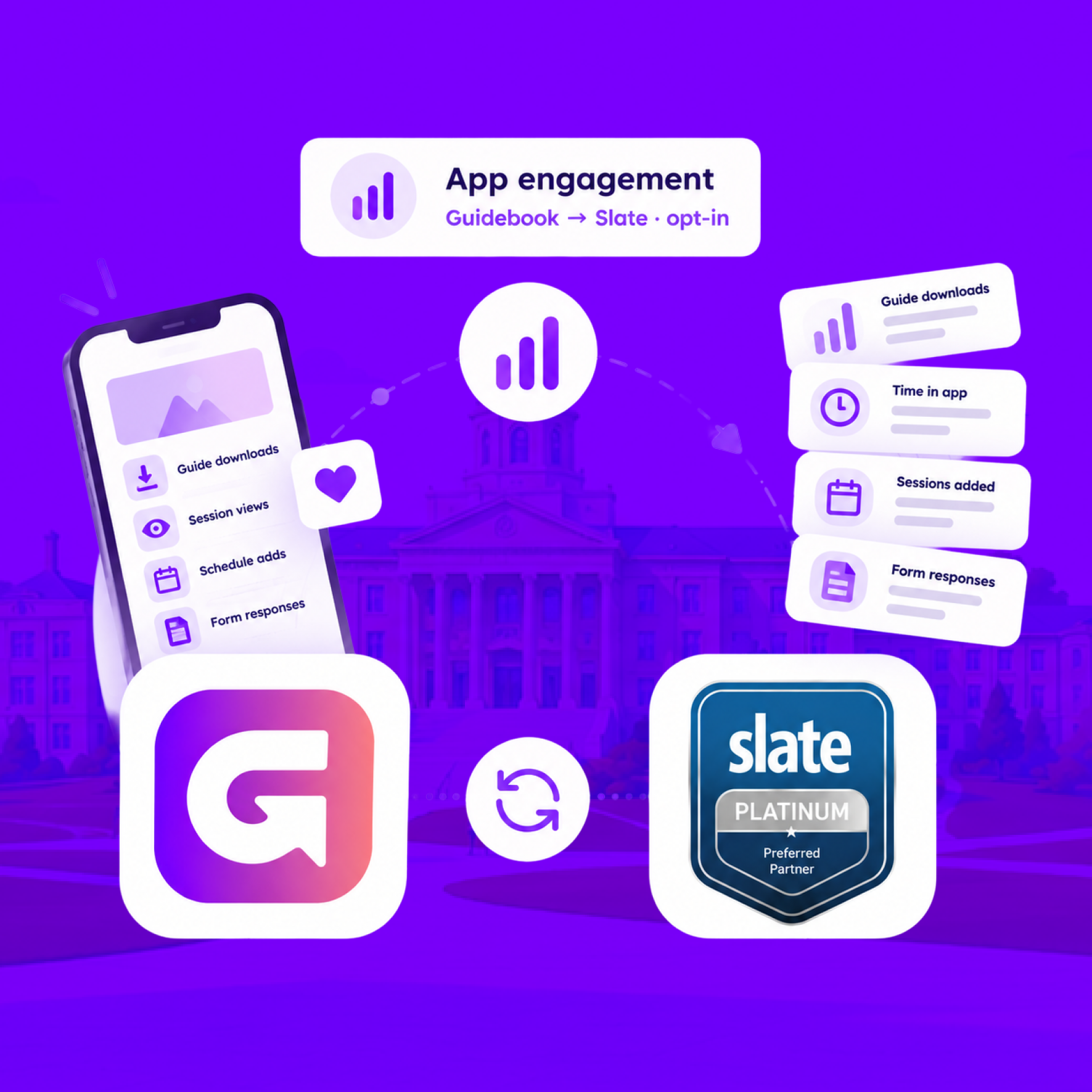
Send app engagement back to Slate
For students who opt in, downloads, schedule adds, views, and form responses land on their event registration every hour.
Send app engagement back to Slate
For students who opt in, downloads, schedule adds, views, and form responses land on their event registration every hour.
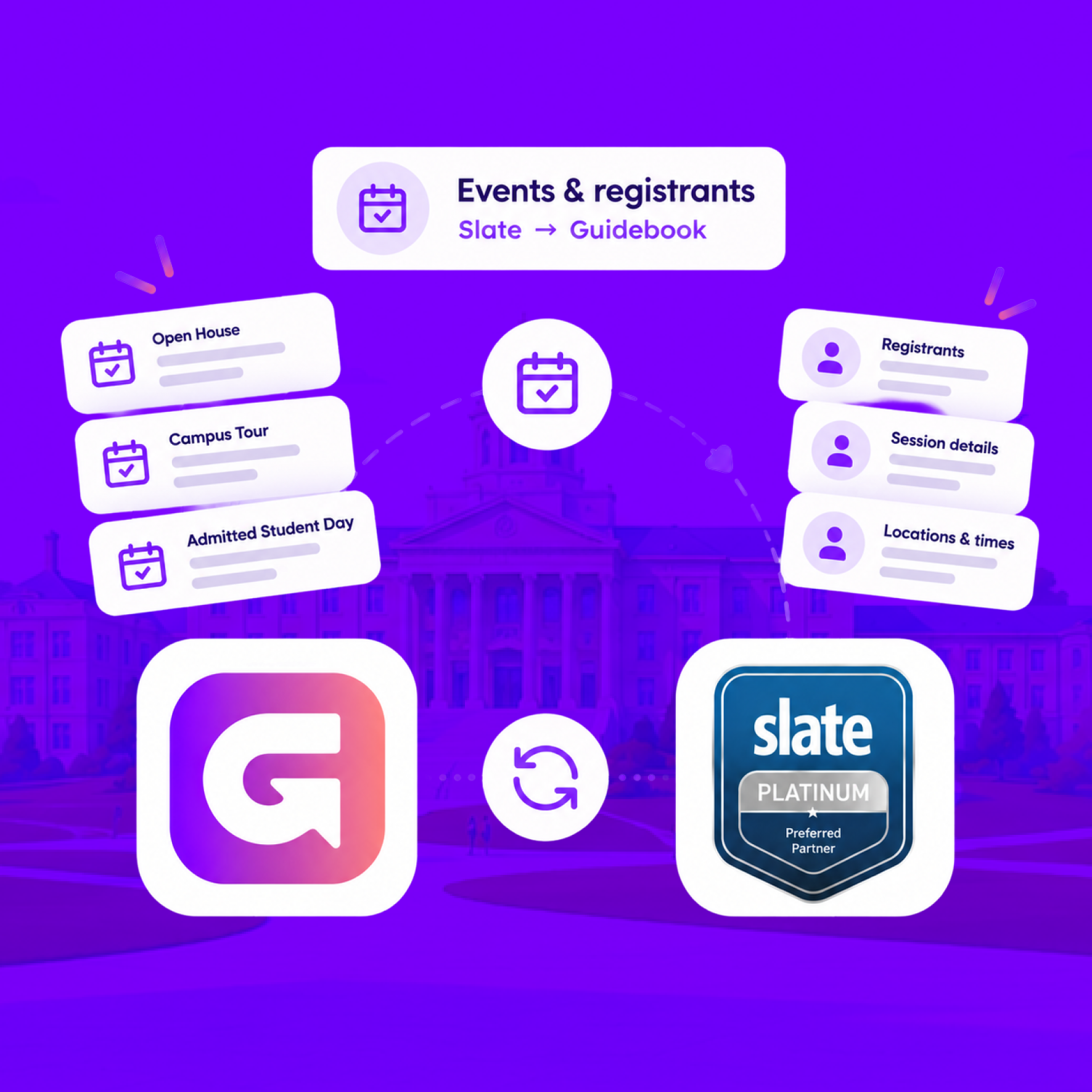
Build the campus event once in Slate
Link a Slate folder to a guide. Every event becomes a session, and registrants are added automatically.
Build the campus event once in Slate
Link a Slate folder to a guide. Every event becomes a session, and registrants are added automatically.
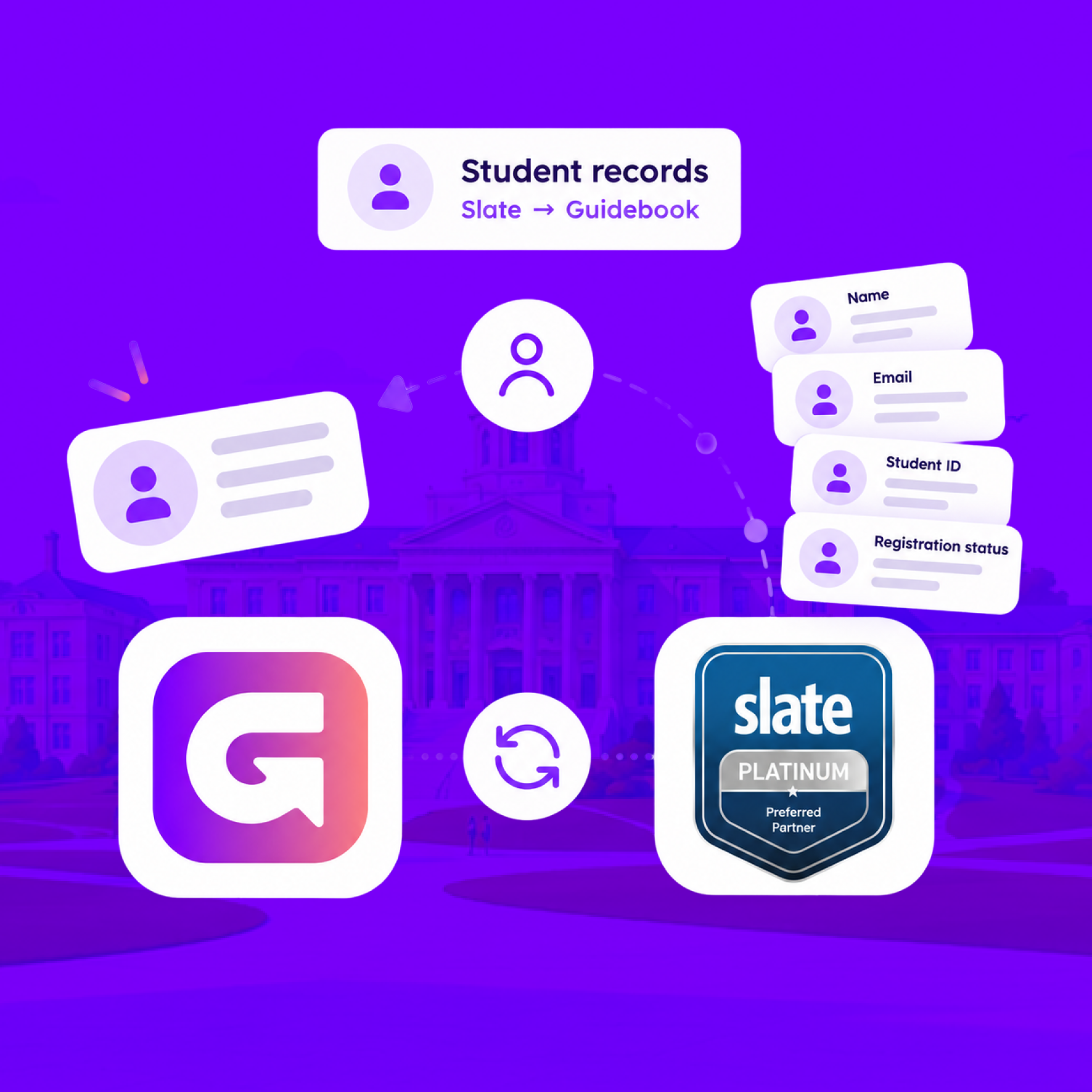
Slate profiles, in the campus app
Match each student's Slate record to their Guidebook account, so college, major, and orientation details stay current on every sync.
Slate profiles, in the campus app
Match each student's Slate record to their Guidebook account, so college, major, and orientation details stay current on every sync.
Campus apps by department
Admissions, orientation, student life, and more — one campus app that works across departments.

Campus apps by department
Admissions, orientation, student life, and more — one campus app that works across departments.
Build unlimited event apps on one license
One partnership for unlimited campus events — orientation, tours, student life, and everything in between.
Build unlimited event apps on one license
One partnership for unlimited campus events — orientation, tours, student life, and everything in between.
Compare event app platforms
See how Guidebook stacks up against other event app and registration platforms.
Compare event app platforms
See how Guidebook stacks up against other event app and registration platforms.
Event apps for nonprofit and community programs
Give members, volunteers, and donors one branded app for conferences, fundraisers, and year-round community.
Event apps for nonprofit and community programs
Give members, volunteers, and donors one branded app for conferences, fundraisers, and year-round community.
Campus integrations and an open API
Connect Guidebook with the campus systems, APIs, and tools your team already uses.
Campus integrations and an open API
Connect Guidebook with the campus systems, APIs, and tools your team already uses.
Event apps for corporate and enterprise teams
Internal meetings, offsites, and large-scale corporate events — with the branding and control enterprise teams need.
Event apps for corporate and enterprise teams
Internal meetings, offsites, and large-scale corporate events — with the branding and control enterprise teams need.
Create a branded event app with no coding
Put schedules, maps, resources, and updates in every attendee's pocket — built for campus events and programs.
Create a branded event app with no coding
Put schedules, maps, resources, and updates in every attendee's pocket — built for campus events and programs.
Launch a branded, white-label event app
A white-label event app with your branding, your content, and your attendee experience — no coding required.
Launch a branded, white-label event app
A white-label event app with your branding, your content, and your attendee experience — no coding required.
Everything in the Guidebook platform
Explore the features event teams use to engage attendees before, during, and after the event.
Everything in the Guidebook platform
Explore the features event teams use to engage attendees before, during, and after the event.
One app for in-person and virtual attendees
The same schedule, networking, and updates whether people are in the room or joining remotely.
One app for in-person and virtual attendees
The same schedule, networking, and updates whether people are in the room or joining remotely.
Event apps built for associations
Annual meetings, chapter events, and member engagement — without rebuilding a new app every year.
Event apps built for associations
Annual meetings, chapter events, and member engagement — without rebuilding a new app every year.
A branded event website that matches the app
Promote the event, collect interest, and keep branding consistent from the first click to check-in.
A branded event website that matches the app
Promote the event, collect interest, and keep branding consistent from the first click to check-in.
Plan, run, and measure events on one platform
App, registration, badges, and websites in one workflow — so planning isn't a pile of disconnected tools.
Plan, run, and measure events on one platform
App, registration, badges, and websites in one workflow — so planning isn't a pile of disconnected tools.
Keep members engaged between events
One branded app for the conference and everything that happens the other 51 weeks of the year.
Keep members engaged between events
One branded app for the conference and everything that happens the other 51 weeks of the year.
The conference app attendees actually use
Schedules, maps, networking, and live updates for annual meetings, summits, and multi-day conferences.
The conference app attendees actually use
Schedules, maps, networking, and live updates for annual meetings, summits, and multi-day conferences.
Registration that feeds your app and badges
Collect registrations, payments, and attendee data in the same platform as your event app.
Registration that feeds your app and badges
Collect registrations, payments, and attendee data in the same platform as your event app.
Design and print event badges in one place
Custom badges, QR check-in, and on-site printing — without a separate badge vendor.
Design and print event badges in one place
Custom badges, QR check-in, and on-site printing — without a separate badge vendor.
A Smaller School?
Deliver a polished, branded event experience without a large team or a big budget.
A Smaller School?
Deliver a polished, branded event experience without a large team or a big budget.
Running Family Programs?
Give families everything they need, from schedules and maps to real-time updates, all in one place.
Running Family Programs?
Give families everything they need, from schedules and maps to real-time updates, all in one place.
Coordinating Move-In Day?
Share updates, manage events, and keep students informed from move-in through the academic year.

Coordinating Move-In Day?
Share updates, manage events, and keep students informed from move-in through the academic year.
Offering Campus Tours?
Deliver branded, self-guided tour experiences with interactive maps and rich media, available 24/7.

Offering Campus Tours?
Deliver branded, self-guided tour experiences with interactive maps and rich media, available 24/7.
Organising a Career Fair?
Simplify logistics for students, employers, and Career Services staff with one easy-to-use app.
Organising a Career Fair?
Simplify logistics for students, employers, and Career Services staff with one easy-to-use app.
Managing Alumni Events?
Plan reunions, regional events, and fundraising campaigns with an app built for alumni engagement.
Managing Alumni Events?
Plan reunions, regional events, and fundraising campaigns with an app built for alumni engagement.
Boost Student Engagement
One hub for schedules, resources, and events that keeps students connected throughout the academic year.
Boost Student Engagement
One hub for schedules, resources, and events that keeps students connected throughout the academic year.
Planning Orientation?
Help new students feel prepared from day one with schedules, campus resources, and real-time updates in one app.
Planning Orientation?
Help new students feel prepared from day one with schedules, campus resources, and real-time updates in one app.
Running Admissions Events?
Manage open houses, tours, and yield events with a branded app that saves time and engages prospective students.

Running Admissions Events?
Manage open houses, tours, and yield events with a branded app that saves time and engages prospective students.
Get a custom Sponsorship Package Template
Stop starting from scratch. Grab free templates that helWe'll build a tailored sponsorship package with suggested pricing, tiers, and benefits..for your specific event.p you build professional sponsorship packages and close deals faster.
Get a custom Sponsorship Package Template
Stop starting from scratch. Grab free templates that helWe'll build a tailored sponsorship package with suggested pricing, tiers, and benefits..for your specific event.p you build professional sponsorship packages and close deals faster.
Plan Your Next Event Without Missing a Beat.
From venue selection to post-event wrap-up, this free checklist walks you through every step (so nothing falls through the cracks).

Plan Your Next Event Without Missing a Beat.
From venue selection to post-event wrap-up, this free checklist walks you through every step (so nothing falls through the cracks).
Real Results From Real Events
100,000+ organizations trust Guidebook. See exactly how universities, associations, enterprises, and more put it to work.

Real Results From Real Events
100,000+ organizations trust Guidebook. See exactly how universities, associations, enterprises, and more put it to work.
Flexible pricing for every event size
Find the perfect plan for your needs, from intimate gatherings to large-scale conferences.

Flexible pricing for every event size
Find the perfect plan for your needs, from intimate gatherings to large-scale conferences.
Join our event experts
Watch on-demand webinars and join live sessions with industry leaders sharing best practices for event success.

Join our event experts
Watch on-demand webinars and join live sessions with industry leaders sharing best practices for event success.
Guidebook in Action
Book a personalized walkthrough and discover how we help event teams create better attendee experiences.
Guidebook in Action
Book a personalized walkthrough and discover how we help event teams create better attendee experiences.
You Can't Tell a Student They Belong. Here's What UGA Does Instead.




You Can't Tell a Student They Belong. Here's What UGA Does Instead.
- UGA's orientation team treats belonging as personal: staff create conditions, and students build their own community.
- One UGA, a spoken word experience delivered live by orientation leaders, was rebuilt by listening to students, leaders, and past participants.
- At more than 40,000 students, small details like names, personal introductions, and accurate name tags tell students they won't be anonymous.
- Growth can quietly turn a small group into a room, so logistics have to keep students at the center.
- The team pairs numbers like retention with what students and parents say after a session.
Every orientation team wants new students to feel they belong. The easy move is to say it from the stage. Janssen, who works on orientation at the University of Georgia, doesn't think that works.
"Belonging is very personal and individual to that student," he says. Staff can create opportunities, introduce people and resources, and describe the community they hope for. Students have to experience it for themselves. In Campus Notes Episode 5, Janssen explains how UGA designs for that.
What is student belonging?
Student belonging is a student's sense that they're accepted, valued, and connected on campus: that they fit, and that they matter there. It isn't the same as attendance or satisfaction. A student can show up to everything and still feel like an outsider. That's why so many orientation and first-year teams treat it as the goal behind the events. We cover it in more depth in what student belonging is and how to measure it.
Create conditions, not declarations
UGA's orientation goal is simple to say and hard to do: create as many chances as possible for students to find their people, take risks, try something new, and start building their own version of community.
Janssen is clear about what it isn't. "It's not a flick of the switch. It's not an epiphany." Orientation sets up the conditions. The student does the rest.

One UGA: a message students actually hear
The program Janssen points to first is One UGA, a spoken word experience that orientation leaders prepare and deliver live. It has gone through a lot of versions over the years, some theatrical, some practical.
This summer, he says, the team found a version that meets students where they are. The reason was listening: to students, to orientation leaders, and to people who'd been through the program before. The message that came through is that community takes time. It takes choices, risks, and putting yourself out there. Sometimes your community isn't in the first place you look.
What the program avoids is the party line. UGA isn't telling students they belong. It's showing them the community the university is trying to build, and the part they play in it.
At 40,000 students, small things carry
Janssen names something every orientation professional knows: "Everybody only gets one orientation experience." UGA runs its programs more than 20 times each summer. Each one still has to feel like that student's only session.
At a university with more than 40,000 students, it's easy for a new student to assume they'll be one fish in a big sea. So the staff model small moments on purpose:
- Using people's names when they meet them
- Making a personal introduction to an office instead of pointing the way
- Getting name tags right, with preferred names and the right city
The name tags take real time to prepare. Janssen thinks they're worth it, because they tell a student on arrival that they won't be anonymous here. Not "student XYZ." Joe, who chose UGA.

Growth tests the design
Janssen says UGA had the most students in its orientation program this year, after a strong enrollment cycle. More students strains every belonging promise. "If we have a small group of twenty six people, that's no longer a small group. That's a room."
So the logistics have to keep students at the center. Janssen credits Guidebook with giving the team "the infrastructure that we need so that we as humans can do our job." Information lives in one place participants can reach. The team doesn't have to print a thousand things. Staff time goes to people, not paper.

Measuring what a dashboard misses
How do you know a program like One UGA is landing? Some of it is trial and error. Some of it is what the team hears afterward: a student who saw themselves in an orientation leader's story, or a parent who says their student really needed to hear that.
Janssen doesn't pretend the numbers don't matter. People on campus want to know resources are being used well, and he points to UGA's retention as part of the longer story. But he's comfortable that some of the most important outcomes are ones "you can't put numbers to." He describes orientation as the doorstep, the entryway. It's not about the orientation team succeeding. It's about students succeeding.
What to take back to your campus
- Design for discovery. Build chances for students to find their people, rather than telling them they've already found them.
- Rewrite with your audience. Keep revising key programs with input from students, leaders, and past participants.
- Protect the small moments. Names, introductions, and correct details tell a student they're seen.
- Watch your group sizes. Growth can quietly turn a small group into a room.
- Count, and also listen. Pair your metrics with what students and families say after the session.
Running orientation at scale? See how teams run new student programs with Guidebook, and read how to measure orientation success.
Watch Janssen's full conversation in Campus Notes Episode 5.
Frequently asked questions

Get the Mobile App Playbook
A short guide to running the whole student journey in one app. No fluff, just what works.
for higher ed
Campus
Playbook
A practical guide to building a connected campus experience.
Free playbook
The Mobile App Playbook for Universities
Students decide if they belong long before they set foot on campus. This playbook shows how to win them over from the first visit through graduation.
- Grow enrollment and boost recruitment
- Increase belonging and retention
- Run every event from one branded app
By submitting, you agree to our Privacy Policy.
You're in.