Send app engagement back to Slate
For students who opt in, downloads, schedule adds, views, and form responses land on their event registration every hour.
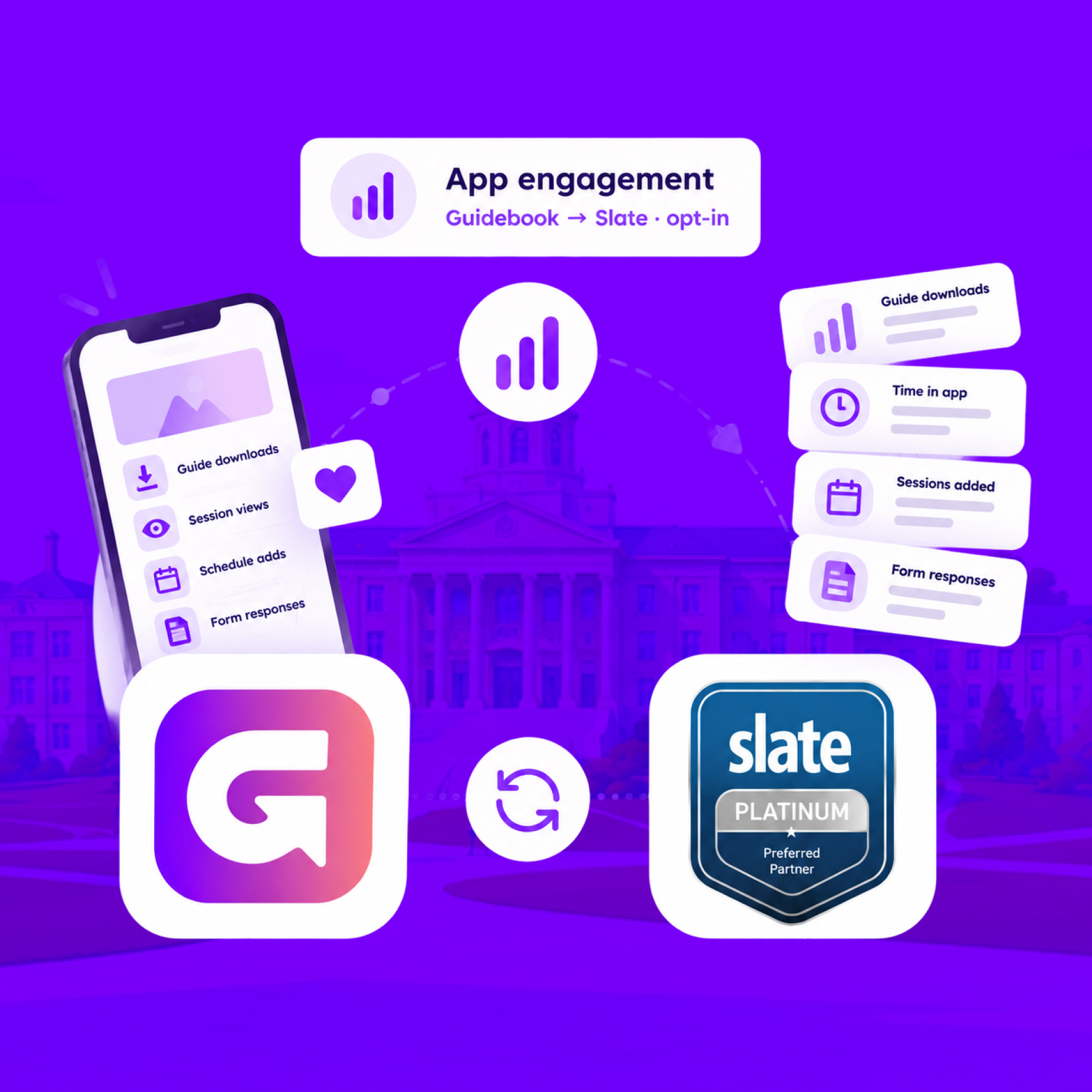
Send app engagement back to Slate
For students who opt in, downloads, schedule adds, views, and form responses land on their event registration every hour.
Build the campus event once in Slate
Link a Slate folder to a guide. Every event becomes a session, and registrants are added automatically.
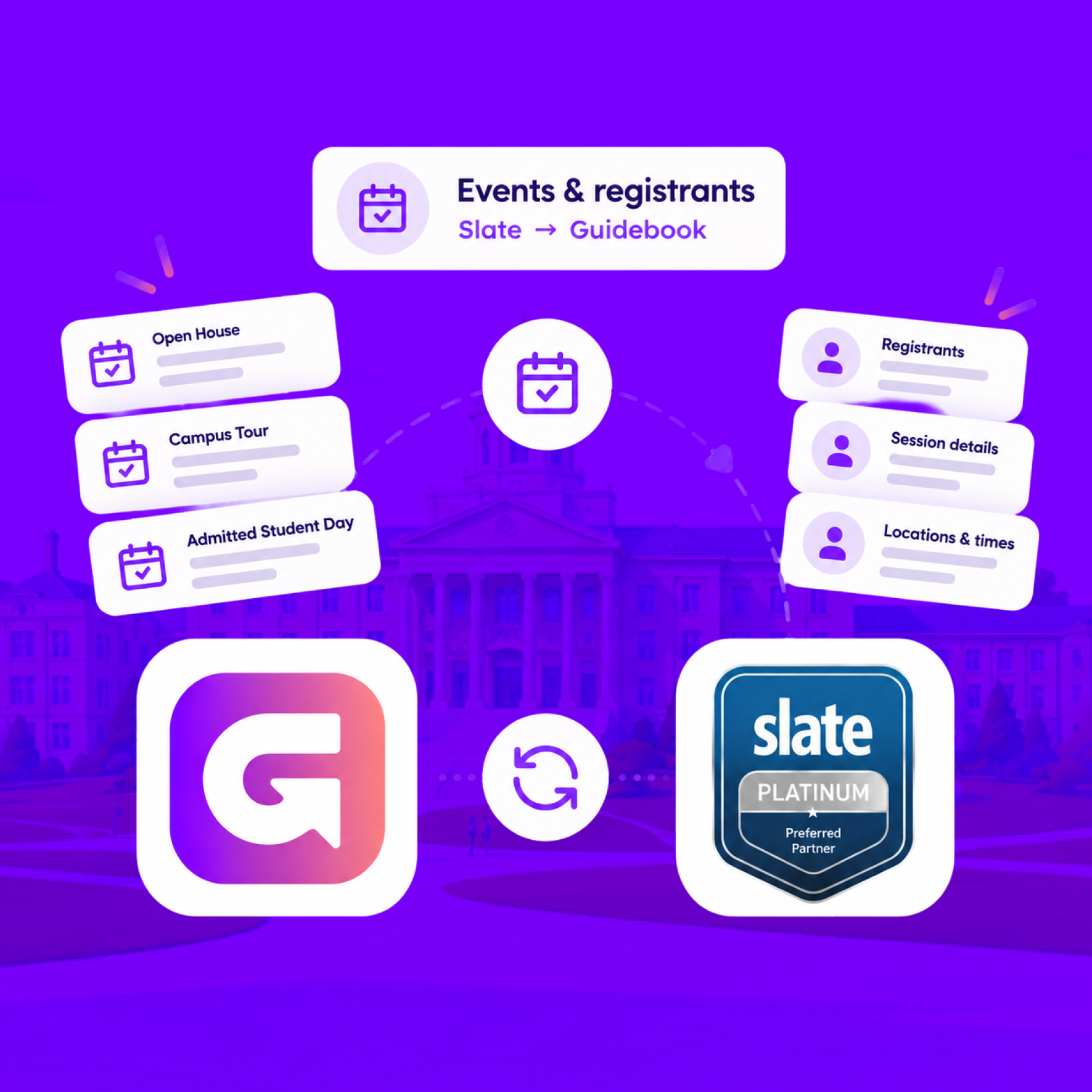
Build the campus event once in Slate
Link a Slate folder to a guide. Every event becomes a session, and registrants are added automatically.
Slate profiles, in the campus app
Match each student's Slate record to their Guidebook account, so college, major, and orientation details stay current on every sync.
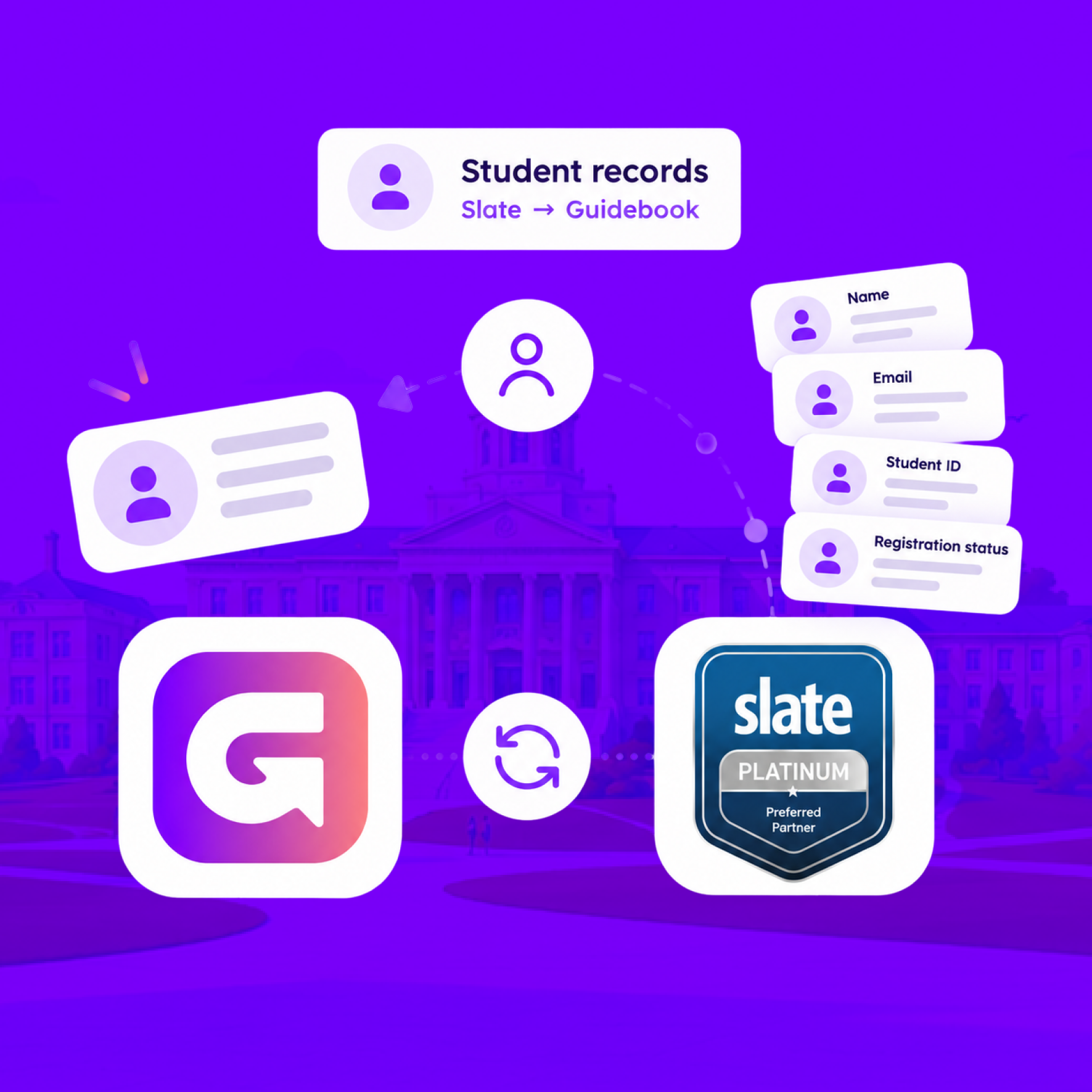
Slate profiles, in the campus app
Match each student's Slate record to their Guidebook account, so college, major, and orientation details stay current on every sync.
Campus apps by department
Admissions, orientation, student life, and more — one campus app that works across departments.

Campus apps by department
Admissions, orientation, student life, and more — one campus app that works across departments.
Build unlimited event apps on one license
One partnership for unlimited campus events — orientation, tours, student life, and everything in between.
Build unlimited event apps on one license
One partnership for unlimited campus events — orientation, tours, student life, and everything in between.
Compare event app platforms
See how Guidebook stacks up against other event app and registration platforms.
Compare event app platforms
See how Guidebook stacks up against other event app and registration platforms.
Event apps for nonprofit and community programs
Give members, volunteers, and donors one branded app for conferences, fundraisers, and year-round community.
Event apps for nonprofit and community programs
Give members, volunteers, and donors one branded app for conferences, fundraisers, and year-round community.
Campus integrations and an open API
Connect Guidebook with the campus systems, APIs, and tools your team already uses.
Campus integrations and an open API
Connect Guidebook with the campus systems, APIs, and tools your team already uses.
Event apps for corporate and enterprise teams
Internal meetings, offsites, and large-scale corporate events — with the branding and control enterprise teams need.
Event apps for corporate and enterprise teams
Internal meetings, offsites, and large-scale corporate events — with the branding and control enterprise teams need.
Create a branded event app with no coding
Put schedules, maps, resources, and updates in every attendee's pocket — built for campus events and programs.
Create a branded event app with no coding
Put schedules, maps, resources, and updates in every attendee's pocket — built for campus events and programs.
Launch a branded, white-label event app
A white-label event app with your branding, your content, and your attendee experience — no coding required.
Launch a branded, white-label event app
A white-label event app with your branding, your content, and your attendee experience — no coding required.
Everything in the Guidebook platform
Explore the features event teams use to engage attendees before, during, and after the event.
Everything in the Guidebook platform
Explore the features event teams use to engage attendees before, during, and after the event.
One app for in-person and virtual attendees
The same schedule, networking, and updates whether people are in the room or joining remotely.
One app for in-person and virtual attendees
The same schedule, networking, and updates whether people are in the room or joining remotely.
Event apps built for associations
Annual meetings, chapter events, and member engagement — without rebuilding a new app every year.
Event apps built for associations
Annual meetings, chapter events, and member engagement — without rebuilding a new app every year.
A branded event website that matches the app
Promote the event, collect interest, and keep branding consistent from the first click to check-in.
A branded event website that matches the app
Promote the event, collect interest, and keep branding consistent from the first click to check-in.
Plan, run, and measure events on one platform
App, registration, badges, and websites in one workflow — so planning isn't a pile of disconnected tools.
Plan, run, and measure events on one platform
App, registration, badges, and websites in one workflow — so planning isn't a pile of disconnected tools.
Keep members engaged between events
One branded app for the conference and everything that happens the other 51 weeks of the year.
Keep members engaged between events
One branded app for the conference and everything that happens the other 51 weeks of the year.
The conference app attendees actually use
Schedules, maps, networking, and live updates for annual meetings, summits, and multi-day conferences.
The conference app attendees actually use
Schedules, maps, networking, and live updates for annual meetings, summits, and multi-day conferences.
Registration that feeds your app and badges
Collect registrations, payments, and attendee data in the same platform as your event app.
Registration that feeds your app and badges
Collect registrations, payments, and attendee data in the same platform as your event app.
Design and print event badges in one place
Custom badges, QR check-in, and on-site printing — without a separate badge vendor.
Design and print event badges in one place
Custom badges, QR check-in, and on-site printing — without a separate badge vendor.
A Smaller School?
Deliver a polished, branded event experience without a large team or a big budget.
A Smaller School?
Deliver a polished, branded event experience without a large team or a big budget.
Running Family Programs?
Give families everything they need, from schedules and maps to real-time updates, all in one place.
Running Family Programs?
Give families everything they need, from schedules and maps to real-time updates, all in one place.
Coordinating Move-In Day?
Share updates, manage events, and keep students informed from move-in through the academic year.

Coordinating Move-In Day?
Share updates, manage events, and keep students informed from move-in through the academic year.
Offering Campus Tours?
Deliver branded, self-guided tour experiences with interactive maps and rich media, available 24/7.

Offering Campus Tours?
Deliver branded, self-guided tour experiences with interactive maps and rich media, available 24/7.
Organising a Career Fair?
Simplify logistics for students, employers, and Career Services staff with one easy-to-use app.
Organising a Career Fair?
Simplify logistics for students, employers, and Career Services staff with one easy-to-use app.
Managing Alumni Events?
Plan reunions, regional events, and fundraising campaigns with an app built for alumni engagement.
Managing Alumni Events?
Plan reunions, regional events, and fundraising campaigns with an app built for alumni engagement.
Boost Student Engagement
One hub for schedules, resources, and events that keeps students connected throughout the academic year.
Boost Student Engagement
One hub for schedules, resources, and events that keeps students connected throughout the academic year.
Planning Orientation?
Help new students feel prepared from day one with schedules, campus resources, and real-time updates in one app.
Planning Orientation?
Help new students feel prepared from day one with schedules, campus resources, and real-time updates in one app.
Running Admissions Events?
Manage open houses, tours, and yield events with a branded app that saves time and engages prospective students.

Running Admissions Events?
Manage open houses, tours, and yield events with a branded app that saves time and engages prospective students.
Get a custom Sponsorship Package Template
Stop starting from scratch. Grab free templates that helWe'll build a tailored sponsorship package with suggested pricing, tiers, and benefits..for your specific event.p you build professional sponsorship packages and close deals faster.
Get a custom Sponsorship Package Template
Stop starting from scratch. Grab free templates that helWe'll build a tailored sponsorship package with suggested pricing, tiers, and benefits..for your specific event.p you build professional sponsorship packages and close deals faster.
Plan Your Next Event Without Missing a Beat.
From venue selection to post-event wrap-up, this free checklist walks you through every step (so nothing falls through the cracks).
.avif)
Plan Your Next Event Without Missing a Beat.
From venue selection to post-event wrap-up, this free checklist walks you through every step (so nothing falls through the cracks).
Real Results From Real Events
100,000+ organizations trust Guidebook. See exactly how universities, associations, enterprises, and more put it to work.

Real Results From Real Events
100,000+ organizations trust Guidebook. See exactly how universities, associations, enterprises, and more put it to work.
Flexible pricing for every event size
Find the perfect plan for your needs, from intimate gatherings to large-scale conferences.

Flexible pricing for every event size
Find the perfect plan for your needs, from intimate gatherings to large-scale conferences.
Join our event experts
Watch on-demand webinars and join live sessions with industry leaders sharing best practices for event success.
.avif)
Join our event experts
Watch on-demand webinars and join live sessions with industry leaders sharing best practices for event success.
Guidebook in Action
Book a personalized walkthrough and discover how we help event teams create better attendee experiences.
Guidebook in Action
Book a personalized walkthrough and discover how we help event teams create better attendee experiences.
The Complete Event Management Guide for Modern Planners
.avif)





The Complete Event Management Guide for Modern Planners
Whether you're coordinating a 500-person conference, a campus orientation program, or a corporate leadership retreat, two things are always true in event management:
The stakes are always high.
The details are always multiplying.
The good news? You don't have to figure it out from scratch every time.
With a clear process, the right strategies, and smart tools, you can transform event management from an overwhelming marathon into a manageable journey with predictable milestones.
Here's what you'll learn in this guide:
- What event management actually encompasses (and how it differs from event planning)
- A 9-step process for managing events from concept to completion
- Strategic approaches that elevate your events beyond basic logistics
- Practical tips that experienced planners swear by
- How technology can reduce manual work and improve attendee experiences
- Essential skills that make event professionals effective
- How to evaluate and choose the right event management platform
Let's dig in.
What Is Event Management
Event management is the process of planning, organizing, and executing events from initial concept through final follow-up. It's a discipline that spans strategy, logistics, communication, and analysis, touching every aspect of what it takes to bring people together for a shared experience.
This process applies across event types: conferences, campus programs, corporate meetings, association gatherings, trade shows, and more. The principles remain consistent even when the scale and audience differ.
Here's what event management encompasses:
- Strategy and definition: Clarifying purpose, audience, and goals before any logistics begin
- Planning and budgeting: Setting timelines, securing vendors, allocating resources across all event elements
- Marketing and promotion: Driving registration and building awareness among your target audience
- Logistics and setup: Coordinating vendors, speakers, staff, and technical requirements
- Execution: Managing day-of operations and delivering the attendee experience
- Post-event analysis: Gathering feedback, measuring success against objectives, and reporting ROI
Overall, event management ensures that every choice or decision aligns with the event goals and leads to a positive experience — for planners and attendees alike.
Event management vs. event planning
These terms are often used interchangeably, but they describe different scopes of work.
Event planning focuses primarily on pre-event tasks like venue selection, vendor booking, scheduling, and the preparation that happens before anyone walks through the door. It's essential work, but it's only part of the picture.
Event management, on the other hand, encompasses the entire lifecycle — including day-of execution, real-time problem-solving, attendee communication, and post-event analysis.
Why does this distinction matter?
Because when events fail, it's rarely in the planning phase; it's in execution and follow-through. Recognizing that event management extends beyond preparation helps you allocate time and resources appropriately across the entire journey.
Why a structured event management process matters
Without a clear process, event planners risk missing critical details, exceeding budget, and leaving attendees with a disappointing experience.
A well-structured event management process gives your entire team guardrails to work within. When everyone knows what needs to happen, who owns it, and when it's due, confusion disappears. Day-of stress also drops significantly, because decisions have already been thought through rather than made on the fly.
Structure also helps teams identify problems early before they snowball into day-of crises. A solid event planning checklist and documentation prevent oversights and create a record you can reference when planning future events, so every iteration improves on the last.
How to Manage an Event in 9 Steps
This is the event management process from start to finish. Each step builds on the previous one, creating a roadmap you can follow regardless of your event's size or type.
1. Define Your Event Goals and Objectives
Every successful event starts with clarity about why it exists.
Before you book a venue or design a registration page, answer these core questions: What does success look like? Who is your target audience? What outcomes matter most? Are you aiming to generate leads, build brand awareness, raise funds, or celebrate a milestone?
Getting clear on your objectives upfront shapes every decision that follows and gives you a concrete benchmark to measure against when the event is over.
Goals guide every subsequent decision and your budget allocation, venue selection, speaker choices, and marketing approach should all trace back to what you're trying to achieve.
Consider these goal categories:
- Engagement goals: Networking opportunities created, session participation rates, community connections formed
- Business goals: Lead generation, brand awareness, revenue targets, partnership development
- Experience goals: Attendee satisfaction scores, feedback quality, likelihood to recommend
Make your goals specific and measurable. "Create a great experience" is a hope. "Achieve 85% attendee satisfaction and generate 200 qualified leads" is a goal you can plan toward and evaluate against.
2. Build Your Event Team and Assign Roles
Your team is the engine behind every successful event. Whether you're covering logistics, marketing, or attendee experience, defining who does what (and making sure everyone is aligned from the start) is one of the highest-leverage investments you can make.
Clear ownership prevents confusion. When everyone assumes someone else is handling a task, things fall through the cracks. When two people think they're in charge of the same decision, conflicts arise.
Designate one person as the overall event lead; someone empowered to make calls quickly and keep the team moving in the same direction. From there, map out specific roles so nothing is ambiguous.
Common event team roles include:
- Event lead: Overall strategy, stakeholder communication, final decision-making
- Logistics coordinator: Venue management, vendor relationships, on-site operations
- Marketing lead: Promotion strategy, registration management, attendee communication
- Registration manager: Registration setup, attendee data, check-in processes
- Content coordinator: Speaker management, agenda development, session logistics
- On-site support: Day-of execution, attendee assistance, troubleshooting
Even small teams benefit from defined responsibilities. A two-person operation still needs clarity around who handles vendor communication versus attendee questions.
Set a cadence for team check-ins and agree on how updates get shared, whether that's a daily Slack thread or a weekly sync.
Catching misalignments early is far easier than untangling them the week of the event.
3. Create Your Event Budget
Your budget is the financial backbone of your event so, set it early and revisit it often. Every major decision, from venue to speakers to technology, flows from what you can realistically spend.
Your event budget should cover every category where money will flow:
- Venue: Rental fees, setup and teardown costs, parking
- Catering: Food, beverages, service staff, gratuities
- A/V and technology: Sound systems, lighting, screens, event apps, WiFi
- Marketing: Advertising, print materials, promotional items
- Staffing: Internal team time, temporary staff, security
- Speakers and entertainment: Honorariums, travel, accommodation
- Contingency: Reserve for unexpected expenses
Anchor your estimates to past event data or published industry benchmarks rather than optimistic guesses. Set aside a contingency fund — typically 10–20% of your total budget — to absorb surprises without derailing everything else.
Watch for hidden costs that catch planners off guard, such as:
- Taxes on venue rentals
- Service fees on catering
- Overtime charges for extended setup
- Cancellation penalties.
In addition, commit to tracking spending in real-time rather than reconciling at the end. This lets you catch overruns early and make adjustments before they become serious problems.
4. Choose Your Event Date and Venue
Date and venue are foundational decisions that shape nearly everything else: capacity, décor, catering options, and overall logistics.
Start your venue search early because desirable spaces fill up quickly, and your options narrow fast the longer you wait.
For date selection, consider:
- Conflicts: Avoid major holidays, industry conferences, and competing events that might split your audience
- Lead time: Allow enough runway for promotion (larger events often need months)
- Seasonality: Weather, travel patterns, and budget cycles can all affect attendance
- Stakeholder availability: Key speakers, sponsors, and VIPs need to be available
With your date confirmed, build your planning timeline in reverse, identifying every milestone and deadline that you need to hit before doors open.
For venue selection, evaluate:
- Capacity: Can it comfortably accommodate your expected attendance?
- Accessibility: Is it easy to reach and accessible for all attendees?
- Location: Does it make sense for your audience geographically?
- Technical requirements: Does it support your A/V, WiFi, and power needs?
- Flexibility: Can the space adapt to your agenda format?
The venue often determines logistical constraints you'll have to work around. For example:
- Room layout affects session formats
- Kitchen facilities affect catering options
- WiFi capacity affects app performance.
So choose a venue that supports what you're trying to accomplish.
5. Plan Your Event Agenda and Content
Your agenda is the backbone of your attendee experience. It determines how people spend their time and what value they take away.
Start with your goals. If networking is a priority, build in dedicated time for genuine connection; not just coffee breaks where people check their phones.
If education is the focus, ensure session formats actively support learning and engagement.
Balance is essential. Mix educational content with networking opportunities. Alternate high-energy sessions with quieter moments. Give attendees variety without overwhelming them with choices.
Build buffer time into your agenda. Transitions always run longer than expected, and a little breathing room goes a long way toward keeping the day on track and attendees relaxed.
For speaker coordination:
- Confirm speakers early and communicate expectations clearly
- Provide presentation guidelines and technical requirements
- Collect materials in advance for review and backup
- Plan for contingencies if speakers cancel or run over time
Every session should answer the question: "What will attendees be able to do or understand after this that they couldn't before?"
Content that can't answer that question probably shouldn't be on the agenda.
6. Promote Your Event and Launch Registration
Start promotion well before registration opens to build anticipation, then launch registration with clear calls to action and a streamlined process.
Marketing channels to consider:
- Email: This is your most direct line to potential attendees, so use it strategically.
- Social media: Build awareness and foster community conversation.
- Website: Provide comprehensive event information and easy registration access.
- Partners: Leverage sponsors, speakers, and industry partners for extended reach.
- Paid advertising: Target specific audiences when organic reach isn't enough.
Remember that registration numbers don't materialize on their own; they're the result of consistent, well-timed promotion. Build your event marketing calendar alongside your planning timeline so campaigns launch with enough runway to gain traction.
For your registration setup, follow these best practices:
- Keep forms simple and only collect information you'll actually use.
- Offer tiered options (early bird, standard, VIP, group rates) to incentivize action.
- Make the path to registration clear and friction-free.
- Test the process yourself before launching.
The right event management platform can connect registration data directly to your event app, eliminating the need for manual uploads, while ensuring that attendee data flows seamlessly from signup to check-in.
7. Manage Day-of Logistics and Operations
The event day is when all your planning comes together or falls apart.
On-site coordination priorities to be aware of include:
- Check-in processes: Get attendees through the door quickly and smoothly
- Vendor management: Ensure all partners are set up and ready
- Run-of-show: Keep sessions on schedule with clear transitions
- Staff briefings: Make sure everyone knows their role and communication channels
In the days leading up to your event, run final confirmations with every vendor, supplier, and staff member. The sooner you discover gaps, the easier it is to fix so you don’t end with an on-site crisis.
That said, no event goes exactly as planned.
The difference between a minor hiccup and a full-blown crisis is usually whether someone thought through the scenario in advance.
So it’s a good idea to build a simple risk register and assign contingency plans before event day.
Here are some common issues to plan for:
A single source of truth for schedules and information keeps your entire team aligned. When changes happen (and they will!) you need one place to update that instantly reaches everyone who needs to know.
8. Engage and Communicate With Attendees
Attendees should always feel informed and present, not hunting for answers.
Push notifications can announce schedule changes, remind attendees of upcoming sessions, and deliver important updates immediately.
Weave interaction into your program design with engagement features like:
- Live polls: Gather instant feedback and make attendees feel heard
- Q&A features: Enable questions without disrupting sessions
- Networking features: Help attendees find and connect with each other
- Gamification: Add fun elements that encourage exploration and engagement
- In-app messaging: Enable direct communication between attendees
The goal is to remove friction so people can focus on the experience. When attendees aren't wondering where to go, what time something starts, or how to connect with someone they just met, they can be fully present.
9. Evaluate Event Success and Report ROI
Post-event work is where you determine whether the effort was worth it and how to improve next time.
Pull out the KPIs you defined in Step 1 and compare them honestly against what happened. Convene a team debrief, send attendee surveys, and document what worked and what didn't while the details are still sharp.
Post-event tasks include:
- Sending surveys: Gather attendee feedback while the experience is fresh
- Analyzing attendance data: Review session popularity, engagement patterns, and drop-off points
- Reviewing budget vs. actuals: Understand where you over- or under-spent
- Sending thank-you communications: Acknowledge speakers, sponsors, and attendees
- Team debrief: Discuss what worked, what didn't, and what to change next time
Common metrics to track:
- Registration-to-attendance conversion rate
- Session attendance and engagement
- Attendee satisfaction scores
- Net Promoter Score (likelihood to recommend)
- Lead generation and business outcomes
- Social media mentions and sentiment
Use this data to improve future events. Document lessons learned while they're fresh.
Event Management Strategies That Drive Results
Beyond the step-by-step process mentioned above, the following strategic approaches elevate your events from functional to exceptional.
Centralize All Event Information in One Platform
When your registration lives in one system, your schedule in a spreadsheet, your communications in email, and your maps in a PDF, confusion multiplies.
Team members waste time hunting for information, while attendees get inconsistent answers to the same questions.
Having a single source of truth changes everything because:
- Registration data flows into your event app without manual uploads.
- Schedule changes push to attendees instantly.
- Engagement data connects to your post-event analysis.
Basically, all the pieces work together instead of requiring you to stitch them together manually.
Prioritize Attendee Experience Over Logistics
It's easy to get consumed by what you need to manage: vendor timelines, budget tracking, speaker coordination, room assignments. But attendees don't experience your logistics; they experience the result.
Shift your perspective by asking "What do attendees need to feel?", instead of "What do I need to accomplish?"
When check-in is fast, attendees start their experience positively. When schedules are clear, people focus on content instead of confusion. And when communication is proactive, anxiety disappears.
Focus on reducing friction wherever possible and the experience will be more memorable (for you and attendees).
Streamline Communication Before, During, and After
Before the event: Set expectations, build excitement, and provide practical information. Send reminders about registration deadlines, share agenda highlights, and answer common questions before they're asked.
During the event: Keep attendees informed in real-time. Announce schedule changes, highlight upcoming sessions, share logistical updates, and celebrate moments worth noting. Push notifications reach people faster than a stage announcement.
After the event: Continue the conversation. Send thank-you messages, share highlights and recordings, request feedback, and outline next steps. The post-event period extends the experience and sets up future engagement.
Build Contingency Plans for Common Challenges
Experienced planners know that hope is not a strategy because something will always change unexpectedly. The question is whether you're prepared.
Use the table below to help you better respond when things take a sudden turn.
Event Management Tips for Successful Event Planning
Start Planning Earlier Than You Think Necessary
For a large conference or corporate gala, your timeline might stretch 12 months or more. Smaller events like webinars or workshops require less runway.
Either way, starting earlier gives you more venue options, better vendor rates, and more time to promote.
Keep Your Registration Process Simple
Complicated registration forms cause drop-off. Every additional field is a reason for someone to abandon the process. Only collect information you'll actually use, and make the path from "I want to attend" to "I'm registered" as short as possible.
Use Technology to Reduce Manual Tasks
For many teams, putting together an event means repetitive, manual processes (which increase the risk of errors and waste time).
Event technology allows you to automate a significant portion of your workflow, freeing you up to focus on more strategic work (such as, enhancing the attendee experience).
Automation opportunities include:
- Syncing registration data directly to your event app.
- Scheduling confirmation emails and reminder emails.
- Replacing paper lists with digital check-in.
- Using push notifications to reach attendees when last-minute changes happen.
- Collecting feedback through in-app surveys.
Communicate Proactively With All Stakeholders
Attendees aren't your only audience. Vendors, sponsors, speakers, and internal teams all need timely information.
When your caterer knows the final headcount two weeks out instead of two days, they perform better.
When speakers have clear expectations and deadlines, they prepare stronger content. Create communication schedules for each stakeholder group.
Collect Feedback Before the Event Ends
Response rates drop sharply after attendees leave and return to their regular lives. Capture feedback during the event (via in-app polls or quick session surveys, for example) while engagement is at its peak.
Post-event surveys still have value for comprehensive feedback, but they work best when supplemented by real-time collection.
How Event Management Technology Helps You Succeed
Technology isn't a replacement for good planning; it's an amplifier.
Streamlined Planning and Coordination
Event platforms centralize tasks, timelines, and information so teams aren't juggling multiple tools. Everything lives in one place with clear owners, deadlines, and visible progress.
Improved Team Collaboration
Shared platforms eliminate the "did you see my email?" problem. Changes propagate instantly, task completion is visible to everyone, and issues can be flagged to the right people in real time.
With deadlines and ownership surfaced in a single view, teams spend less time chasing status updates and more time doing the actual work.
Real-time Attendee Communication and Engagement
Push notifications, in-app messaging, live polls, and networking features keep attendees informed and engaged throughout the event.
When your planning platform connects directly to your attendee-facing tools, updates you make appear for attendees immediately; no reprinted schedules, no missed announcements.
Data-driven Insights and Reporting
Strong analytics make it possible to track attendance, engagement, and satisfaction at a level of detail that would be impossible to capture manually.
Which sessions drew the biggest crowds?
Where did engagement peak?
How did actual spending compare to budget?
This data proves ROI to stakeholders and gives you the raw material to make your next event measurably better.
Essential Skills for Effective Event Management
Process and technology matter, but they're only as effective as the people wielding them. These core skills complement your systems and tools:
- Organization: Managing multiple timelines, vendors, and details simultaneously without dropping the ball
- Communication: Keeping stakeholders aligned and attendees informed across every channel
- Problem-solving: Adapting quickly when things don't go as planned (because they never do)
- Budget management: Tracking expenses, making trade-offs, and staying within financial constraints
- Leadership: Coordinating teams under pressure, often with limited formal authority
- Attention to detail: Catching the small things that can derail an otherwise well-planned event
- Flexibility: Adjusting when circumstances shift while staying focused on the end goal
How to Choose the Right Event Management Platform
Not all platforms are created equal. Here's how to evaluate your options:
The right platform should feel like a partner, not just another tool to manage.
Turn Event Planning Into Meaningful Experiences
Event management isn't simply about controlling logistics; it's about creating the conditions for something meaningful to happen.
When people arrive at your event, they shouldn't be wondering where to go, what's happening next, or how to find information.
They should feel informed, confident, and present.
That's when connections form, ideas spark, and communities strengthen.
Your role as an event manager is to make that possible. Every checklist item, vendor call, and schedule update leads to the moment when an attendee has an experience worth remembering.
Ready to simplify your event management? Request a demo to see how Guidebook can help you create events that truly connect with your audience.
FAQs About Event Management
[faq]
Q: How far in advance should you start planning an event?
A: Large conferences or galas often require 12 months or more of lead time. Smaller events like webinars or workshops can come together in weeks. The key is securing enough runway for venue booking, vendor coordination, and promotion without so much lead time that momentum stalls early.
Q: What is the difference between an event manager and an event coordinator?
A: An event manager owns the full lifecycle: strategy, budget, stakeholder relationships, and post-event analysis. An event coordinator typically focuses on specific logistical tasks and day-of execution under the manager's direction. Coordinators handle the details; managers own the outcomes.
Q: How do you manage multiple events at the same time?
A: Managing multiple events requires a centralized platform where you can track timelines, share resources, and maintain consistent branding without rebuilding everything from scratch. Look for tools that support templating and give you a unified view across all active events.
Q: What should be included in an event management checklist?
A thorough checklist spans goals and objectives, budget line items, venue and vendor details, marketing tasks, registration setup, day-of logistics, and post-event follow-up. If it's a decision or a task that affects the event, it belongs on the checklist.
Q: Can you run a successful event without event management software?
A: Small, simple events can be managed with spreadsheets and email. But as events grow in scale, complexity, or frequency, manual processes become a liability ((more mistakes and oversights, plus a lot of wasted time that could have gone to strategic work).
Q: What are the most common event management mistakes?
A: Starting too late, underestimating costs, skipping contingency planning, and leaving communication responsibilities unclear are among the most frequent pitfalls. Most mistakes trace back to insufficient planning time or ambiguous ownership of key tasks.
Q: How do you measure event success?
A: Measure success against the goals you set at the start. Common metrics include registration-to-attendance conversion, session engagement, attendee satisfaction scores, Net Promoter Score, and business outcomes like leads generated or revenue influenced.
Q: What's the best way to handle last-minute changes during an event?
A: Designate a single decision-maker empowered to authorize changes on the spot, and use push notifications or in-app messaging to reach attendees instantly. Having one source of truth for schedules means updates flow to everyone at the same time, eliminating conflicting information.
[/faq]

Get the Mobile App Playbook
A short guide to running the whole student journey in one app. No fluff, just what works.
for higher ed
Campus
Playbook
A practical guide to building a connected campus experience.
Free playbook
The Mobile App Playbook for Universities
Students decide if they belong long before they set foot on campus. This playbook shows how to win them over from the first visit through graduation.
- Grow enrollment and boost recruitment
- Increase belonging and retention
- Run every event from one branded app
By submitting, you agree to our Privacy Policy.
You're in.
.png)