Send app engagement back to Slate
For students who opt in, downloads, schedule adds, views, and form responses land on their event registration every hour.
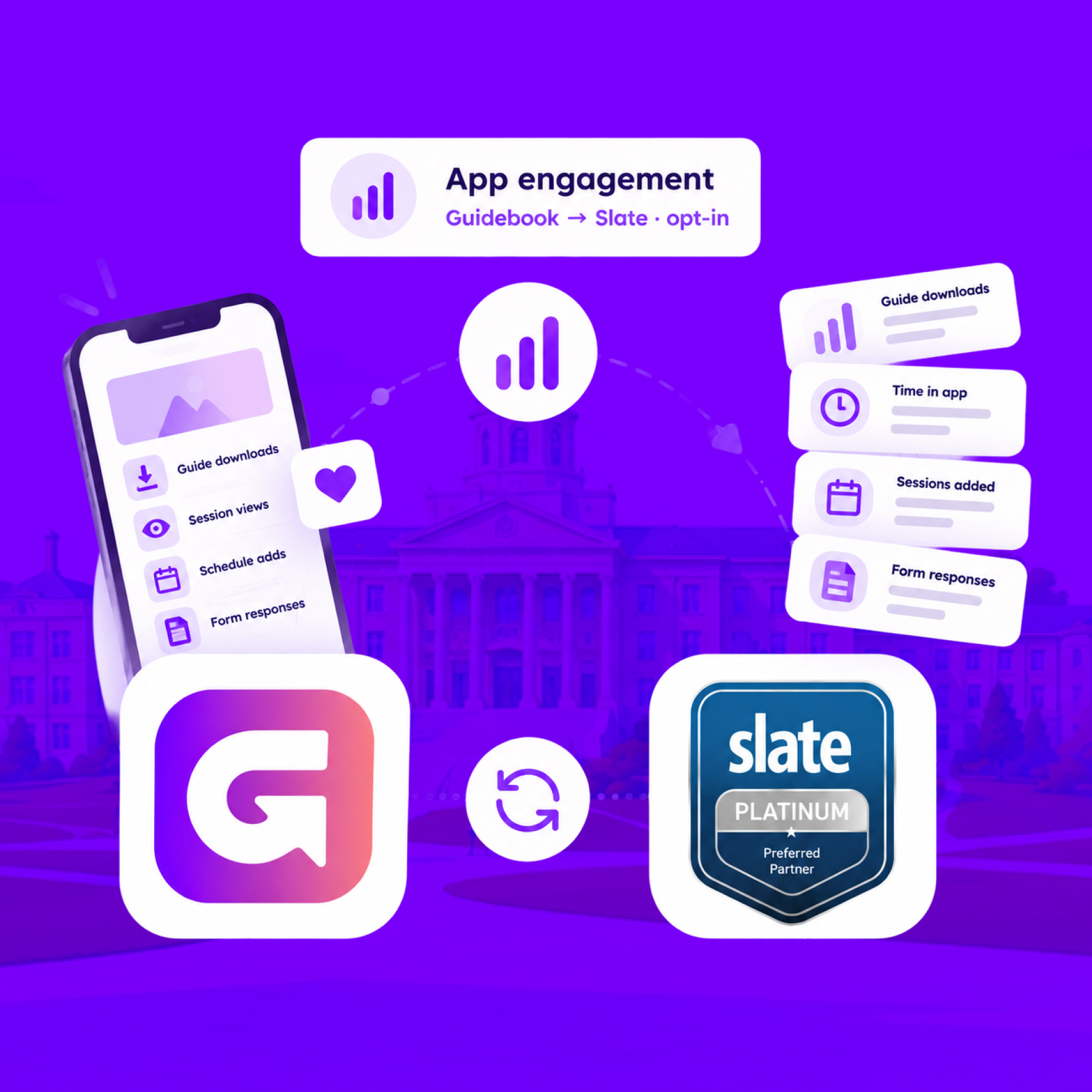
Send app engagement back to Slate
For students who opt in, downloads, schedule adds, views, and form responses land on their event registration every hour.
Build the campus event once in Slate
Link a Slate folder to a guide. Every event becomes a session, and registrants are added automatically.
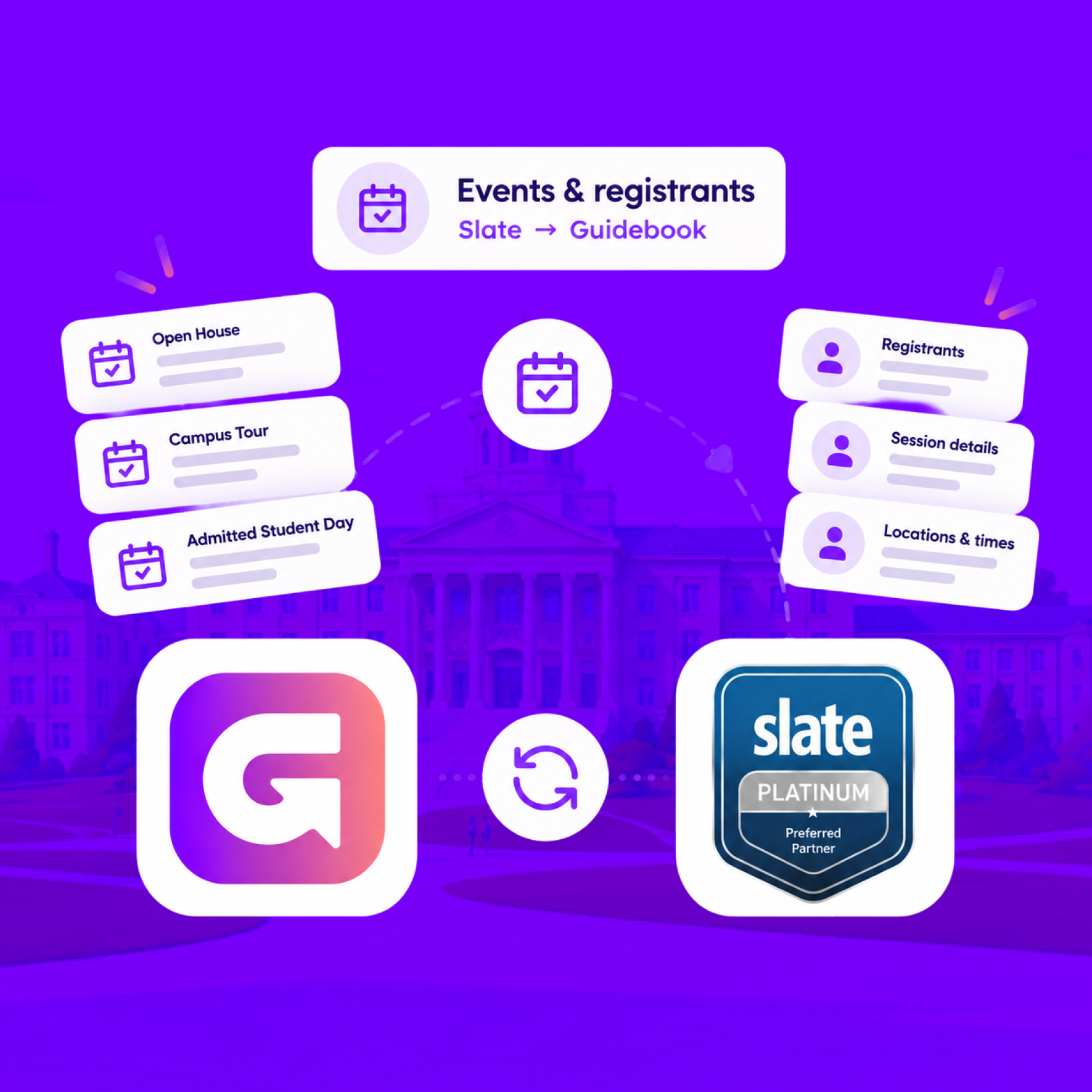
Build the campus event once in Slate
Link a Slate folder to a guide. Every event becomes a session, and registrants are added automatically.
Slate profiles, in the campus app
Match each student's Slate record to their Guidebook account, so college, major, and orientation details stay current on every sync.
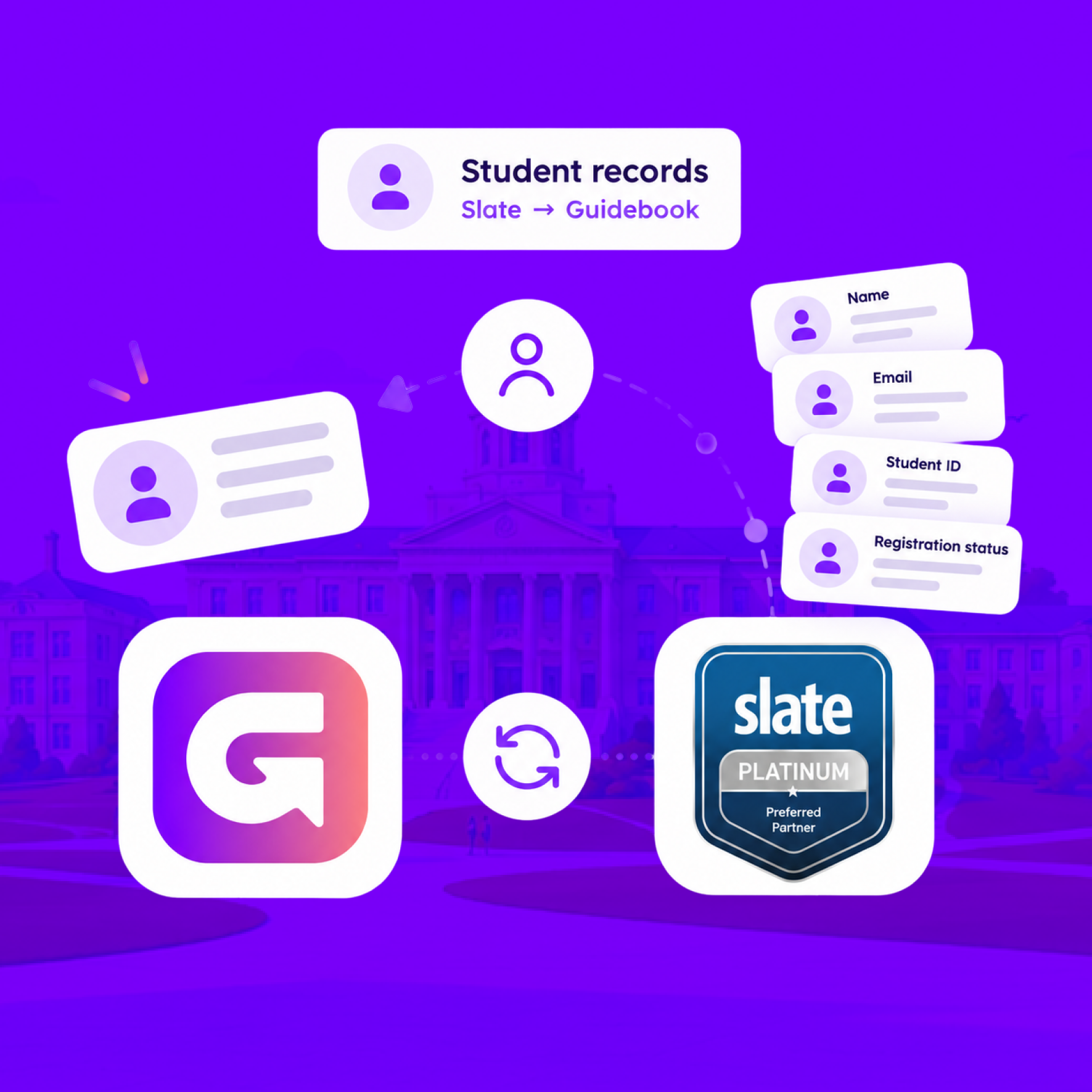
Slate profiles, in the campus app
Match each student's Slate record to their Guidebook account, so college, major, and orientation details stay current on every sync.
Campus apps by department
Admissions, orientation, student life, and more — one campus app that works across departments.

Campus apps by department
Admissions, orientation, student life, and more — one campus app that works across departments.
Build unlimited event apps on one license
One partnership for unlimited campus events — orientation, tours, student life, and everything in between.
Build unlimited event apps on one license
One partnership for unlimited campus events — orientation, tours, student life, and everything in between.
Compare event app platforms
See how Guidebook stacks up against other event app and registration platforms.
Compare event app platforms
See how Guidebook stacks up against other event app and registration platforms.
Event apps for nonprofit and community programs
Give members, volunteers, and donors one branded app for conferences, fundraisers, and year-round community.
Event apps for nonprofit and community programs
Give members, volunteers, and donors one branded app for conferences, fundraisers, and year-round community.
Campus integrations and an open API
Connect Guidebook with the campus systems, APIs, and tools your team already uses.
Campus integrations and an open API
Connect Guidebook with the campus systems, APIs, and tools your team already uses.
Event apps for corporate and enterprise teams
Internal meetings, offsites, and large-scale corporate events — with the branding and control enterprise teams need.
Event apps for corporate and enterprise teams
Internal meetings, offsites, and large-scale corporate events — with the branding and control enterprise teams need.
Create a branded event app with no coding
Put schedules, maps, resources, and updates in every attendee's pocket — built for campus events and programs.
Create a branded event app with no coding
Put schedules, maps, resources, and updates in every attendee's pocket — built for campus events and programs.
Launch a branded, white-label event app
A white-label event app with your branding, your content, and your attendee experience — no coding required.
Launch a branded, white-label event app
A white-label event app with your branding, your content, and your attendee experience — no coding required.
Everything in the Guidebook platform
Explore the features event teams use to engage attendees before, during, and after the event.
Everything in the Guidebook platform
Explore the features event teams use to engage attendees before, during, and after the event.
One app for in-person and virtual attendees
The same schedule, networking, and updates whether people are in the room or joining remotely.
One app for in-person and virtual attendees
The same schedule, networking, and updates whether people are in the room or joining remotely.
Event apps built for associations
Annual meetings, chapter events, and member engagement — without rebuilding a new app every year.
Event apps built for associations
Annual meetings, chapter events, and member engagement — without rebuilding a new app every year.
A branded event website that matches the app
Promote the event, collect interest, and keep branding consistent from the first click to check-in.
A branded event website that matches the app
Promote the event, collect interest, and keep branding consistent from the first click to check-in.
Plan, run, and measure events on one platform
App, registration, badges, and websites in one workflow — so planning isn't a pile of disconnected tools.
Plan, run, and measure events on one platform
App, registration, badges, and websites in one workflow — so planning isn't a pile of disconnected tools.
Keep members engaged between events
One branded app for the conference and everything that happens the other 51 weeks of the year.
Keep members engaged between events
One branded app for the conference and everything that happens the other 51 weeks of the year.
The conference app attendees actually use
Schedules, maps, networking, and live updates for annual meetings, summits, and multi-day conferences.
The conference app attendees actually use
Schedules, maps, networking, and live updates for annual meetings, summits, and multi-day conferences.
Registration that feeds your app and badges
Collect registrations, payments, and attendee data in the same platform as your event app.
Registration that feeds your app and badges
Collect registrations, payments, and attendee data in the same platform as your event app.
Design and print event badges in one place
Custom badges, QR check-in, and on-site printing — without a separate badge vendor.
Design and print event badges in one place
Custom badges, QR check-in, and on-site printing — without a separate badge vendor.
A Smaller School?
Deliver a polished, branded event experience without a large team or a big budget.
A Smaller School?
Deliver a polished, branded event experience without a large team or a big budget.
Running Family Programs?
Give families everything they need, from schedules and maps to real-time updates, all in one place.
Running Family Programs?
Give families everything they need, from schedules and maps to real-time updates, all in one place.
Coordinating Move-In Day?
Share updates, manage events, and keep students informed from move-in through the academic year.

Coordinating Move-In Day?
Share updates, manage events, and keep students informed from move-in through the academic year.
Offering Campus Tours?
Deliver branded, self-guided tour experiences with interactive maps and rich media, available 24/7.

Offering Campus Tours?
Deliver branded, self-guided tour experiences with interactive maps and rich media, available 24/7.
Organising a Career Fair?
Simplify logistics for students, employers, and Career Services staff with one easy-to-use app.
Organising a Career Fair?
Simplify logistics for students, employers, and Career Services staff with one easy-to-use app.
Managing Alumni Events?
Plan reunions, regional events, and fundraising campaigns with an app built for alumni engagement.
Managing Alumni Events?
Plan reunions, regional events, and fundraising campaigns with an app built for alumni engagement.
Boost Student Engagement
One hub for schedules, resources, and events that keeps students connected throughout the academic year.
Boost Student Engagement
One hub for schedules, resources, and events that keeps students connected throughout the academic year.
Planning Orientation?
Help new students feel prepared from day one with schedules, campus resources, and real-time updates in one app.
Planning Orientation?
Help new students feel prepared from day one with schedules, campus resources, and real-time updates in one app.
Running Admissions Events?
Manage open houses, tours, and yield events with a branded app that saves time and engages prospective students.

Running Admissions Events?
Manage open houses, tours, and yield events with a branded app that saves time and engages prospective students.
Get a custom Sponsorship Package Template
Stop starting from scratch. Grab free templates that helWe'll build a tailored sponsorship package with suggested pricing, tiers, and benefits..for your specific event.p you build professional sponsorship packages and close deals faster.
Get a custom Sponsorship Package Template
Stop starting from scratch. Grab free templates that helWe'll build a tailored sponsorship package with suggested pricing, tiers, and benefits..for your specific event.p you build professional sponsorship packages and close deals faster.
Plan Your Next Event Without Missing a Beat.
From venue selection to post-event wrap-up, this free checklist walks you through every step (so nothing falls through the cracks).
.avif)
Plan Your Next Event Without Missing a Beat.
From venue selection to post-event wrap-up, this free checklist walks you through every step (so nothing falls through the cracks).
Real Results From Real Events
100,000+ organizations trust Guidebook. See exactly how universities, associations, enterprises, and more put it to work.

Real Results From Real Events
100,000+ organizations trust Guidebook. See exactly how universities, associations, enterprises, and more put it to work.
Flexible pricing for every event size
Find the perfect plan for your needs, from intimate gatherings to large-scale conferences.

Flexible pricing for every event size
Find the perfect plan for your needs, from intimate gatherings to large-scale conferences.
Join our event experts
Watch on-demand webinars and join live sessions with industry leaders sharing best practices for event success.
.avif)
Join our event experts
Watch on-demand webinars and join live sessions with industry leaders sharing best practices for event success.
Guidebook in Action
Book a personalized walkthrough and discover how we help event teams create better attendee experiences.
Guidebook in Action
Book a personalized walkthrough and discover how we help event teams create better attendee experiences.
25 Symposium Event Ideas to Keep Attendees Engaged
.avif)





25 Symposium Event Ideas to Keep Attendees Engaged
25 Symposium Event Ideas to Make Your Gathering Unforgettable
Planning a symposium that actually engages attendees takes more than a strong speaker lineup. It takes deliberate choices about how attendees spend the time between, and around, the presentations.
This guide is here to help you with that, as we dive into:
- How to choose the right icebreakers based on your group size and time constraints.
- Which interactive session formats work best for expert-heavy audiences.
- How to structure networking activities that feel natural for (sometimes) introverted academics and researchers.
- Creative ways to tie themed activities directly to your symposium topic.
- How to layer in tech tools that work for both in-person and virtual attendees.
Take what makes sense for your specific event and leave the rest.
Let’s get to it!
Icebreakers and opening activities to set the tone
The opening of a symposium sets the tone for everything that follows.
Attendees who feel at ease early participate more openly, ask better questions, and stick around for networking instead of slipping out after the last session.
Here are five icebreakers that work especially well for intimate, knowledge-focused gatherings. For very short gatherings (half-day or less), pick one icebreaker and execute it well rather than stacking two. The goal is energy and connection, not a schedule crunch.
1. Two truths and a lie (research edition)
Ask each attendee to submit two facts and one fiction about their work before the event. Display them on screen and let the room guess. It’s a low-pressure way to surface interesting research while sparking curiosity. Plus, it naturally leads to follow-up conversations.
2. Word cloud warm-up
Open with a live poll asking attendees to submit one word that describes what they hope to take away. Watching the cloud populate in real time creates an immediate sense of shared purpose and tells you a lot about the room’s priorities.
3. Themed trivia
A quick 10-minute quiz on your symposium topic gets people laughing, competing gently, and connecting across tables before a single presentation begins.
4. Speed introductions
Pair attendees for 90-second conversations before rotating. This is basically a compact version of speed networking that warms up the room quickly without eating into your agenda.
5. Prompt cards at seats
Place a single discussion question on each chair tied to the day’s theme. When attendees sit down, they have an immediate conversation starter with whoever’s next to them.
Interactive session formats beyond lectures
Symposiums are designed around in-depth discussion and active participation, which means your audience already expects more than a talking head at a podium.
They’re a focused group with plenty to say. The opportunity is to lean into that expectation and design sessions that genuinely put attendees in the conversation.
Here are six formats worth building into your agenda
6. Fishbowl debate
Place four to five speakers in an inner circle to debate a contested topic in your field, with the rest of the audience observing. After each round, one inner seat opens for an audience member to join. It creates a layered, evolving discussion that feels live and unpredictable.
7. Lightning talks + instant reaction polls
Give speakers five to seven minutes to present one focused idea, then immediately open a live poll asking the audience to vote on a related question. The rhythm keeps energy high and ensures every presentation sparks a response.
8. Open space technology
Publish a blank agenda at the start of the day and invite attendees to propose and self-select into discussion topics. This format works especially well for expert groups who have more to say than a pre-set agenda allows.
9. Peer review workshop
Split attendees into small groups and give each a short case study, abstract, or research challenge to critique and improve together. It mirrors the academic peer review process in a collaborative, low-stakes setting.
10. Panel with structured audience input
Before the panel begins, collect written questions from the room. The moderator weaves them in throughout (rather than saving all Q&A for the end) keeping the audience invested from the first minute.
11. Demonstration + discussion
Invite a presenter to show rather than tell. Whether it’s a research method, a software tool, or a data visualization, live demonstrations generate questions that pure lectures rarely do.
Networking ideas tailored for symposiums
One of the real advantages of a symposium is that the focused group creates the conditions for genuine connection, not just card-swapping.
But that potential doesn’t automatically become reality. Structured activities are what close the gap, especially for audiences that skew introverted or academic.
Here are five networking formats that work within a tight one-day window:
12. Speed networking with research prompts
Pair participants one-to-one for short, timed conversations before rotating, giving each pairing a specific prompt. “What’s one finding from your work that surprised you?” is more useful than leaving it open-ended.
Academic audiences need somewhere to go immediately, or the conversation stalls.
13. Roundtable solution shares
Set up tables with topic signs and conversation prompts, then rotate participants every 12–15 minutes. Keep groups to six or eight so everyone actually speaks. The format works well when your topic lends itself to problem-sharing rather than lecture.
14. Goal-tagged name badges
Add one line to each attendee’s badge: “I’m looking for...” or “I can help with...” It removes the awkwardness of cold introductions and gives people a reason to read each other’s badges deliberately.
It’s a simple mechanism, but declaring what you need in a room full of people who might have it is surprisingly powerful.
15. Collaborative problem wall
Post three to five open questions from your field on large sheets around the room. During breaks, attendees add sticky note responses and reactions to each other’s ideas. By the end of the day, the walls become a visible, crowdsourced output of the group’s collective thinking.
16. Curated lunch seating
Assign seats at lunch by research interest or career stage rather than leaving it to chance. A brief prompt at each table gets conversation started without any facilitation overhead. The goal isn’t to force connection; it’s to remove the default behavior of sitting with people you already know.
Themed and creative twists for memorable moments
A symposium doesn’t have to choose between being rigorous and being memorable. The most effective creative touches reinforce your theme rather than distract from it; they make the intellectual content feel more alive, not less serious.
Here are five ideas that earn their place on a tight agenda.
17. Scenario challenge
Ask a speculative question about your field (e.g. “What does this look like in 20 years?”) and give small groups 15 minutes to build a response. Then present the findings in a rapid-fire format. It’s intellectually engaging, generates surprising discussion, and creates a natural anchor for the closing session.
18. Visual idea wall
Set up a large sheet of paper or whiteboard where participants add responses, reactions, and sketches to a discipline-specific prompt throughout the day, such as “One assumption in our field worth challenging” or “A gap no one is talking about.”
By the time you reach the closing session, it’s become a real artifact of the group’s collective thinking.
19. Themed trivia between sessions
Short trivia rounds tied to the history of your field, notable findings, or field-specific fun facts work well as session resets. Even five minutes of low-stakes competition before the next talk can do more to re-energize attendees than a coffee break.
20. Wellness reset
Build a 10-minute guided stretch or breathing exercise into the mid-afternoon slot, facilitated by a volunteer or a short video. It sounds simple, but it meaningfully sustains focus during the hours when energy typically dips.
21. Closing commitment cards
End the day by asking every attendee to write one action they’ll take based on what they learned and one person in the room they plan to follow up with. Collect and mail them back 30 days later. It creates accountability, extends the symposium’s impact, and gives attendees a reason to stay connected.
Tech-enhanced and hybrid-friendly ideas
Adding a remote audience to a symposium changes the dynamics considerably. While it can be tempting to treat the hybrid experience as an afterthought, the goal is to give those virtual attendees genuine participation opportunities.
Here are five tech-driven ideas that work across formats.
22. Live polling throughout sessions
A well-placed poll mid-presentation does two things: it gives the speaker real-time signal about how the room is tracking, and it gives attendees something to do other than listen passively. With the right event technology, you can build these into your app at scale.
23. Digital Q&A queues
Replace the hand-raise format with a shared digital queue where both in-room and remote attendees submit questions. A moderator reads and curates them in real time, which also helps introverted attendees participate without the pressure of speaking up in a room.
24. Virtual breakout rotations
For hybrid symposia, build structured breakout sessions where remote attendees rotate between small virtual rooms on the same schedule as in-person table rotations. The parallel structure makes both groups feel like participants in the same event, not separate experiences.
25. Gamified session check-ins
Award points for actions like attending sessions, submitting questions, or completing a brief post-session reflection. A visible leaderboard keeps people oriented across the day without demanding anything heavy. Small rewards — e.g. early access to proceedings, a featured mention — are enough to make this work.
Quick-reference: Symposium event ideas by category
The best symposiums leave people wanting to come back
A great symposium doesn't just inform; it reminds people why they care about their work.
The ideas in this guide are a starting point. Choose a few, try them, and refine as you go. The planners who run the most memorable events aren't the ones with the biggest budgets; they're the ones who keep asking how to make the experience better.
Frequently asked questions
[faq]
Q: How do you make a symposium more interactive without derailing the agenda?
A: The key is building interactivity into the session structure itself rather than adding activities on top of it. Formats like live polling, structured Q&A queues, and fishbowl debates don’t require extra time slots. They replace passive listening within sessions that were already on the schedule. Even a single two-minute poll mid-presentation meaningfully increases engagement without disrupting flow.
Q: What are good symposium icebreakers for academic audiences?
A: Academic audiences tend to respond well to icebreakers that feel intellectually relevant rather than purely social. Research-themed trivia, word cloud warm-ups asking about session goals, and “Two Truths and a Lie” framed around professional work all hit the right note. Avoid overly personal or physical activities since the goal is to lower barriers, not raise them.
Q: How do you plan a hybrid symposium effectively?
A: Start by designing the experience for remote attendees first, then adapt for the room. Build parallel participation structures (shared Q&A queues, simultaneous breakout rotations, a live digital backchannel) so virtual attendees aren’t watching a livestream of something happening without them. Also plan for WiFi failure: ensure all critical materials are accessible offline.
Q: What are the best symposium networking ideas for small groups?
A: Structured formats work better than open networking for small, expert groups. Roundtable discussions with rotating participants, goal-tagged name badges, and curated lunch seating all create intentional connection points without the awkwardness of unstructured mingling. The smaller the group, the more a single prompt or shared task can do the heavy lifting.
Q: Are there free symposium engagement ideas that work on a tight budget?
A: Many of the highest-impact ideas cost nothing. Live polls (using free tiers of tools like Mentimeter), prompt cards at seats, commitment cards, collaborative problem walls using sticky notes, and open space technology sessions all require zero budget. The investment is in design and facilitation, not spend.
Q: What should a one-day symposium agenda include beyond presentations?
A: A well-balanced one-day agenda typically includes at least one structured icebreaker at the start, one interactive session format (like a panel with live Q&A or a fishbowl debate), one structured networking activity during a break, and a closing reflection or commitment exercise. Spacing these throughout the day maintains energy and prevents the passive-listening fatigue that long presentation blocks create.
Q: How do you theme a symposium around a specific topic without it feeling gimmicky?
A: The best themes amplify the intellectual content rather than decorate it. A “Field of the Future” scenario challenge, a visual idea wall with discipline-specific prompts, or themed trivia built from the history of your research area all tie directly to why attendees are there. If a creative element can’t be explained in terms of what it adds to the conversation, it probably doesn’t belong.
Q: What virtual symposium event ideas actually work for remote-only audiences?
A: Virtual symposiums benefit most from highly structured participation: live polls woven throughout sessions, digital Q&A queues, small-group breakout rooms with facilitated prompts, and a shared backchannel for real-time reactions. Gamified check-ins and closing commitment cards translate seamlessly online. The biggest risk with virtual formats is passive watching. So, every 20 to 30 minutes, consider building in a touchpoint that requires the audience to do something.
[/faq]

Get the Mobile App Playbook
A short guide to running the whole student journey in one app. No fluff, just what works.
for higher ed
Campus
Playbook
A practical guide to building a connected campus experience.
Free playbook
The Mobile App Playbook for Universities
Students decide if they belong long before they set foot on campus. This playbook shows how to win them over from the first visit through graduation.
- Grow enrollment and boost recruitment
- Increase belonging and retention
- Run every event from one branded app
By submitting, you agree to our Privacy Policy.
You're in.
.png)