Campus apps by department
Admissions, orientation, student life, and more — one campus app that works across departments.

Campus apps by department
Admissions, orientation, student life, and more — one campus app that works across departments.
Build unlimited event apps on one license
One partnership for unlimited campus events — orientation, tours, student life, and everything in between.
Build unlimited event apps on one license
One partnership for unlimited campus events — orientation, tours, student life, and everything in between.
Compare event app platforms
See how Guidebook stacks up against other event app and registration platforms.
Compare event app platforms
See how Guidebook stacks up against other event app and registration platforms.
Event apps for nonprofit and community programs
Give members, volunteers, and donors one branded app for conferences, fundraisers, and year-round community.
Event apps for nonprofit and community programs
Give members, volunteers, and donors one branded app for conferences, fundraisers, and year-round community.
Campus integrations and an open API
Connect Guidebook with the campus systems, APIs, and tools your team already uses.
Campus integrations and an open API
Connect Guidebook with the campus systems, APIs, and tools your team already uses.
Event apps for corporate and enterprise teams
Internal meetings, offsites, and large-scale corporate events — with the branding and control enterprise teams need.
Event apps for corporate and enterprise teams
Internal meetings, offsites, and large-scale corporate events — with the branding and control enterprise teams need.
Create a branded event app with no coding
Put schedules, maps, resources, and updates in every attendee's pocket — built for campus events and programs.
Create a branded event app with no coding
Put schedules, maps, resources, and updates in every attendee's pocket — built for campus events and programs.
Launch a branded, white-label event app
A white-label event app with your branding, your content, and your attendee experience — no coding required.
Launch a branded, white-label event app
A white-label event app with your branding, your content, and your attendee experience — no coding required.
Everything in the Guidebook platform
Explore the features event teams use to engage attendees before, during, and after the event.
Everything in the Guidebook platform
Explore the features event teams use to engage attendees before, during, and after the event.
One app for in-person and virtual attendees
The same schedule, networking, and updates whether people are in the room or joining remotely.
One app for in-person and virtual attendees
The same schedule, networking, and updates whether people are in the room or joining remotely.
Event apps built for associations
Annual meetings, chapter events, and member engagement — without rebuilding a new app every year.
Event apps built for associations
Annual meetings, chapter events, and member engagement — without rebuilding a new app every year.
A branded event website that matches the app
Promote the event, collect interest, and keep branding consistent from the first click to check-in.
A branded event website that matches the app
Promote the event, collect interest, and keep branding consistent from the first click to check-in.
Plan, run, and measure events on one platform
App, registration, badges, and websites in one workflow — so planning isn't a pile of disconnected tools.
Plan, run, and measure events on one platform
App, registration, badges, and websites in one workflow — so planning isn't a pile of disconnected tools.
Keep members engaged between events
One branded app for the conference and everything that happens the other 51 weeks of the year.
Keep members engaged between events
One branded app for the conference and everything that happens the other 51 weeks of the year.
The conference app attendees actually use
Schedules, maps, networking, and live updates for annual meetings, summits, and multi-day conferences.
The conference app attendees actually use
Schedules, maps, networking, and live updates for annual meetings, summits, and multi-day conferences.
Registration that feeds your app and badges
Collect registrations, payments, and attendee data in the same platform as your event app.
Registration that feeds your app and badges
Collect registrations, payments, and attendee data in the same platform as your event app.
Design and print event badges in one place
Custom badges, QR check-in, and on-site printing — without a separate badge vendor.
Design and print event badges in one place
Custom badges, QR check-in, and on-site printing — without a separate badge vendor.
A Smaller School?
Deliver a polished, branded event experience without a large team or a big budget.
A Smaller School?
Deliver a polished, branded event experience without a large team or a big budget.
Running Family Programs?
Give families everything they need, from schedules and maps to real-time updates, all in one place.
Running Family Programs?
Give families everything they need, from schedules and maps to real-time updates, all in one place.
Coordinating Move-In Day?
Share updates, manage events, and keep students informed from move-in through the academic year.

Coordinating Move-In Day?
Share updates, manage events, and keep students informed from move-in through the academic year.
Offering Campus Tours?
Deliver branded, self-guided tour experiences with interactive maps and rich media, available 24/7.

Offering Campus Tours?
Deliver branded, self-guided tour experiences with interactive maps and rich media, available 24/7.
Organising a Career Fair?
Simplify logistics for students, employers, and Career Services staff with one easy-to-use app.
Organising a Career Fair?
Simplify logistics for students, employers, and Career Services staff with one easy-to-use app.
Managing Alumni Events?
Plan reunions, regional events, and fundraising campaigns with an app built for alumni engagement.
Managing Alumni Events?
Plan reunions, regional events, and fundraising campaigns with an app built for alumni engagement.
Boost Student Engagement
One hub for schedules, resources, and events that keeps students connected throughout the academic year.
Boost Student Engagement
One hub for schedules, resources, and events that keeps students connected throughout the academic year.
Planning Orientation?
Help new students feel prepared from day one with schedules, campus resources, and real-time updates in one app.
Planning Orientation?
Help new students feel prepared from day one with schedules, campus resources, and real-time updates in one app.
Running Admissions Events?
Manage open houses, tours, and yield events with a branded app that saves time and engages prospective students.

Running Admissions Events?
Manage open houses, tours, and yield events with a branded app that saves time and engages prospective students.
Get a custom Sponsorship Package Template
Stop starting from scratch. Grab free templates that helWe'll build a tailored sponsorship package with suggested pricing, tiers, and benefits..for your specific event.p you build professional sponsorship packages and close deals faster.
Get a custom Sponsorship Package Template
Stop starting from scratch. Grab free templates that helWe'll build a tailored sponsorship package with suggested pricing, tiers, and benefits..for your specific event.p you build professional sponsorship packages and close deals faster.
Plan Your Next Event Without Missing a Beat.
From venue selection to post-event wrap-up, this free checklist walks you through every step (so nothing falls through the cracks).
.avif)
Plan Your Next Event Without Missing a Beat.
From venue selection to post-event wrap-up, this free checklist walks you through every step (so nothing falls through the cracks).
Real Results From Real Events
100,000+ organizations trust Guidebook. See exactly how universities, associations, enterprises, and more put it to work.

Real Results From Real Events
100,000+ organizations trust Guidebook. See exactly how universities, associations, enterprises, and more put it to work.
Flexible pricing for every event size
Find the perfect plan for your needs, from intimate gatherings to large-scale conferences.

Flexible pricing for every event size
Find the perfect plan for your needs, from intimate gatherings to large-scale conferences.
Join our event experts
Watch on-demand webinars and join live sessions with industry leaders sharing best practices for event success.
.avif)
Join our event experts
Watch on-demand webinars and join live sessions with industry leaders sharing best practices for event success.
Guidebook in Action
Book a personalized walkthrough and discover how we help event teams create better attendee experiences.
Guidebook in Action
Book a personalized walkthrough and discover how we help event teams create better attendee experiences.
Your Call For Proposals Is Ruining Your Conference





Your Call For Proposals Is Ruining Your Conference
When your conference ends there’s often little respite before preparation begins for next year’s event. It feels like as the tables are being broken down and chairs are being stacked, the call for proposals is already going out to solicit next year’s speakers - which might be your first mistake.
Here’s the old model we’re all used to: The call for proposals goes out, speakers apply with their talks, speakers are chosen by a volunteer committee, those speakers speak at the conference, attendees roll the dice and hope that they end up attending a worthwhile session. At the end of the day, you’ve basically left your conference’s content in the hands of your speakers.
As we attend more and more conferences, and become more and more tired of rolling the dice, the industry has begun to collectively say, “There must be a better way!” How can we make sure that our sessions are supporting a single theme? How do we keep speakers on topic? Is it even possible to break the cycle and evolve your event?
You can change the trajectory of your conference from year to year. But the old model is going to have to go and it’s going to take a concerted effort on your organization’s part. The result, however, will be unprecedented attendee engagement and growing attendance numbers.
Define your thesis

Jeff Hurt is the Executive Vice President at Velvet Chainsaw Consulting in Dallas, TX. Jeff is an industry leader when it comes to crafting better conferences, annual meetings and professional development. When it’s time to focus your event Jeff says you should think, “Who’s my target audience and what’s keeping them up at night?” Or, even better, “What are the business outcomes of my target attendee?”

This is the first step when taking back control of your conference. Answering these questions immediately gives you your core learning objectives for the event. If your sessions are all supporting your core learning objectives, you’re on your way to creating truly effective content.
Tracy King is an independent consultant at InspirED, LLC. She helps people bridge learning science and practice to create engaging program content. For Tracy, after your organization’s membership has been polled, leadership should be asking the question, “What do attendees need to know to be successful in this industry?”Curate your content

Your event is defined by the sum of its content. Much like a finely designed trade publication, people are counting on your event for relevancy and a dose of progressivism. Don’t disappoint them with stale, haphazard content.
Your favorite magazines, blogs and podcasts all carefully curate their content. Why wouldn’t you do the same for your event?
Finding the right folks
Curation will almost definitely mean taking a second look at your call for proposals process. If you’re looking for a very specific type of content, you’ll only be able to rely partially on proposals submitted by speakers. There will also be an element of recruiting the right speakers to support the learning objectives.
Tracy is an advocate of content curation, but she understands that for most organizations the process of finding speakers will be a combination of proposals and recruiting. “A good medium place for associations to be is to develop the curriculum for their meeting so they have the learning objectives in place and know what kind of change they want to see in their learners. Their call for proposals can be a mix of recruiting known speakers and opening a call for the other components.”
Conference quality control
Moving to a curation style of developing your event’s content also means that the organization will need to take greater responsibility for the quality the speakers are delivering. Or as Tracy puts it, “If you’re approaching a meeting from a learning standpoint, you have to be involved in the design of the learning.”
If you have recruited speakers, the task is a simpler one because you can outline your expectations from the beginning. If you are culling speakers from the call for proposals, you can still outline expectations, “but the commitment is a lot lower and you have to be committed to training and supporting your faculty in creating good learning,” says Tracy.
Break your patterns

You’ve probably noticed by now that we’re not talking about quick fixes. In some instances, we’re looking at major changes in the overall approach to a meeting. Igniting innovation can be a tricky undertaking and can often be difficult for many organizations. It’s best to start at the beginning, and change begins with taking a look at how you evaluate your event’s success.
Rethinking ROI
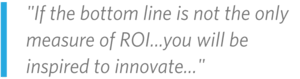
Tracy says, “If the bottom line is not the only measure of ROI - if change and value in the workplace is something that is measured and part of your bottom line - you will be inspired to innovate, because how can you not?”
According to Tracy, being in touch with your attendees’ needs can’t help but spur innovation. “You’re in the marketplace and talking to the employers - what do they need? What does their workforce need? How can we provide that and be the premiere provider of that content? What tools do your employees need to be successful and rise in the ranks of their profession? That would inspire an association to deliver things differently.”
Storytelling 101
If we stop seeing our events as a collection of individual sessions and more as a complete experience - one that’s supporting our learning objectives - we’ll begin to deliver more reliably impactful experiences to our attendees.
It’s what Tracy calls an “arc.” Jeff says you can begin to craft your arc by answering the question, “What emotional journey are you taking people on?”

Every great story has a clear beginning, middle and end. It is our responsibility to lead attendees through the story arc and make sure that the experience itself is delivered in a digestible, cohesive format. Don’t be surprised if this has you rethinking certain assumed structures from previous years’ formats.
The human brain is primed to latch onto story - we use stories to frame our experiences. If the experience of an event has been considered, you’ll give your attendees the perfect tool for success - a solid framing device.
How to win with your call for proposals
For Jeff and Tracy, mastering this process is going to determine the success of your event in the future. Tracy put it this way: “In order for associations to differentiate themselves, they have to think in terms of their attendees’ experience and the value for the attendee. And the value needs to be ‘this is going to create positive change for me.’ If attendees are always casting dice at an event, they’re going to choose another event.”
Making a cohesive event experience, rethinking your ROI, curating speakers - it all stems back to your call for proposals. When you’re looking for speakers are you dictating the content of your conference? Or is your content choosing your objectives for you?
Designing a conference schedule is a tricky business. At Guidebook, we have a team of world-class designers who do the work for you. All you have to do is upload to a template (it takes 30 seconds). Watch the video!

Get the Mobile App Playbook
A short guide to running the whole student journey in one app. No fluff, just what works.
for higher ed
Campus
Playbook
A practical guide to building a connected campus experience.
Free playbook
The Mobile App Playbook for Universities
Students decide if they belong long before they set foot on campus. This playbook shows how to win them over from the first visit through graduation.
- Grow enrollment and boost recruitment
- Increase belonging and retention
- Run every event from one branded app
By submitting, you agree to our Privacy Policy.
You're in.
.png)

.avif)