Campus apps by department
Admissions, orientation, student life, and more — one campus app that works across departments.

Campus apps by department
Admissions, orientation, student life, and more — one campus app that works across departments.
Build unlimited event apps on one license
One partnership for unlimited campus events — orientation, tours, student life, and everything in between.
Build unlimited event apps on one license
One partnership for unlimited campus events — orientation, tours, student life, and everything in between.
Compare event app platforms
See how Guidebook stacks up against other event app and registration platforms.
Compare event app platforms
See how Guidebook stacks up against other event app and registration platforms.
Event apps for nonprofit and community programs
Give members, volunteers, and donors one branded app for conferences, fundraisers, and year-round community.
Event apps for nonprofit and community programs
Give members, volunteers, and donors one branded app for conferences, fundraisers, and year-round community.
Campus integrations and an open API
Connect Guidebook with the campus systems, APIs, and tools your team already uses.
Campus integrations and an open API
Connect Guidebook with the campus systems, APIs, and tools your team already uses.
Event apps for corporate and enterprise teams
Internal meetings, offsites, and large-scale corporate events — with the branding and control enterprise teams need.
Event apps for corporate and enterprise teams
Internal meetings, offsites, and large-scale corporate events — with the branding and control enterprise teams need.
Create a branded event app with no coding
Put schedules, maps, resources, and updates in every attendee's pocket — built for campus events and programs.
Create a branded event app with no coding
Put schedules, maps, resources, and updates in every attendee's pocket — built for campus events and programs.
Launch a branded, white-label event app
A white-label event app with your branding, your content, and your attendee experience — no coding required.
Launch a branded, white-label event app
A white-label event app with your branding, your content, and your attendee experience — no coding required.
Everything in the Guidebook platform
Explore the features event teams use to engage attendees before, during, and after the event.
Everything in the Guidebook platform
Explore the features event teams use to engage attendees before, during, and after the event.
One app for in-person and virtual attendees
The same schedule, networking, and updates whether people are in the room or joining remotely.
One app for in-person and virtual attendees
The same schedule, networking, and updates whether people are in the room or joining remotely.
Event apps built for associations
Annual meetings, chapter events, and member engagement — without rebuilding a new app every year.
Event apps built for associations
Annual meetings, chapter events, and member engagement — without rebuilding a new app every year.
A branded event website that matches the app
Promote the event, collect interest, and keep branding consistent from the first click to check-in.
A branded event website that matches the app
Promote the event, collect interest, and keep branding consistent from the first click to check-in.
Plan, run, and measure events on one platform
App, registration, badges, and websites in one workflow — so planning isn't a pile of disconnected tools.
Plan, run, and measure events on one platform
App, registration, badges, and websites in one workflow — so planning isn't a pile of disconnected tools.
Keep members engaged between events
One branded app for the conference and everything that happens the other 51 weeks of the year.
Keep members engaged between events
One branded app for the conference and everything that happens the other 51 weeks of the year.
The conference app attendees actually use
Schedules, maps, networking, and live updates for annual meetings, summits, and multi-day conferences.
The conference app attendees actually use
Schedules, maps, networking, and live updates for annual meetings, summits, and multi-day conferences.
Registration that feeds your app and badges
Collect registrations, payments, and attendee data in the same platform as your event app.
Registration that feeds your app and badges
Collect registrations, payments, and attendee data in the same platform as your event app.
Design and print event badges in one place
Custom badges, QR check-in, and on-site printing — without a separate badge vendor.
Design and print event badges in one place
Custom badges, QR check-in, and on-site printing — without a separate badge vendor.
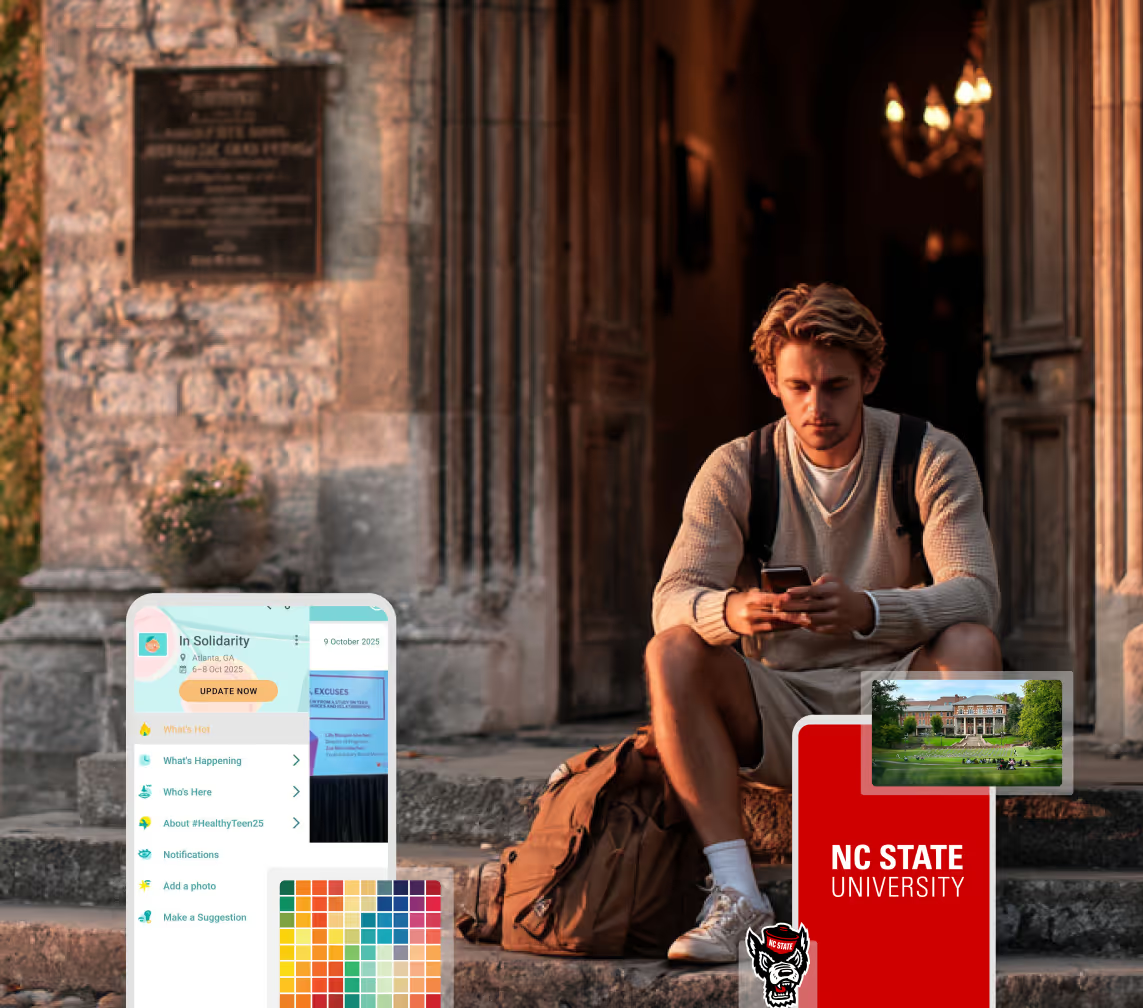
A Smaller School?
Deliver a polished, branded event experience without a large team or a big budget.
A Smaller School?
Deliver a polished, branded event experience without a large team or a big budget.
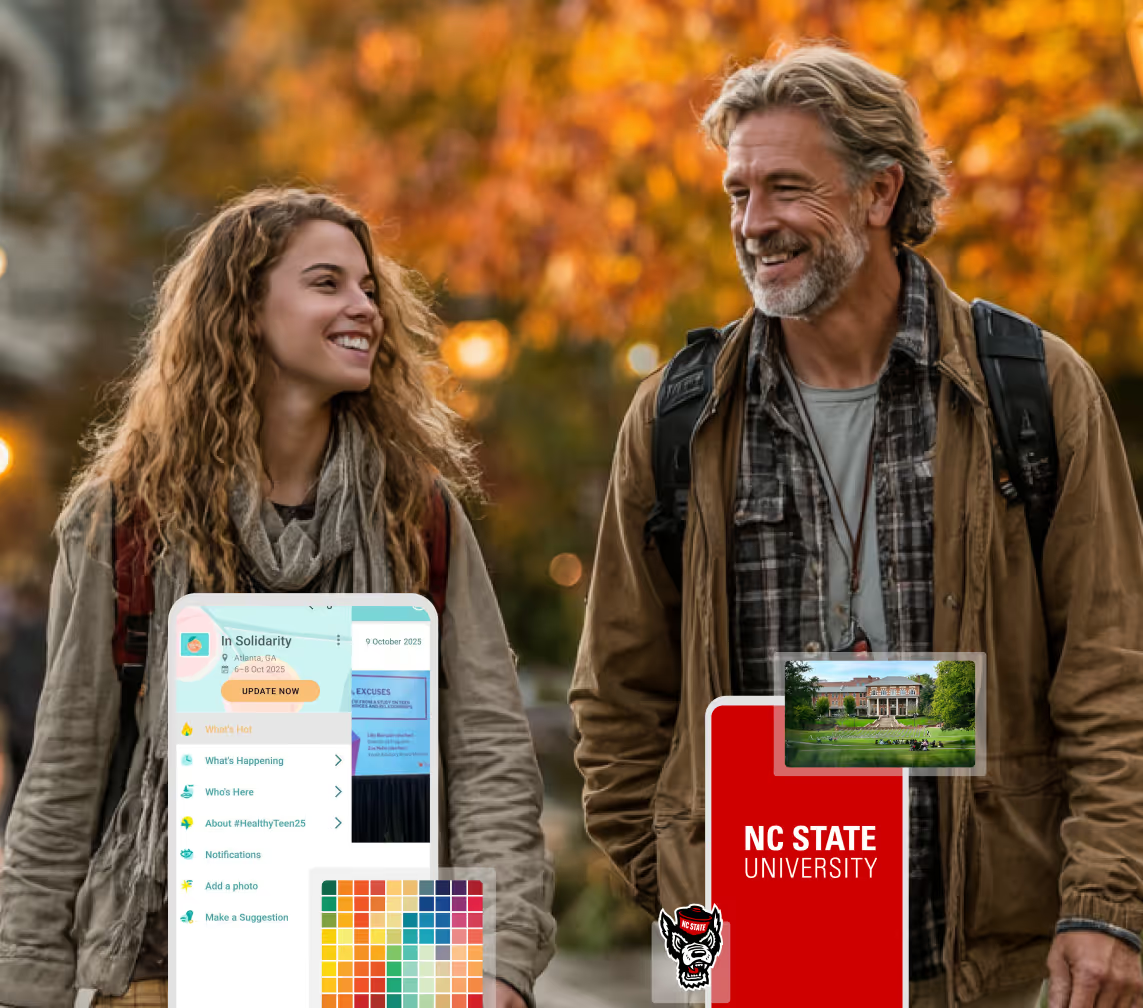
Running Family Programs?
Give families everything they need, from schedules and maps to real-time updates, all in one place.
Running Family Programs?
Give families everything they need, from schedules and maps to real-time updates, all in one place.
Coordinating Move-In Day?
Share updates, manage events, and keep students informed from move-in through the academic year.

Coordinating Move-In Day?
Share updates, manage events, and keep students informed from move-in through the academic year.
Offering Campus Tours?
Deliver branded, self-guided tour experiences with interactive maps and rich media, available 24/7.

Offering Campus Tours?
Deliver branded, self-guided tour experiences with interactive maps and rich media, available 24/7.
Organising a Career Fair?
Simplify logistics for students, employers, and Career Services staff with one easy-to-use app.
Organising a Career Fair?
Simplify logistics for students, employers, and Career Services staff with one easy-to-use app.
Managing Alumni Events?
Plan reunions, regional events, and fundraising campaigns with an app built for alumni engagement.
Managing Alumni Events?
Plan reunions, regional events, and fundraising campaigns with an app built for alumni engagement.
Boost Student Engagement
One hub for schedules, resources, and events that keeps students connected throughout the academic year.
Boost Student Engagement
One hub for schedules, resources, and events that keeps students connected throughout the academic year.
Planning Orientation?
Help new students feel prepared from day one with schedules, campus resources, and real-time updates in one app.
Planning Orientation?
Help new students feel prepared from day one with schedules, campus resources, and real-time updates in one app.
Running Admissions Events?
Manage open houses, tours, and yield events with a branded app that saves time and engages prospective students.

Running Admissions Events?
Manage open houses, tours, and yield events with a branded app that saves time and engages prospective students.
Get a custom Sponsorship Package Template
Stop starting from scratch. Grab free templates that helWe'll build a tailored sponsorship package with suggested pricing, tiers, and benefits..for your specific event.p you build professional sponsorship packages and close deals faster.
Get a custom Sponsorship Package Template
Stop starting from scratch. Grab free templates that helWe'll build a tailored sponsorship package with suggested pricing, tiers, and benefits..for your specific event.p you build professional sponsorship packages and close deals faster.
Plan Your Next Event Without Missing a Beat.
From venue selection to post-event wrap-up, this free checklist walks you through every step (so nothing falls through the cracks).
.avif)
Plan Your Next Event Without Missing a Beat.
From venue selection to post-event wrap-up, this free checklist walks you through every step (so nothing falls through the cracks).
Real Results From Real Events
100,000+ organizations trust Guidebook. See exactly how universities, associations, enterprises, and more put it to work.

Real Results From Real Events
100,000+ organizations trust Guidebook. See exactly how universities, associations, enterprises, and more put it to work.
Flexible pricing for every event size
Find the perfect plan for your needs, from intimate gatherings to large-scale conferences.
Flexible pricing for every event size
Find the perfect plan for your needs, from intimate gatherings to large-scale conferences.
Join our event experts
Watch on-demand webinars and join live sessions with industry leaders sharing best practices for event success.
.avif)
Join our event experts
Watch on-demand webinars and join live sessions with industry leaders sharing best practices for event success.
Guidebook in Action
Book a personalized walkthrough and discover how we help event teams create better attendee experiences.
Guidebook in Action
Book a personalized walkthrough and discover how we help event teams create better attendee experiences.
A Dive into the Data: Making the Case for Mobile





A Dive into the Data: Making the Case for Mobile
Mobile isn't just an epic game-changer. It's a prerequisite, Act One. Just one critical leg of the journey. Pick your analogy, but I like to think of mobile as the force that's accelerating a train we're all now aboard. It's critical to get it right—because strategic shifts made today lay the groundwork for what's coming.
How are people using their devices?
It’s clear that people are turning to mobile to find answers to their questions. But what do we know about actual smartphone usage? How often are people actually using their phones, and how does it compare to the usage of their devices? Let’s take a look at a study Google did, collecting user behavior from a sample of 11,964 cross-device users over the first three months of 2016.In the average day, more than 25% of all users only use a smartphone, which is nearly twice as many as those who only use a computer.What does this mean for you? If you aren't reaching your people on mobile, you risk missing out on a quarter of your audience. We live in a mobile-first world, and failing to reach people where they are is just dropping the ball. Not only this, but also, people spend an alarming amount of their day on devices, with smartphones leading the way.
Those who use a smartphone spend almost three hours per day on it.Even further,
80% use a smartphone daily, compared to just 67% who use a computer.What does this mean for you? For the first time ever, smartphone usage has surpassed even that of computers. Optimizing your content on a native mobile application is now an even greater priority than doing so for the desktop experience.
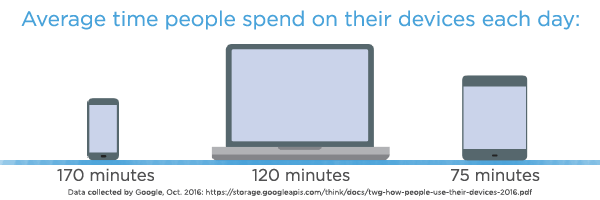 At this point, your guard may be going up. Who would prioritize a mobile strategy over their website? After all, many of us spend a majority of the day in front of a computer. And when we have a question, it’s definitely one of the first places we turn for answers. By no means is mobile a replacement for the desktop experience, but when you’re thinking about the role that mobile plays in people’s usage of their different devices, it’s important to consider how or why your audience is using an app; it’s about convenience, speed, and ease. People aren’t just looking for answers when they happen to be in front of a computer. It’s a 24/7 endeavor. And the data show, they’re now turning to their phones far more often than any other device, when they need reliable content and information.
39% of people search only on their smartphone.And more searches happen on mobile than on computers and tablets for 15 of the 24 hours in any given day.
Mobile-optimized websites vs. the Native App
Let’s take a look at another study. In a March 2016 study looking at data collected by Google Analytics, researchers determined that 53% of people will abandon a mobile site if it takes more than three seconds to load. We expect relevant information, fast. But here’s the thing: Google further tested 900,000 mobile sites around the world and found that the average time it takes to fully load a mobile page is 22 seconds.So mobile websites are taking forever to load, and people aren’t putting up with it. There’s a huge disconnect there, and it’s a problem that’s inherent in the current state of mobile-optimized websites and network speed.If a mobile-optimized website isn’t the answer, what is?
A key part of the mobile experience is about personalization and extending your brand presence. And the means of achieving that is by giving your audience the opportunity to download a native mobile app straight on their devices - one that learns about them and prove itself to be truly valuable. When we take another look at the data, we find this to be the case:89% of US marketers reported that personalization on their apps resulted in an increase in revenue. (source)When an app on your phone is personalized to you (meaning it learns and remembers information about you, your interests and disinterests, the types of content you typically engage with…) it makes a world of difference in increasing usage and ensuring your users are actually seeking your app out. And by being smart with the data that’s available to you and better understanding how your users are interacting with your content on mobile, you can scale personalization far more easily. If you’re a Guidebook user, check out Audience Insights -- it’s a ridiculously easy way of learning all about your users. People also expect companies to have a unified brand presence across all platforms. It’s one thing to be present on mobile, but an entirely different one to be able to say you’re effectively communicating your brand.
63% of people expect brands to deliver a consistent experience every time they interact with that brand… yet only 42% of brands do. (source)Your audience interacts with you and your brand on multiple devices, and it’s important that you’re providing a consistent experience across them. Check out how it’s easier than ever to brand your app. You should be aiming to deliver fast, relevant, useful experiences, and lay the groundwork early with a strong mobile presence that’s available both online and offline. So there you have it. The data clearly says people expect relevant content and information to be available to them on their phones quickly, seamlessly, and intelligently. Now how are you going to address it?

Get the Mobile App Playbook
A short guide to running the whole student journey in one app. No fluff, just what works.
for higher ed
Campus
Playbook
A practical guide to building a connected campus experience.
Free playbook
The Mobile App Playbook for Universities
Students decide if they belong long before they set foot on campus. This playbook shows how to win them over from the first visit through graduation.
- Grow enrollment and boost recruitment
- Increase belonging and retention
- Run every event from one branded app
By submitting, you agree to our Privacy Policy.
You're in.
.png)

%20(1).avif)