Campus apps by department
Admissions, orientation, student life, and more — one campus app that works across departments.

Campus apps by department
Admissions, orientation, student life, and more — one campus app that works across departments.
Build unlimited event apps on one license
One partnership for unlimited campus events — orientation, tours, student life, and everything in between.
Build unlimited event apps on one license
One partnership for unlimited campus events — orientation, tours, student life, and everything in between.
Compare event app platforms
See how Guidebook stacks up against other event app and registration platforms.
Compare event app platforms
See how Guidebook stacks up against other event app and registration platforms.
Event apps for nonprofit and community programs
Give members, volunteers, and donors one branded app for conferences, fundraisers, and year-round community.
Event apps for nonprofit and community programs
Give members, volunteers, and donors one branded app for conferences, fundraisers, and year-round community.
Campus integrations and an open API
Connect Guidebook with the campus systems, APIs, and tools your team already uses.
Campus integrations and an open API
Connect Guidebook with the campus systems, APIs, and tools your team already uses.
Event apps for corporate and enterprise teams
Internal meetings, offsites, and large-scale corporate events — with the branding and control enterprise teams need.
Event apps for corporate and enterprise teams
Internal meetings, offsites, and large-scale corporate events — with the branding and control enterprise teams need.
Create a branded event app with no coding
Put schedules, maps, resources, and updates in every attendee's pocket — built for campus events and programs.
Create a branded event app with no coding
Put schedules, maps, resources, and updates in every attendee's pocket — built for campus events and programs.
Launch a branded, white-label event app
A white-label event app with your branding, your content, and your attendee experience — no coding required.
Launch a branded, white-label event app
A white-label event app with your branding, your content, and your attendee experience — no coding required.
Everything in the Guidebook platform
Explore the features event teams use to engage attendees before, during, and after the event.
Everything in the Guidebook platform
Explore the features event teams use to engage attendees before, during, and after the event.
One app for in-person and virtual attendees
The same schedule, networking, and updates whether people are in the room or joining remotely.
One app for in-person and virtual attendees
The same schedule, networking, and updates whether people are in the room or joining remotely.
Event apps built for associations
Annual meetings, chapter events, and member engagement — without rebuilding a new app every year.
Event apps built for associations
Annual meetings, chapter events, and member engagement — without rebuilding a new app every year.
A branded event website that matches the app
Promote the event, collect interest, and keep branding consistent from the first click to check-in.
A branded event website that matches the app
Promote the event, collect interest, and keep branding consistent from the first click to check-in.
Plan, run, and measure events on one platform
App, registration, badges, and websites in one workflow — so planning isn't a pile of disconnected tools.
Plan, run, and measure events on one platform
App, registration, badges, and websites in one workflow — so planning isn't a pile of disconnected tools.
Keep members engaged between events
One branded app for the conference and everything that happens the other 51 weeks of the year.
Keep members engaged between events
One branded app for the conference and everything that happens the other 51 weeks of the year.
The conference app attendees actually use
Schedules, maps, networking, and live updates for annual meetings, summits, and multi-day conferences.
The conference app attendees actually use
Schedules, maps, networking, and live updates for annual meetings, summits, and multi-day conferences.
Registration that feeds your app and badges
Collect registrations, payments, and attendee data in the same platform as your event app.
Registration that feeds your app and badges
Collect registrations, payments, and attendee data in the same platform as your event app.
Design and print event badges in one place
Custom badges, QR check-in, and on-site printing — without a separate badge vendor.
Design and print event badges in one place
Custom badges, QR check-in, and on-site printing — without a separate badge vendor.
A Smaller School?
Deliver a polished, branded event experience without a large team or a big budget.
A Smaller School?
Deliver a polished, branded event experience without a large team or a big budget.
Running Family Programs?
Give families everything they need, from schedules and maps to real-time updates, all in one place.
Running Family Programs?
Give families everything they need, from schedules and maps to real-time updates, all in one place.
Coordinating Move-In Day?
Share updates, manage events, and keep students informed from move-in through the academic year.

Coordinating Move-In Day?
Share updates, manage events, and keep students informed from move-in through the academic year.
Offering Campus Tours?
Deliver branded, self-guided tour experiences with interactive maps and rich media, available 24/7.

Offering Campus Tours?
Deliver branded, self-guided tour experiences with interactive maps and rich media, available 24/7.
Organising a Career Fair?
Simplify logistics for students, employers, and Career Services staff with one easy-to-use app.
Organising a Career Fair?
Simplify logistics for students, employers, and Career Services staff with one easy-to-use app.
Managing Alumni Events?
Plan reunions, regional events, and fundraising campaigns with an app built for alumni engagement.
Managing Alumni Events?
Plan reunions, regional events, and fundraising campaigns with an app built for alumni engagement.
Boost Student Engagement
One hub for schedules, resources, and events that keeps students connected throughout the academic year.
Boost Student Engagement
One hub for schedules, resources, and events that keeps students connected throughout the academic year.
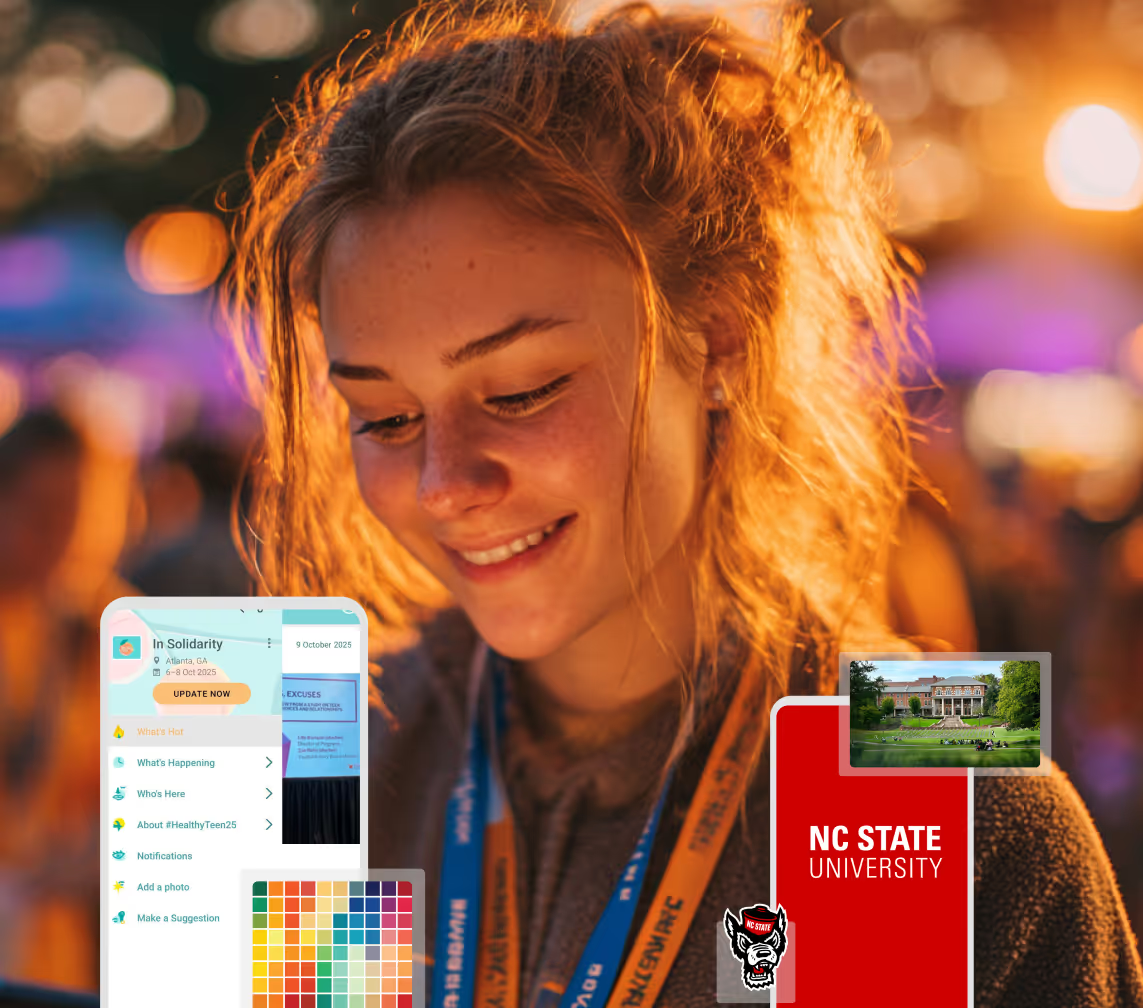
Planning Orientation?
Help new students feel prepared from day one with schedules, campus resources, and real-time updates in one app.
Planning Orientation?
Help new students feel prepared from day one with schedules, campus resources, and real-time updates in one app.
Running Admissions Events?
Manage open houses, tours, and yield events with a branded app that saves time and engages prospective students.

Running Admissions Events?
Manage open houses, tours, and yield events with a branded app that saves time and engages prospective students.
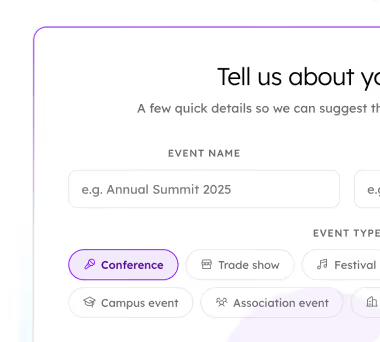
Get a custom Sponsorship Package Template
Stop starting from scratch. Grab free templates that helWe'll build a tailored sponsorship package with suggested pricing, tiers, and benefits..for your specific event.p you build professional sponsorship packages and close deals faster.
Get a custom Sponsorship Package Template
Stop starting from scratch. Grab free templates that helWe'll build a tailored sponsorship package with suggested pricing, tiers, and benefits..for your specific event.p you build professional sponsorship packages and close deals faster.
Plan Your Next Event Without Missing a Beat.
From venue selection to post-event wrap-up, this free checklist walks you through every step (so nothing falls through the cracks).
.avif)
Plan Your Next Event Without Missing a Beat.
From venue selection to post-event wrap-up, this free checklist walks you through every step (so nothing falls through the cracks).
Real Results From Real Events
100,000+ organizations trust Guidebook. See exactly how universities, associations, enterprises, and more put it to work.

Real Results From Real Events
100,000+ organizations trust Guidebook. See exactly how universities, associations, enterprises, and more put it to work.
Flexible pricing for every event size
Find the perfect plan for your needs, from intimate gatherings to large-scale conferences.
Flexible pricing for every event size
Find the perfect plan for your needs, from intimate gatherings to large-scale conferences.
Join our event experts
Watch on-demand webinars and join live sessions with industry leaders sharing best practices for event success.
.avif)
Join our event experts
Watch on-demand webinars and join live sessions with industry leaders sharing best practices for event success.
Guidebook in Action
Book a personalized walkthrough and discover how we help event teams create better attendee experiences.
Guidebook in Action
Book a personalized walkthrough and discover how we help event teams create better attendee experiences.
Guidebook Meets: How T.A.P.E.D Uses Event Software for Nonprofits to Build Inclusive Conferences
.avif)




Guidebook Meets: How T.A.P.E.D Uses Event Software for Nonprofits to Build Inclusive Conferences
When your attendees include individuals who are deaf, hard of hearing and deafblind, accessibility can’t be an afterthought. It needs to be part of the planning process from day one.
That’s exactly how the Texas Association for Parents and Educators of the Deaf (T.A.P.E.D) approaches its biennial statewide conference. Led by Marina McCormick, the association’s President, T.A.P.E.D offers one of the largest conferences of its kind in the United States.
The conference provides high quality, professional learning opportunities that support the needs of professionals, families and students within the field of deaf education.
This aligns with T.A.P.E.D’s wider mission which, as Marina explained, is “for families, educators and communities to collaborate to ensure equity and excellence in service for our students who are deaf, hard of hearing or deafblind.”
During a recent Guidebook Meets conversation, Marina shared how the organization uses event software for nonprofits to build a mobile event app, resulting in a more inclusive, accessible and efficient experience for attendees.
This article provides an overview of the key takeaways from our conversation with Marina and you can watch the full conversation here:
Removing Barriers, Not Just Managing Logistics
From the outset, T.A.P.E.D’s top planning priority has been inclusive event planning. One thing Marina recommends that event planners ask themselves is: What barriers might someone face in engaging with this event?
“Many of our participants themselves are deaf or hard of hearing, and they rely on sign language interpretation or real-time captioning to access information,” Marina explained.
The conference planning committee also thinks beyond sessions and factors in hallway conversations, last-minute updates and moments in between.
“Not only do our participants need communication access with our keynote speakers or during their breakout sessions, but they also need to have access to timely updates throughout the conference.”
In the past, this level of communication required extensive signage and printed materials (both of which were costly, time-consuming and often inaccessible themselves).
That’s where a mobile app - as part of a broader accessible event technology strategy - became a critical solution for Marina and her team.
Why a Nonprofit Event App Made Sense for T.A.P.E.D
Like many associations and nonprofits, T.A.P.E.D runs lean: the conference planning committee is volunteer-led and members have to juggle their responsibilities with their day job. So there’s a strong need for something simple, scalable and participant-friendly.
“Guidebook appealed to us because of its ease of use, both for our participants and our planning committee.”
Marina went on to explain that neither she nor her committee members are experts at app development.
"Guidebook makes it so easy for you to develop a conference app with user-friendly guides and self-explanatory data entry along the way. So we, with our very limited knowledge of app development, we're able to sit down and create an app for a conference. And this is a huge win for us."
Now in their third year using Guidebook, the team has built confidence and efficiency.
“2024 is our third time using Guidebook,” Natalie explained. “And I feel like we just get better and better at using this mobile technology at each one of our conferences.”
By using a mobile event app, T.A.P.E.D reduced the time spent on manual tasks, freeing up committee members to focus on behind-the-scenes logistics and hospitality.
Features That Support a Diverse, Distributed Audience
As T.A.P.E.D planners learned more about Guidebook’s event software, they began expanding its role in the attendee experience.
Several features proved especially valuable:
- Push notifications to communicate real-time updates like session changes or surprise breaks
- Embedded video content with sign language interpretation and captioning
- Integration with social platforms to help attendees connect before and after the event
- Screen reader compatibility and in-app messaging for attendees who don’t use sign language
The app’s ability to embed content, manage accessibility settings and centralize conference updates made it an ideal fit for T.A.P.E.D’s needs.
While every feature isn’t perfect - for example, image alt text and font sizing remain areas of improvement - Marina praised the availability of Guidebook’s Accessibility Conformance Report (ACR).
“One thing that I really like about Guidebook is that the mobile app's Accessibility Conformance Report, or ACR is easily accessible on the website…It just helps you engineer better solutions for your participants.”
Gradual Adoption and Two Versions of the Same Event
As much as Marina and her team find value in using Guidebook, not all of her attendees have shared that same enthusiasm. Marina shared that some attendees still prefer the printed program, and that the committee balances both formats thoughtfully.
But differences in experience are noticeable.
“Individuals who are using the hard copy program and are relying on that, who don't download the app, they miss out. Going back to those push notifications, they’re missing that information about, ‘okay, here are changes or surprise, we’re having a new break offering, come on down to our exhibitor hall!’”
This led to real-time word-of-mouth moments, where one participant would explain the surprise and then help a peer download the app on the spot.
The team now includes app education in the opening session of the conference and continues to evolve their communication strategy.
“I love that deeper level of discussion... What is the information we want to share, how do we want to share it, and where is it most effective?”
Advice for Nonprofits and Associations That Are Getting Started With Event Technology
Marina emphasizes that using event software for nonprofits doesn’t require perfection from the start. What matters most is the willingness to get started…and to keep evolving.
“Be brave enough to try it. Give yourself permission to not be perfect. Be like a scientist about it: what worked, what didn’t, how am I going to improve moving forward?”
She also encourages planners to think holistically about accessibility:
- Combine high-tech and low-tech options to support different needs
- Use surveys before and after the event to inform decisions and iterate
- Embed tools like the end-of-conference survey directly in the app
- Make presentation materials accessible in the app so no one misses out
At the end of the day, accessibility and connection go hand in hand. And nonprofits have an opportunity to lead by example.
“Mobile apps are one way to equalize the playing field for everybody so that they can better experience what your organization has to offer.”
Takeaways for Associations and Nonprofits
- Identify the barriers that might prevent someone from fully engaging with your app.
- Use event tech to reduce manual overhead and improve access.
- Prioritize tools that are easy for both staff and attendees to learn.
- Blend digital and physical formats to meet attendees where they are.
- Don’t wait for the perfect time. Start with what you can do today.
Looking for event software for nonprofits that helps you build more inclusive, engaging experiences?
Guidebook provides a holistic feature set - to build a branded event app, manage registrations and engage attendees - that simplifies event planning from start to finish.
Learn more about Guidebook’s event technology for nonprofits and associations or book a demo with one of our product experts.

Get the Mobile App Playbook
A short guide to running the whole student journey in one app. No fluff, just what works.
for higher ed
Campus
Playbook
A practical guide to building a connected campus experience.
Free playbook
The Mobile App Playbook for Universities
Students decide if they belong long before they set foot on campus. This playbook shows how to win them over from the first visit through graduation.
- Grow enrollment and boost recruitment
- Increase belonging and retention
- Run every event from one branded app
By submitting, you agree to our Privacy Policy.
You're in.
.png)